New Mexico
Land of diverse cultures, history, and high desert.

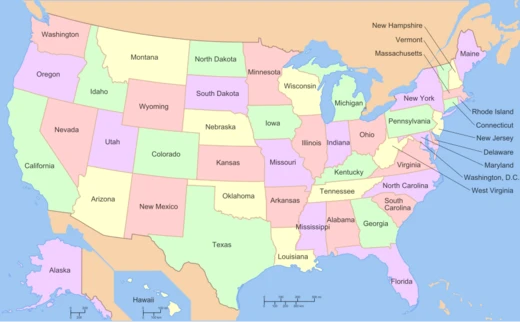
New Mexico is a landlocked state in the Southwestern region of the United States, one of the Mountain States of the southern Rocky Mountains. It shares the Four Corners region with Utah, Colorado, and Arizona, borders Texas to the east and southeast, Oklahoma to the northeast, and the Mexican state of Chihuahua to the south. Its largest city is Albuquerque, and its capital, Santa Fe, founded in 1610, is the oldest state capital in the U.S. and the highest in elevation. New Mexico is the fifth-largest state by area but ranks 36th in population and 45th in population density. Its climate and geography range from forested mountains to sparse deserts, with the Rio Grande creating a riparian biome through the center. One-third of its land is federally owned, including 15 national parks and monuments and three UNESCO World Heritage Sites (Taos Pueblo, Carlsbad Caverns, and Chaco Culture). New Mexico was home to Pueblo peoples, the Mogollon culture, and Ute since time immemorial, with later arrivals of Navajo, Apache, Spanish, and Comanche. The 1680 Pueblo Revolt was a significant uprising against Spanish colonial rule. After Mexican independence in 1821, New Mexico became an autonomous territory, and following the Mexican–American War in 1848, the U.S. annexed it as part of the New Mexico Territory. It became the 47th state on January 6, 1912. During World War II, it hosted key Manhattan Project facilities and the first nuclear test, Trinity, in 1945. The convergence of Pueblo, Apache, Navajo, Comanche, Ute, Spanish, Mexican, and American influences created a unique culture. As one of nine majority-minority states, it has the highest proportion of Hispanic and Latino Americans and the second-highest proportion of Native Americans. Its economy is diversified, with major sectors including mining, oil and gas, aerospace, media, and film. The federal government has a significant presence, including military installations and Department of Energy research centers.
Quick Facts
- Native Name
- es · Nuevo México / nv · Yootó Hahoodzo
- Former
- Santa Fe de Nuevo México (1598–1848) · New Mexico Territory (1850–1912)
- Flag Link
- Flag of New Mexico
- Anthem
- "O Fair New Mexico" and "Así Es Nuevo México"
- Nickname
- The Land of Enchantment
- Motto
- la · Crescit eundo (It grows as it goes)
- Population Demonym
- New Mexican, Nuevo Mexicano
- Seat
- Santa Fe
- Largestcity
- Albuquerque
- Largestcounty
- Bernalillo
- Largestmetro
- Albuquerque metropolitan area
- Officiallang
- None; Spanish and English are working languages
Facts from the source article.
Lore & Background
New Mexico's name predates the country of Mexico, deriving from the Spanish term Nuevo México, given after the region known as the Kingdom of Mexico. The Chamuscado and Rodríguez Expedition named the region north of the Rio Grande San Felipe del Nuevo México in 1581. Before statehood, the name loosely applied to various territorial configurations. The first known inhabitants were members of the Clovis culture of Paleo-Indians, with footprints suggesting human presence as early as 21,000–23,000 BC. Later inhabitants included the Mogollon and Ancestral Pueblo cultures, known for sophisticated pottery and urban development. Spanish exploration was spurred by Aztec legends of the Seven Cities of Gold. In 1539, Esteban de Dorantes became the first person from the Old World to reach New Mexico, where he was killed by Pueblo peoples. Francisco Vázquez de Coronado arrived in 1540. Juan de Oñate y Salazar began Spanish colonization in 1598, including the Ácoma Massacre. Santa Fe was established as a permanent capital in 1610. The Pueblo Revolt of 1680, led by Po'pa, was a major rebellion against Spanish rule.
Reader's Guide
New Mexico's significance lies in its long and layered history as a crossroads of indigenous, Spanish, Mexican, and American cultures. It was the site of the first successful revolution against European colonial rule in the Americas—the 1680 Pueblo Revolt—and later became a key territory in U.S. westward expansion after the Mexican–American War. Its role in the Manhattan Project and the first atomic bomb test at Trinity in 1945 marked a pivotal moment in world history. The state's cultural legacy is evident in its unique cuisine, Spanish dialect, music, and architectural styles such as Pueblo Revival and Territorial. New Mexico has the highest proportion of Hispanic and Latino Americans and the second-highest proportion of Native Americans among U.S. states, and it is home to one-third of the Navajo Nation, 19 federally recognized Pueblo communities, and three federally recognized Apache tribes. Its economy is diversified, with strengths in mining, oil and gas, aerospace, media, and film, and it hosts major federal research centers like Sandia and Los Alamos National Laboratories. Despite ranking low in wealth, healthcare, and education, it has high concentrations of scientists and engineers, and Los Alamos County is one of the most educated counties in the U.S. The state's flag, reflecting indigenous and Spanish inspiration, is among the most recognizable in the country.
Did You Know?
- Santa Fe, founded in 1610, is the oldest state capital in the United States and the highest in elevation at 7,000 feet.
- New Mexico has three UNESCO World Heritage Sites wholly contained within the state, the most of any U.S. state.
- The 1680 Pueblo Revolt was the first successful revolution against colonial rule in the Americas.
- New Mexico was the site of the first nuclear test, Trinity, in 1945.
More in U.S. States 1-24
Spotted an error? Know more?
Reader corrections go straight into our review queue. Suggest an edit · How this site is sourced