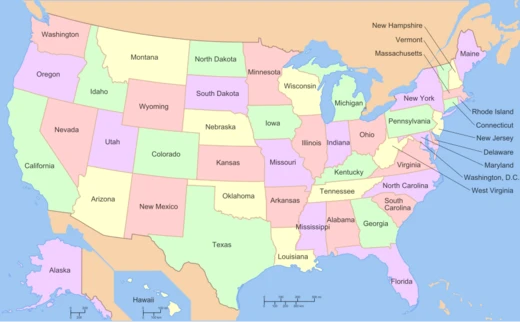
New Hampshire
First to establish an independent government and state constitution; first primary in U.S. elections.

New Hampshire (pronounced HAMP-shər) is a state in the New England region of the northeastern United States. It shares borders with Massachusetts to the south, Vermont to the west, Maine and the Gulf of Maine to the east, and the Canadian province of Quebec to the north. Among the 50 states, it ranks as the fifth smallest by land area and the tenth least populous, with about 1.38 million residents as of the 2020 census. Concord serves as the state capital, while Manchester is its largest city. The state motto, “Live Free or Die,” highlights its role in the American Revolution, and its nickname, “The Granite State,” comes from its abundant granite formations and quarries. New Hampshire is famous for hosting the first primary in the U.S. presidential election cycle, which gives it outsized influence in national politics.
For thousands of years before European contact, Algonquian-speaking peoples, including the Abenaki, lived in the region. English settlers arrived in the 1600s, establishing some of the earliest non-Indigenous colonies. The Province of New Hampshire was founded in 1629 and named after the English county of Hampshire. During the French and Indian War, the area was on the frontier of British territory and saw conflict with French forces and their Indigenous allies. Tensions between the colonies and Britain escalated in the 1760s, and in 1774, New Hampshire witnessed an early act of rebellion when Patriots seized Fort William and Mary from the British. In 1776, it became the first British North American colony to form its own independent government and state constitution. The state signed the Declaration of Independence and contributed troops, ships, and supplies to the Revolutionary War. In 1788, it became the ninth state to ratify the U.S. Constitution, making that document effective. During the mid-1800s, New Hampshire was a hub of abolitionist activity and sent nearly 32,000 Union soldiers to fight in the Civil War. After the war, the state experienced rapid industrialization and population growth, becoming a center for textiles, shoemaking, and papermaking. The Amoskeag Manufacturing Company in Manchester was the largest cotton textile plant in the world at the time. French Canadians made up the largest wave of immigrants, and today about a quarter of New Hampshire residents have French American ancestry.
Quick Facts
- Flag Link
- Flag and seal of New Hampshire
- Nicknames
- Granite State / White Mountain State
- Motto
- "Live Free or Die"
- Anthem
- "Old New Hampshire"
- Officiallang
- English · (French allowed for official business with Quebec; other languages allowed for certain specific uses)
- Population Demonym
- New Hampshirite · Granite Stater
- Seat
- Concord
- Largestcity
- Manchester
- Largestcounty
- Hillsborough
- Largestmetro
- Greater Boston (combined and metro) / Nashua (urban)
- Area Rank
- 46th
- Area Total Sq Mi
- 9,350
Facts from the source article.
Lore & Background
New Hampshire was inhabited for thousands of years by Algonquian-speaking peoples such as the Abenaki. Europeans arrived in the 17th century, with the English establishing some of the earliest non-indigenous settlements. The Province of New Hampshire was established in 1629, named after the English county of Hampshire. During the American Revolution, New Hampshire saw one of the earliest acts of rebellion with the seizing of Fort William and Mary from the British in 1774. In 1776, it became the first of the British North American colonies to establish an independent government and state constitution.
Reader's Guide
New Hampshire's significance lies in its early and influential role in American independence and its modern impact on presidential elections. It was the first colony to declare independence from Great Britain and the ninth state to ratify the U.S. Constitution, bringing it into effect. Its presidential primary, starting in 1952, became a crucial testing ground for candidates, drawing national and international attention. The state's motto, 'Live Free or Die,' reflects its revolutionary spirit, while its nickname, 'The Granite State,' refers to its extensive granite formations. Economically, New Hampshire transitioned from a center of textile manufacturing to a diversified economy including high-tech and financial services, and it is among the wealthiest and most-educated states, with no income tax or sales tax.
Did You Know?
- New Hampshire has the shortest ocean coastline of any U.S. coastal state, with a length of 18 miles (29 km).
- Mount Washington holds the record for the highest wind speed ever recorded in the Northern and Western Hemispheres.
More in U.S. States 1-24
Spotted an error? Know more?
Reader corrections go straight into our review queue. Suggest an edit · How this site is sourced