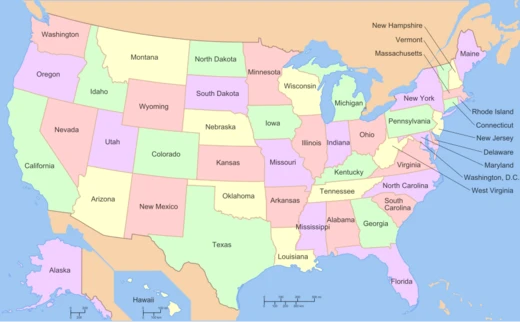
Nevada
Landlocked Western state known for silver, gambling, and libertarian laws.

Nevada is a landlocked state in the Western United States, sometimes placed in the Mountain West and Southwestern United States. It is known as the 'Silver State' for the importance of silver to its history and economy, and as the 'Battle Born State' because it achieved statehood during the Civil War. Nevada became the 36th state on October 31, 1864, and is famous for its libertarian laws, legalized gambling, and tourism industry.
Quick Facts
- Flag Link
- Flag of Nevada
- Nicknames
- The Silver State (official); / The Sagebrush State; The Battle Born State
- Population Demonym
- Nevadan
- Motto
- All for Our Country
- Anthem
- "Home Means Nevada"
- Former
- Nevada Territory, Utah Territory, Arizona Territory
- Seat
- Carson City
- Largestcity
- Las Vegas
- Largestcounty
- Clark
- Largestmetro
- Las Vegas Valley
- Governor
- Joe Lombardo (R)
- Lieutenant Governor
- Stavros Anthony (R)
Facts from the source article.
Lore & Background
Nevada's name comes from the Spanish adjective 'nevada,' meaning 'snowy' or 'snow-covered,' referring to the snow-capped mountains. The first Europeans to explore the region were Spanish, and the area was part of Alta California and Nuevo México within the Viceroyalty of New Spain. After Mexican independence in 1821, the United States annexed the area in 1848 following the Mexican–American War. The discovery of silver at the Comstock Lode in 1859 spurred a population boom, leading to the creation of Nevada Territory in 1861 and statehood in 1864.
Native American tribes including the Paiute, Shoshone, and Washoe originally inhabited the region. Nevada is the driest U.S. state, largely desert and semi-arid, and comprises most of the Great Basin and a large portion of the Mojave Desert. In 2020, 80.1% of the state's land was managed by the U.S. federal government. The tourism industry is Nevada's largest employer, and mining remains substantial, with Nevada being the fifth-largest producer of gold in the world.
Reader's Guide
Nevada's significance lies in its unique history and economy. It was the second of two states added to the Union during the Civil War, earning the nickname 'Battle Born State.' The state's libertarian laws, including legalized gambling and lenient marriage and divorce laws, transformed it into a major tourist destination in the 20th century. Nevada is the only U.S. state where prostitution is legal, though it is illegal in its most populated regions. The state's economy is heavily reliant on tourism, with mining, especially gold, remaining a substantial sector. Nevada is also notable for its environmental challenges and adaptations: it is the driest U.S. state, and droughts influenced by climate change have increased in frequency and severity. However, Nevada is among the leaders in adapting to climate change, with initiatives including climate science at the Desert Research Institute, extensive water recycling in the Las Vegas metropolitan area, investment in solar power, and hosting the largest industrial park in the U.S. for electric vehicle manufacturing. The state's name, meaning 'snowy' in Spanish, reflects its many mountain ranges, including the Sierra Nevada, Toiyabe Range, Ruby Mountains, and Spring Mountains.
Did You Know?
- Nearly three-quarters of Nevada's population live in Clark County, which contains the Las Vegas–Paradise metropolitan area.
- The state's name means 'snowy' in Spanish, referring to the snow-covered mountains.
More in U.S. States 1-24
Spotted an error? Know more?
Reader corrections go straight into our review queue. Suggest an edit · How this site is sourced