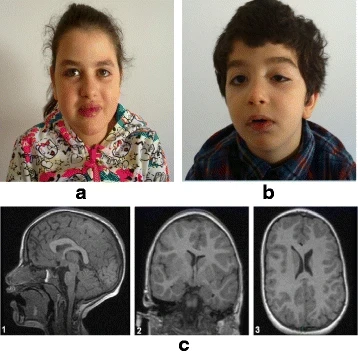
Keutel syndrome
Rare autosomal recessive disorder with cartilage calcification and midface hypoplasia.
Keutel syndrome is a rare autosomal recessive genetic disorder marked by abnormal diffuse cartilage calcification, midface hypoplasia, peripheral pulmonary stenosis, hearing loss, short distal phalanges, and mild mental retardation. It is associated with mutations in the MGP gene, which encodes matrix Gla protein. The condition was first identified in 1972 and shares some features with chondrodysplasia punctata, though peripheral pulmonary stenosis is unique to Keutel syndrome.
Quick Facts
- Inheritance
- Autosomal recessive
- Associated gene
- MGP (matrix Gla protein)
- First identified
- 1972
- Distinctive feature
- Peripheral pulmonary stenosis
Facts from the source article.
Did You Know?
- In consanguineous parents of children with KS, one parent is often phenotypically normal while the other is positive for pulmonary stenosis.
- MGP-knockout mice develop extensive diffuse cartilaginous calcification and vascular media replacement with a chondrocyte-like matrix, leading to premature death.
- Arterial calcification from MGP inactivation is commonly seen in patients with diabetes, atherosclerosis, and renal dysfunction.
Signs and symptoms
Facial abnormalities in Keutel syndrome include a sloping forehead, maxillary hypoplasia, depressed nasal bridge, wide mouth, dental malocclusion, and receding chin. Diagnosis is supported by electroencephalography, computed tomography, and skeletal survey. Radiography commonly reveals diffuse cartilage calcification and brachytelephalangism, with the first through fourth distal phalanges broadened and shortened while the fifth remains unaffected. Patients often have shorter than average stature and mild developmental delay. Pulmonary angiography and soft tissue radiography show significant cartilaginous ossification in the trachea and larynx, with perichondral and endochondral centers ossified. Abnormal calcification is most pronounced in the auricles and tracheal cartilage. Peripheral pulmonary stenosis is frequent. Recurrent respiratory infection, otitis media, and sinusitis are common, possibly due to diffuse laryngotracheal calcification.
Pathogenesis
Keutel syndrome is caused by a loss-of-function mutation in the matrix Gla protein gene (MGP). MGP resides in the extracellular matrix and inhibits calcification by repressing bone morphogenetic protein 2. Mutations that disrupt a consensus donor splice site at the exon 2-intron 2 junction lead to diffuse calcification of soft tissue cartilage. MGP is a vitamin K dependent protein synthesized by chondrocytes and vascular smooth muscle cells; vitamin K deficiency or coumarin-derivative use can render MGP uncarboxylated and inactive, diminishing its biological function.
More in Syndromes with Craniofacial Abnormalities
Spotted an error? Know more?
Reader corrections go straight into our review queue. Suggest an edit · How this site is sourced