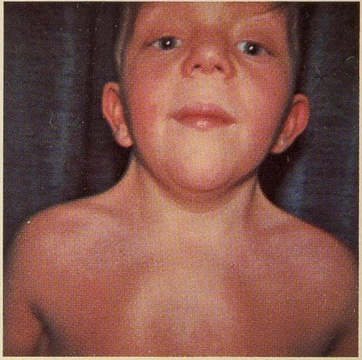
Smith–Fineman–Myers syndrome
X-linked congenital disorder causing skeletal, nervous, and intellectual impairments.

Smith–Fineman–Myers syndrome (SFMS1) is a congenital disorder present from birth. The condition was identified around 1980 by Richard D. Smith, Robert M. Fineman, and Gart G. Myers, after whom it is named.
The syndrome involves the skeletal and nervous systems. Externally, affected individuals have an unusual facial appearance: a slightly smaller than average head, a narrow face (dolichocephaly), a large mouth with a drooping lower lip that stays open, a protruding upper jaw, widely spaced upper front teeth, an underdeveloped chin, a cleft palate, and eyes that are exotropic (turned outward) with drooping eyelids. Males with SFMS tend to have short stature and a thin body build. Their skin is lightly pigmented and often has many freckles. They may also develop scoliosis and chest abnormalities.
As infants and young children, affected boys have reduced muscle tone. X-rays can reveal underdeveloped bones that resemble those of younger children. Before age 10, low muscle tone is typical; after age 10, muscle tone and reflexes increase, leading to spasticity. Their hands are short with unusual palm creases and short, shaped fingers. Foot abnormalities include shortened and fused toes. Genital abnormalities range from mild to severe undescended testes.
People with SFMS have severe intellectual disability. They may be restless at times, exhibit behavioral problems, have seizures, and experience severe delays in language development. They tend to be self-absorbed and have a reduced ability to socialize. Psychomotor retardation—a slowing of thoughts and physical movements—is also present. Cortical atrophy, or degeneration of the brain’s outer layer, is typically found in older affected individuals.
Genetically, SFMS is an X-linked condition mapped to chromosome Xq13. Because males have only one X chromosome, they are more likely to show the full set of symptoms; females, with two X chromosomes, are not affected because the normal copy masks the abnormal one. An affected father cannot pass the disease to his sons, but he can pass the gene to his daughters. Each daughter has a 50% chance of passing the gene to her children. Sons of a female carrier have a 50% chance of showing symptoms, while none of her daughters will display symptoms.
- Discovered by
- Richard D. Smith, Robert M. Fineman, Gart G. Myers
- Year discovered
- around 1980
- Inheritance
- X-linked (chromosome Xq13)
- Affected gene
- ATRX (Xq13)
- Primary systems affected
- skeletal and nervous system
Lore & Background
Smith–Fineman–Myers syndrome was first described around 1980 by Richard D. Smith, Robert M. Fineman, and Gart G. Myers. The syndrome is characterized by a distinct facial appearance including a narrow face, large mouth with drooping lower lip, protruding upper jaw, widely spaced upper front teeth, underdeveloped chin, cleft palate, and slanted eyes with drooping eyelids. Affected males have short stature, thin body build, lightly pigmented skin with multiple freckles, scoliosis, and chest abnormalities. Infants and young boys show reduced muscle tone, while those over age 10 develop increased muscle tone and spasticity. Other features include short hands with unusual palm creases, foot abnormalities such as shortened and fused toes, and undescended testes.
Reader's Guide
Smith–Fineman–Myers syndrome is significant as a rare X-linked disorder that provides insight into the role of the ATRX gene on chromosome Xq13 in intellectual disability and developmental abnormalities. The syndrome shares genetic overlap with other X-linked intellectual disability conditions such as Alpha-thalassemia/mental retardation syndrome, Carpenter syndrome, Juberg-Marsidi syndrome, and spastic paraplegia. Diagnosis relies on visible symptoms, family history, brain and skeletal imaging, chromosome studies, and genetic analysis of the ATRX gene. Treatment is symptomatic, including anticonvulsant medication for seizures and behavioral therapy. The syndrome does not appear to shorten lifespan or worsen with age. Reported cases have all been male, consistent with X-linked inheritance where females are carriers. The condition was first formally reported in two brothers in Sydney, Australia in 1991, and later in monozygotic twins in Brazil in 1998.
Did You Know?
- SFMS is an X-linked disease mapped to chromosome Xq13, and only males typically show full symptoms.
- Affected boys under age 10 have reduced muscle tone, while those over 10 develop increased muscle tone and spasticity.
- Some patients with SFMS have a mutation in the ATRX gene, which is also associated with other X-linked intellectual disability syndromes.
- The syndrome includes spleen agenesis (absence of the spleen) and undescended testes that can lead to female gender assignment.
Frequently Asked Questions
What is Smith–Fineman–Myers syndrome?
SFMS1 is a congenital condition present from birth that impacts both the skeletal and nervous systems. It is inherited in an X-linked pattern and is associated with the ATRX gene located at Xq13 on the X chromosome.
Who identified Smith–Fineman–Myers syndrome and when?
The condition was first described around 1980 by three researchers—Richard D. Smith, Robert M. Fineman, and Gart G. Myers. The syndrome carries their surnames as a tribute to their original identification.
What facial and skeletal features are characteristic of SFMS1?
Affected individuals typically show a slightly smaller head, a narrow face, a large mouth with a persistently open lower lip, a protruding upper jaw, widely spaced front teeth, an underdeveloped chin, and a cleft palate. Their eyes also tend to turn outward (exotropia).
How is Smith–Fineman–Myers syndrome inherited?
SFMS1 follows an X-linked inheritance pattern, with the responsible ATRX gene sitting at position Xq13 on the X chromosome. Because of this, the condition predominantly affects males who inherit the affected X chromosome.
Why does Smith–Fineman–Myers syndrome matter in the context of stature-related syndromes?
Although it is not primarily a short-stature condition, SFMS1 involves skeletal abnormalities that can influence overall body proportions and growth. It is catalogued alongside stature-affected syndromes because its skeletal manifestations overlap with the broader category of congenital growth disorders.
More in Syndromes affecting stature 1-22
Spotted an error? Know more?
Reader corrections go straight into our review queue. Suggest an edit · How this site is sourced