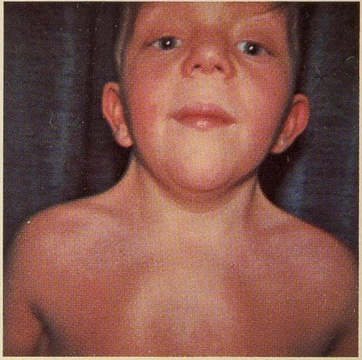
Noonan syndrome
Genetic disorder with distinctive facial features and heart defects.

Noonan syndrome (NS) is a genetic condition that can cause mildly unusual facial features, short stature, congenital heart defects, bleeding issues, and skeletal abnormalities. It belongs to a group of disorders called RASopathies, where the RAS/MAPK cell signaling pathway is constantly active. The condition is named after Jacqueline Noonan, an American pediatric cardiologist who first documented a case in 1963.
Signs and symptoms often include widely spaced eyes, light-colored eyes, low-set ears, a short neck, and a small lower jaw. Heart problems, such as pulmonary valve stenosis, are common. The breastbone may stick out or be sunken, and the spine can curve abnormally. Intelligence is usually normal, but complications like leukemia can occur. Some symptoms overlap with Watson syndrome, a related genetic condition.
A variety of genetic mutations can cause Noonan syndrome. It can be inherited in an autosomal dominant pattern or arise from a new mutation. Diagnosis is suspected based on physical features, medical imaging, and blood tests, and can be confirmed with genetic testing.
There is no cure. Treatment focuses on managing symptoms and underlying issues; extra school support may be needed. Growth hormone therapy during childhood can help increase final height. Long-term outcomes largely depend on the severity of heart problems.
About 1 in 1,000 people have a mild form of NS, while roughly 1 in 2,000 have a more severe version. Males are affected more often than females.
The most common diagnostic clues are distinctive facial features and musculoskeletal problems. Facial characteristics are most noticeable in infancy and often become less obvious with age.
**Head and Face:** Features include a large head with extra skin on the back of the neck, a low hairline at the nape, a high forehead hairline, a triangular face, a broad forehead, and a short, webbed neck. Widely spaced eyes (hypertelorism) occur in 95% of cases, often with extra skin folds at the inner eye corners, drooping eyelids, bulging eyes, crossed eyes, jerky eye movements, and vision errors. The nose is often small, wide, and upturned. Ears are low-set, backward-rotated, and have a thick outer rim in over 90% of people; chronic ear infections and hearing loss are common.
Quick Facts
- Field
- Medical genetics, pediatrics
- Symptoms
- Mildly unusual facial features, short height, congenital heart disease, bleeding problems, skeletal malformations
- Complications
- Leukemia
- Onset
- Present at birth
- Types
- Type 1 to 6
- Causes
- Genetic mutation (autosomal dominant)
- Diagnosis
- Suspected based on symptoms, confirmed with genetic testing
- Differential
- Cardiofaciocutaneous syndrome, Turner syndrome, Costello syndrome, neurofibromatosis type 1
- Treatment
- Based on the symptoms
- Medication
- Growth hormone
- Prognosis
- Depends on the severity of heart problems
- Frequency
- 1 in 1000 (1 in 2,000 severe disease)
Facts from the source article.
Lore & Background
Noonan syndrome (NS) is a genetic disorder that may present with mildly unusual facial features, short height, congenital heart disease, bleeding problems, and skeletal malformations. Facial features include widely spaced eyes, light-colored eyes, low-set ears, a short neck, and a small lower jaw. Heart problems may include pulmonary valve stenosis. The breast bone may either protrude or be sunken, while the spine may be abnormally curved. Intelligence is often normal. Complications of NS can include leukemia. Some of NS' symptoms are shared with Watson syndrome, a related genetic condition.
Reader's Guide
Noonan syndrome is significant as the second most common syndromic cause of congenital heart disease, with 50–70% of individuals born with some form of congenital heart defect, most commonly pulmonary valvular stenosis. The condition is caused by mutations in genes such as PTPN11, SOS1, RAF1, and RIT1, which affect the RAS/MAPK signaling pathway. Diagnosis is suspected based on symptoms, medical imaging, and blood tests, and confirmed with genetic testing. There is no cure; treatment is symptomatic, including growth hormone therapy during childhood to increase final height. Long-term outcomes typically depend on the severity of heart problems. The condition affects an estimated 1 in 1,000 people mildly and about 1 in 2,000 more severely, with males affected more often than females.
Did You Know?
- Noonan syndrome is named after American pediatric cardiologist Jacqueline Noonan, who described her first case in 1963.
- About 50–70% of individuals with Noonan syndrome are born with some form of congenital heart defect.
- Mutations in the PTPN11 gene account for 50% of genetically diagnosed cases of Noonan syndrome.
- Growth hormone therapy during childhood can increase an affected person's final height.
Distinctive Facial and Physical Features
Noonan syndrome is immediately recognizable in many patients by a constellation of facial and skeletal traits that are most striking during infancy and gradually soften as the individual matures. The eyes are the hallmark: widely spaced placement appears in roughly 95 percent of affected people, often accompanied by extra skin folds at the inner corners, drooping upper lids, bulging of the eyeballs, misaligned gaze, or involuntary jerking movements. The ears sit low and rotate backward in over 90 percent of cases, with a notably thick outer rim. A small, broad, upturned nose, a triangular face shape, a broad forehead, and a short, webbed neck complete the craniofacial picture. The mouth may show an undersized lower jaw, a high-arched palate, and a deeply grooved line above the upper lip. Beyond the head, the skin can develop keloid scars, lymphatic swelling of the extremities, and darkly pigmented spots. Limbs may display blunt fingertips, extra soft padding, and a wide carrying angle at the elbows. Adults with the condition typically reach a final height near the lower boundary of the normal range, while spinal curvature affects up to thirty percent and may demand surgical correction in the majority of those affected.
Cardiac, Digestive, and Hematologic Complications
Although intelligence is frequently within the normal range, Noonan syndrome carries a heavy burden of internal-organ involvement. The heart is the most critical organ affected: the condition ranks as the second most common syndromic cause of congenital heart disease, and between fifty and seventy percent of individuals are born with some structural cardiac defect. Narrowing of the pulmonary valve is the single most frequent lesion, present in half to sixty percent of cases, while thickened heart-muscle walls, holes in the atrial or ventricular septum, and other abnormalities round out the spectrum. The digestive tract is also commonly troubled, with swallowing difficulties, sluggish gut movement, delayed stomach emptying, and intestinal malrotation; roughly three-quarters of affected children experience failure to thrive from infancy through puberty, and a feeding tube is occasionally necessary. Bleeding tendencies arise from platelet dysfunction, partial deficiencies of several clotting factors, and imbalances in the fibrinolytic system, with associations to von Willebrand disease and low platelet counts. Lymphatic malformations such as posterior neck hygromas and limb edema add further complexity, and a small subset of patients face the risk of developing leukemia. In some males, undescended testicles complicate the clinical picture.
Genetic Basis and Diagnostic Pathway
Noonan syndrome does not stem from a single gene change; rather, a number of distinct mutations across the genome can each produce the condition. Inheritance typically follows an autosomal dominant pattern, meaning one affected parent can pass the trait to offspring, yet it can also appear as a completely new mutation with no family history. At the cellular level, every form of the syndrome belongs to a family of disorders called RASopathies, in which the RAS/MAPK signaling cascade remains inappropriately switched on, disrupting normal cell growth and differentiation. This shared mechanism also explains why some clinical features overlap with Watson syndrome, a closely related genetic condition. In practice, a physician may first suspect the diagnosis by observing the characteristic facial and skeletal signs, reviewing medical imaging of the heart and spine, and ordering blood work that reveals clotting-factor abnormalities. Definitive confirmation, however, requires genetic testing to identify the specific mutation responsible. Epidemiologically, an estimated one in a thousand people carries a mild form of the condition, while about one in two thousand presents with a more severe phenotype, and males appear to be diagnosed more frequently than females.
Treatment, Long-Term Outlook, and the Woman Behind the Name
Because no cure for Noonan syndrome has yet been identified, medical care is tailored to each patient's particular constellation of symptoms. Children who struggle to gain weight or grow at a normal pace may benefit from growth-hormone therapy, sometimes combined with IGF-1 or used alongside IGF-1 alone, to nudge their final adult height closer to the lower end of the normal range. Extra academic support in school may be required as part of the broader management plan. For those whose spinal curvature is severe, surgical correction is needed in well over half of affected individuals. The single most important determinant of long-term prognosis remains the severity of the congenital heart defect present at birth; those with milder cardiac involvement generally fare well into adulthood. The condition bears the name of Jacqueline Noonan, an American pediatric cardiologist who described her first case in 1963. Her work established the clinical framework that guides how the syndrome is recognized and managed to this day.
Frequently Asked Questions
What is Noonan syndrome?
Noonan syndrome is an inherited genetic condition marked by a recognizable facial appearance, below-average height, and potential heart abnormalities. It belongs to the RASopathy family of disorders, all of which involve an overactive RAS/MAPK cell-signaling pathway.
What causes Noonan syndrome?
The condition results from mutations that leave the RAS/MAPK signaling pathway in a permanently activated state within cells. It was first formally described in 1963 by pediatric cardiologist Jacqueline Noonan, and the syndrome carries her name.
What physical features are associated with Noonan syndrome?
Affected individuals often display widely spaced eyes, a short webbed neck, low-set ears, and a relatively small lower jaw. Skeletal irregularities and a tendency toward easy bruising or prolonged bleeding can also be present.
How is Noonan syndrome inherited?
It typically follows an autosomal dominant pattern, so a single mutated copy from either parent can produce the condition. A substantial share of cases, however, stem from a de novo mutation with no prior family history.
How common is Noonan syndrome?
Estimates place prevalence at roughly one in 1,000 to one in 2,000 individuals, with the range reflecting differences in how strictly severity is defined. It remains one of the more frequently encountered RASopathies seen in pediatric cardiology and genetics clinics.
More in Syndromes affecting stature 1-22
Spotted an error? Know more?
Reader corrections go straight into our review queue. Suggest an edit · How this site is sourced