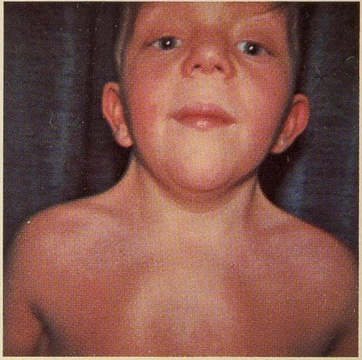
Kocher–Debre–Semelaigne syndrome
Rare childhood hypothyroidism with muscle hypertrophy and Herculean appearance.

Kocher–Debré–Semelaigne syndrome (KDSS) is a rare form of hypothyroidism occurring in infancy or childhood, characterized by lower extremity or generalized muscular hypertrophy (giving a Herculean appearance), myxoedema, short stature, and cognitive impairment. The syndrome is named after Emil Theodor Kocher, Robert Debré, and Georges Semelaigne, and is also known by several alternative names including Debré–Semelaigne syndrome and cretinism-muscular hypertrophy.
- Field
- Pediatric endocrinology, neurology
- Known for
- Hypothyroidism in infancy or childhood with muscular hypertrophy
- Alternative names
- Debré–Semelaigne syndrome, cretinism-muscular hypertrophy, hypothyroid myopathy, hypothyroidism-large muscle syndrome, hypothyreotic muscular hypertrophy in children, infantile myxoedema-muscular hype
Lore & Background
The syndrome is named after Emil Theodor Kocher, Robert Debré, and Georges Semelaigne. The age at which a child presents with KDSS may vary from newborn to as late as 11 years of age. This disease is very rare, as only less than 10% of children with hypothyroid myopathy develop this condition. Along with features of hypothyroidism (such as lethargy, slow heart rate, cold intolerance, dry skin, and hoarse voice), the main additional feature is muscle hypertrophy, which can occur in any muscle of the limbs but commonly affects the calf muscles, giving the typical Herculean appearance.
Reader's Guide
Kocher–Debré–Semelaigne syndrome is significant as a rare pediatric presentation of hypothyroidism that includes distinctive muscular hypertrophy, often leading to a Herculean appearance. Its recognition is important because the muscle hypertrophy and other symptoms are reversible on treatment with levothyroxine. The syndrome's pathophysiology is not fully settled; assumed causes include abnormal carbohydrate metabolism leading to glycogen accumulation, or excess intracellular calcium due to ineffective reuptake into the sarcoplasmic reticulum. The adult-onset form is Hoffmann syndrome, though sources disagree on whether Hoffmann syndrome lacks painful spasms and pseudomyotonia. Differential diagnoses include glycogen storage diseases, muscular dystrophies, and other myopathies, and hypothyroidism can be a comorbidity of conditions such as McArdle disease and late-onset Pompe disease.
Did You Know?
- The adult-onset form of this syndrome is Hoffmann syndrome.
- Some sources claim Hoffmann syndrome lacks painful spasms and pseudomyotonia, but other sources list these symptoms as also present in Hoffmann syndrome.
Clinical Presentation & Diagnostic Profile
KDSS can manifest anywhere from birth to the eleventh year of life, giving the entity a remarkably broad window of onset. Despite that range, the condition stays exceedingly uncommon; fewer than one in ten children who develop hypothyroid myopathy will progress to the full KDSS picture. Alongside the classic hypothyroid signs—lethargy, bradycardia, cold intolerance, dry skin, and a hoarse voice—the feature that most sharply distinguishes this syndrome is pronounced muscular hypertrophy, often accompanied by short stature and cognitive impairment. Although any limb muscle group can be involved, the calves are most frequently affected, producing the striking Herculean silhouette that first drew clinical attention. Additional neuromuscular findings include pseudomyotonia, myokymia, delayed tendon reflexes, sluggish contraction-and-relaxation cycles, generalized stiffness, and proximal weakness. Macroglossia may also be present. The intensity of every symptom tracks closely with how long the hypothyroid state has persisted and how severe the hormonal deficit is. Electrodiagnostic testing yields either a normal tracing or low-amplitude, short-duration motor unit potentials consistent with myopathy, while serum creatine kinase levels are typically raised.
Pathophysiology & Cellular Mechanisms
The muscular enlargement seen in KDSS is thought to arise from a derangement in carbohydrate handling within the muscle cell. One leading hypothesis points to excessive glycogen storage together with an accumulation of mucopolysaccharides in the myofibrillar compartment. A separate line of reasoning implicates calcium mishandling: when the sarcoplasmic reticulum fails to reabsorb calcium efficiently, the fiber remains locked in sustained contraction, which over time drives hypertrophy. Thyroid hormone deficiency also triggers a fiber-type shift, converting fast-twitch fibers into slow-twitch ones and thereby explaining the characteristically sluggish reflexes. This shift is attributed to diminished mitochondrial oxidative capacity, a decline in beta-adrenergic receptor density, and the induction of an insulin-resistant metabolic state. Weakness, meanwhile, is linked to reduced intramuscular carnitine, impaired oxidative phosphorylation, expression of a slower myosin ATPase isoform, and compromised transmembrane transport. In congenital cases, abnormal maturation of the basal ganglia has been proposed as the structural substrate for the rigidity that accompanies the condition.
Naming, Nomenclature & Differential Diagnosis
The eponym honours three physicians—Emil Theodor Kocher, Robert Debré, and Georges Semelaigne—whose observations collectively defined the entity. Over the decades the condition has accumulated a remarkable catalogue of alternative labels, including Debré–Semelaigne syndrome, cretinism-muscular hypertrophy, hypothyroid myopathy, and myxoedema-myotonic dystrophy syndrome, reflecting the many facets through which it has been described. In adults the analogous presentation is called Hoffmann syndrome; some authorities distinguish the two by noting that Hoffmann syndrome lacks painful spasms and pseudomyotonia, yet other references list those very features as present in the adult form, leaving the distinction contested. Clinicians must also separate KDSS from a long list of mimics producing a pseudoathletic calf appearance with exercise intolerance or weakness: glycogen storage diseases (type V and late-onset type II), myotonia congenita, Brody disease, limb-girdle dystrophy, Duchenne and Becker dystrophy, focal myositis, sarcoid granulomas, and muscular amyloid deposits. Because both hyper- and hypothyroidism perturb glycogen metabolism, and because hypothyroidism is a known comorbidity of McArdle disease and late-onset Pompe disease, distinguishing a primary myopathy from a secondary thyroid-driven process demands careful clinical reasoning.
Treatment & Prognosis
The most encouraging aspect of KDSS is that the condition is, in principle, fully reversible. Administration of levothyroxine—the synthetic thyroxine used to replace deficient thyroid hormone—has been shown to resolve the muscular hypertrophy and the accompanying neuromuscular abnormalities. Because the severity of every manifestation is governed by the duration of the hypothyroid state and the magnitude of the hormonal shortfall, early recognition and prompt initiation of replacement therapy are critical to limiting the window during which metabolic derangement can compound. The fact that the Herculean muscle bulk, pseudomyotonia, myokymia, and proximal weakness all recede under adequate levothyroxine underscores that the pathology is functional and metabolic rather than structural or degenerative. This reversibility also carries important implications for the differential diagnosis: a clinician who suspects a primary myopathy such as a glycogen storage disease or muscular dystrophy should consider a trial of thyroid replacement before committing to invasive genetic or histological workup, particularly when the clinical picture overlaps with the pseudoathletic calf phenotype shared by several of those conditions.
Frequently Asked Questions
Who is Kocher–Debré–Semelaigne syndrome?
It is a rare pediatric endocrine condition named after three physicians—Emil Theodor Kocher, Robert Debré, and Georges Semelaigne—who each contributed to describing it. The syndrome presents in infancy or early childhood as a severe form of hypothyroidism accompanied by striking muscular overgrowth.
What are Kocher–Debré–Semelaigne syndrome's powers/role?
Its most recognizable 'power' is the dramatic enlargement of muscles, especially in the legs, which gives affected children a muscular, Herculean build despite their short stature. Clinically it also brings on myxoedema, impaired cognition, and growth failure, placing it squarely in the realm of pediatric endocrinology and neurology.
Why is Kocher–Debré–Semelaigne syndrome important?
It highlights how untreated congenital or infantile hypothyroidism can produce a paradoxical picture—massive muscle bulk alongside stunted growth and intellectual disability—making it a key diagnostic consideration in pediatric endocrinology. Recognizing it early prevents irreversible neurological damage and avoids misdiagnosis as a primary myopathy.
What are Kocher–Debré–Semelaigne syndrome's alternative names?
The condition goes by several other labels, including Debré–Semelaigne syndrome, cretinism with muscular hypertrophy, and hypothyroid myopathy. You may also see it referred to as infantile myxoedema with muscular hypertrophy or simply 'hypothyroidism–large muscle syndrome.'
More in Syndromes affecting stature 1-22
Spotted an error? Know more?
Reader corrections go straight into our review queue. Suggest an edit · How this site is sourced