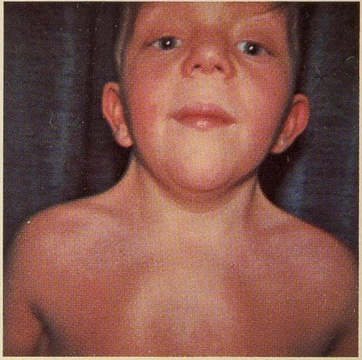
Langer–Giedion syndrome
Rare genetic disorder from chromosome 8 deletion.

Langer–Giedion syndrome (LGS) is a rare genetic condition with an autosomal dominant inheritance pattern. It results from a small deletion on chromosome 8. The syndrome is named after the two physicians who conducted the primary research on it during the 1960s. Most diagnoses occur at birth or in early childhood.
**Signs and symptoms** Common features include mild to moderate intellectual disability, short stature, distinctive facial characteristics, a small head, and skeletal abnormalities such as bony growths that protrude from bone surfaces.
**Craniofacial** People with LGS often have a long, prominent philtrum, a thin upper lip, widely spaced eyes, a bulbous nasal tip, a broad nasal bridge, wide nostrils, a small lower jaw (micrognathia), a receding jaw (retrognathia), deep-set eyes, and large ears. The head is frequently unusually small compared to unaffected individuals of the same age and sex. Dental issues may appear, including extra central incisors or missing teeth.
**Musculoskeletal** LGS causes cone-shaped epiphyses in the finger bones, along with short fingers and toes. The fifth fingers may be bent. Other skeletal problems can include winged scapulae, thin ribs, and scoliosis. Affected individuals may also develop hip issues similar to those in Legg–Calvé–Perthes disease, such as progressive degeneration of the femoral head. As people age, benign bone growths called exostoses often form on bone surfaces. Depending on their location, these growths can lead to complications like spinal cord compression, uneven limb growth, and reduced mobility. Joint hypermobility is present early on but progresses to stiffness as osteochondromas develop, typically between infancy and mid-childhood, limiting movement. Hip dysplasia may appear, usually in early adulthood, though it can also occur in infancy or childhood.
**Skin, hair, sweat glands, and nails** Ectodermal dysplasia is a key feature. Most individuals have sparse scalp hair, especially severe in males, who often experience alopecia shortly after puberty. Despite this, eyebrows may be unusually thick.
**Cause** The syndrome is caused by the loss of a small segment from the long arm of chromosome 8, which contains several genes. The missing region is 8q23.2–q24.1 and includes the genes *TRPS1* and *EXT1*.
Quick Facts
- Differential
- Tricho-rhino-phalangeal syndrome Type 1, Fibrodysplasia Ossificans Progressiva, Trichorhinophalangeal syndrome type 3, multiple exostoses, Legg–Calvé–Perthes disease
Facts from the source article.
Lore & Background
Langer–Giedion syndrome is characterized by a range of signs and symptoms including mild to moderate intellectual disability, short stature, unique facial features, small head, and skeletal abnormalities such as bony growths projecting from bone surfaces. Craniofacial features may include a long prominent philtrum, thin upper lip, wide spaced eyes, bulbous nasal tip, broad nasal bridge, wide nostrils, micrognathia, retrognathia, deep set eyes, and large ears. Dental abnormalities such as supernumerary central incisors and missing teeth may occur.
Musculoskeletal manifestations include cone shaped epiphyses of the phalanges, short fingers and toes, bent fifth fingers, winged scapula, thin ribs, scoliosis, and hip problems similar to Legg–Calvé–Perthes disease. Affected individuals often develop benign bony growths called exostoses, which can cause complications like spinal cord compression, asymmetric limb growth, and reduced mobility. Joint hypermobility is present initially but progresses to stiffness as osteochondromas develop between infancy and mid-childhood. Hip dysplasia may develop in early adulthood, though it can occur earlier.
Ectodermal dysplasia is a key feature, with most individuals having sparse scalp hair, particularly severe in males who often experience alopecia shortly after puberty, while eyebrows may be unusually thick. The syndrome results from a deletion of chromosome 8q23.2–q24.1, which includes the TRPS1 and EXT1 genes. Diagnosis is based on clinical findings and confirmed by cytogenetic testing, often using aCGH on peripheral blood.
Reader's Guide
Langer–Giedion syndrome is significant as a rare genetic disorder that illustrates the effects of a contiguous gene deletion on chromosome 8. Its identification in the 1960s by two doctors helped establish the link between specific chromosomal deletions and complex syndromic presentations. The condition's features—spanning craniofacial, musculoskeletal, and ectodermal systems—demonstrate the pleiotropic effects of losing the TRPS1 and EXT1 genes. The syndrome's natural history, from joint hypermobility in childhood to stiffness and exostoses later, highlights the progressive nature of some genetic disorders. While no cure exists, treatments such as external fixators for limbic and facial reconstructions address some symptoms. The syndrome also serves as a model for understanding how deletions of multiple genes can produce a distinct clinical picture, and its diagnosis via aCGH exemplifies modern genomic medicine's ability to precisely characterize genetic losses.
Did You Know?
- Langer–Giedion syndrome is caused by a deletion of a small section of chromosome 8q23.2–q24.1, which includes the TRPS1 and EXT1 genes.
- Diagnosis is usually made at birth or in early childhood and can be confirmed by cytogenetic testing, often using aCGH on peripheral blood.
Genetic Architecture & Historical Naming
Langer–Giedion syndrome is an exceedingly rare autosomal dominant condition rooted in a specific chromosomal deletion. The underlying defect involves the loss of a small segment on the long arm of chromosome 8, spanning the region designated 8q23.2 through q24.1. Within this deleted stretch reside at least two critical genes—TRPS1 and EXT1—whose absence collectively drives the broad constellation of physical and developmental traits seen in affected individuals. Because the disorder follows an autosomal dominant pattern, a single inherited copy of the deletion is sufficient to produce the phenotype. The condition bears the names of two physicians who conducted the principal investigative work characterizing the syndrome during the 1960s, cementing their contributions in medical nomenclature. The syndrome is also catalogued in the rare-disease literature under the alternate designation Trichorhinophalangeal syndrome type 2, a label that reflects the triad of hair, nose, and finger involvement that typifies the presentation.
Craniofacial & Ectodermal Presentation
The facial and ectodermal hallmarks of Langer–Giedion syndrome give affected individuals a highly recognizable appearance. The head is characteristically small relative to peers of the same age and sex. The face displays a long, prominent philtrum paired with a thin upper lip, while the eyes are widely set and often appear deep-set. The nose features a bulbous tip, a broad bridge, and flared nostrils. The jaw may be underdeveloped or set back, and the ears tend to be large. Dental anomalies are common, ranging from extra central incisors to the complete absence of certain teeth. Ectodermal dysplasia stands as a defining component of the syndrome, manifesting most visibly in hair. Scalp hair is typically sparse, and the condition is especially pronounced in males, many of whom develop noticeable alopecia shortly after puberty. Paradoxically, eyebrows may remain unusually thick despite the thinning of scalp hair.
Skeletal Architecture & Progressive Bone Changes
The musculoskeletal involvement in Langer–Giedion syndrome is both distinctive and progressive. In the hands and feet, the epiphyses of the finger and toe bones assume a cone-like shape, producing short digits; the fifth fingers are occasionally bent. Beyond the extremities, individuals may develop winged scapulae, thin ribs, and scoliosis. Hip pathology resembling Legg–Calvé–Perthes disease—progressive degeneration of the femoral head—can also emerge. A particularly significant feature is the age-dependent development of exostoses, benign bony outgrowths projecting from bone surfaces. These typically appear between infancy and mid-childhood and can compress the spinal cord, create asymmetric limb growth, and markedly restrict mobility. Joint mechanics shift over time: early hypermobility gives way to progressive stiffness as osteochondromas accumulate. Hip dysplasia, while most commonly presenting in early adulthood, may surface as early as infancy. The cumulative effect is a steadily narrowing range of physical function as the individual matures.
Diagnostic Pathway & Therapeutic Options
Because Langer–Giedion syndrome is so uncommon, identification often relies on recognizing the constellation of clinical features at birth or in early childhood. Once suspected, the diagnosis is confirmed through cytogenetic analysis, which can detect the characteristic deletion averaging approximately five million base pairs in size. In contemporary practice, array comparative genomic hybridization performed on a peripheral blood sample has become the standard tool for precisely mapping the boundaries of the chromosomal loss and identifying which specific genes, including TRPS1 and EXT1, have been affected. This molecular delineation is essential for accurate genetic counseling within families. On the treatment front, no intervention can restore the missing genetic material, and the syndrome remains incurable. Management is therefore symptomatic and multidisciplinary. External fixators have been employed to address limb and facial deformities, offering reconstructive options for the most functionally limiting skeletal abnormalities. Ongoing orthopedic, dental, and developmental support form the backbone of long-term care.
Frequently Asked Questions
What is Langer–Giedion syndrome?
Langer–Giedion syndrome is a rare, inherited genetic condition passed down through an autosomal dominant pattern. It is caused by a small segment being missing from chromosome 8, specifically in the 8q23.2–q24.1 region.
What are the core traits associated with Langer–Giedion syndrome?
Individuals typically present with short stature, mild to moderate intellectual disability, a small head, and distinctive facial features. Skeletal issues are also common, particularly bony growths that protrude from the surface of bones.
When do most Langer–Giedion syndrome diagnoses happen?
The condition is usually identified either at birth or during early childhood, since the craniofacial and skeletal signs are often visible from a very young age.
Who is Langer–Giedion syndrome named after?
The syndrome takes its name from two physicians who carried out the primary research describing the condition in the 1960s. Their work established the clinical picture that gave the disorder its dual eponym.
How is Langer–Giedion syndrome inherited?
It follows an autosomal dominant inheritance pattern, meaning a single copy of the altered chromosome 8 segment is enough to produce the condition. A parent carrying the deletion can pass it to a child with a fifty percent chance.
More in Syndromes affecting stature 1-22
Spotted an error? Know more?
Reader corrections go straight into our review queue. Suggest an edit · How this site is sourced