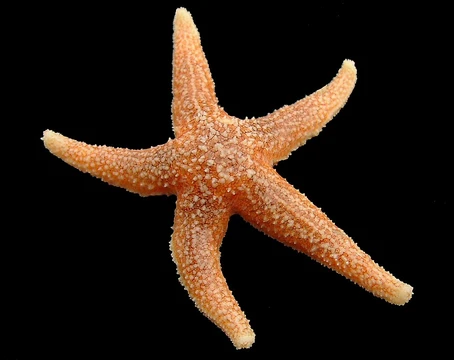
Patiria miniata
A Pacific sea star with webbed arms and a wide central disk.

Patiria miniata, commonly known as the bat star, sea bat, webbed star, or broad-disk star, is a species of sea star in the family Asterinidae. It is notable for its webbed arms, which resemble a bat's wings, and its wide central disk. The bat star typically has five arms but can have up to nine, and occurs in a variety of colors including green, purple, red, orange, yellow, and brown, either mottled or solid.
Quick Facts
- Genus
- Patiria
- Species
- miniata
Facts from the source article.
Lore & Background
The bat star's genus has been debated, shifting between Asterina and Patiria since Fisher's 1911 North Pacific Asteroidea monograph. Recent molecular systematics have constrained Asterina and identified Patiria as a complex of three closely related Pacific species: P. miniata, P. pectinifera in Asia, and P. chilensis in South America. Anatomically, bat stars breathe through gill-like structures on their back and lack pedicellariae, relying on cilia to keep their skin clean. They have an endoskeleton of vesicles and visual sensors at the end of each ray to detect light and prey. To feed, they cover prey with their stomach and secrete digestive juices to liquefy food. They are omnivorous, eating both plants and animals alive or dead. Instead of a circulatory system, they have a water vascular system used for movement, food transport, waste removal, and respiration, drawing water in through a madreporite on the top side.
Reader's Guide
Bat stars are significant as detritivores and scavengers, collecting algae and dead animals from the ocean floor, thereby helping keep the ocean floor clear and clean. Their primary food source is algae, including seaweed and drifting algae, and they may steal algae from sea urchins. Bryozoans, particularly Tubulipora species in southern California, are an incidental food source. They have a symbiotic relationship with polychaete worms (Ophiodromus pugettensis) that live in their arm grooves on the mouth side, feeding on leftover food; up to 20 worms can live on one bat star. Bat stars are otherwise solitary, using their arms to 'fight' by pushing and laying an arm over other organisms that encroach on their space, food, or resources. They also secrete mucus to deter other animals from taking up habitat on their body. Juveniles live under rocks and boulders, while adults live in the open. Although not evaluated on the IUCN Red List, bat stars face threats from warming ocean temperatures due to climate change, which may be linked to sea star wasting disease, a deadly condition that can spread quickly through populations.
Did You Know?
- Bat stars sometimes have up to nine arms, though they typically have five.
- They breathe through gill-like structures on their back and lack the pincers most starfish use for cleaning.
- Bat stars can 'fight' by pushing and laying an arm over another organism.
- Up to 20 polychaete worms can live on a single bat star, feeding on leftover food.
More in Starfish, Part 2 1-24
Spotted an error? Know more?
Reader corrections go straight into our review queue. Suggest an edit · How this site is sourced