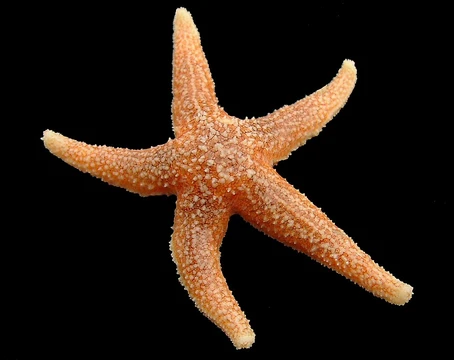
Luidia clathrata
A tropical starfish with slender arms and regenerative ability.

Luidia clathrata is a tropical species of starfish in the family Luidiidae, known as the slender-armed starfish, gray sea star, or lined sea star. It is notable for its large size, slender arms, and ability to regenerate limbs, as well as its selective feeding on the coot clam Mulinia lateralis.
Quick Facts
- Taxon
- Luidia clathrata
Facts from the source article.
Lore & Background
Luidia clathrata has a relatively small disc and five slender arms, with the upper surface clad in longitudinal rows of calcified plates called ossicles and paxillae. No plates are found along the margins of the arms, but the underside marginal plates are large and covered with paxillae. Its tube feet lack suckers and have two swollen regions. The starfish is usually grey or light brown, sometimes tinged with pink, with a dark central row of plates on the upper arms and a paler underside.
It is found in the western Atlantic Ocean from Virginia south to Brazil, including the Caribbean Sea and Gulf of Mexico, on sandy or muddy sea beds. When it loses an arm through predation, it can regenerate the limb; a new arm-tip appears within a week, and growth proceeds at about 3.7 mm per month. A study found that increased ocean acidification had no significant effect on its regenerative capacity.
Luidia clathrata is both a predator and forager, selectively feeding on the coot clam Mulinia lateralis when abundant, using chemoreceptors. It also ingests sediment and strains food particles through spines around its mouth. Its diet includes gastropod and bivalve molluscs, foraminiferans, nematodes, ostracods, small crustaceans, and detritus. It is photosensitive and mostly buries in sediment during daylight, sometimes everting its stomach to ingest detritus while buried.
Reader's Guide
Luidia clathrata is significant as a large, flattish starfish of the western Atlantic, reaching up to 30 cm in diameter. Its slender arms and distinctive paxillae-covered surfaces distinguish it from other starfish. The species plays a role in its ecosystem as both a predator and forager, with a notable preference for the coot clam Mulinia lateralis in Tampa Bay, Florida. Its ability to regenerate lost limbs, with a new arm-tip appearing within a week and subsequent growth at about 3.7 mm per month, is a key biological trait. Importantly, research indicates that increased ocean acidification does not significantly impair this regenerative ability, suggesting resilience to certain environmental changes. The starfish also contributes to nutrient cycling by ingesting sediment and extracting food particles, and it exhibits photosensitive behavior, spending daylight hours buried. Its annual spawning and planktonic bipinnaria larval stage lasting about a month before metamorphosis into juveniles complete its life cycle. The species is found from Virginia to Brazil, including the Caribbean and Gulf of Mexico, typically on sandy or muddy bottoms to depths of 40 m, occasionally deeper.
Physical Form and Coloration
Luidia clathrata presents as a broad, flattened starfish that can reach a span of roughly thirty centimeters across. Its central disc is comparatively modest, while the five elongated arms stretch out to two or three times the disc's width, giving the animal a distinctly slender silhouette. The upper surfaces of both disc and arms are armored in neat longitudinal rows of calcified ossicles and paxillae—small pillar-shaped spines topped with flattened caps studded with tiny spinules. Along the outer edges of the arms, true plates are absent; paxillae take their place. Beneath, however, the marginal plates are notably large and themselves studded with paxillae. The tube feet, arranged in rows on the ventral side, lack the familiar suckers of many starfish, instead bearing two swollen regions. A central mouth sits on the underside, connected to an evertible oesophagus and cardiac stomach, while the gonads lie tucked beneath the flanks of each arm. Coloration typically runs grey to light brown, occasionally flushed with pink, and a distinctive dark grey or black stripe of plates runs down the center of each upper arm. The ventral surface is noticeably paler.
Range and Preferred Habitat
Native to the western Atlantic, Luidia clathrata traces a broad coastal arc from the shores of Virginia southward all the way to Brazil. Its range also encompasses the Caribbean Sea and the Gulf of Mexico, making it a familiar sight across a wide swath of tropical and subtropical waters. The species favors soft-bottom environments, typically settling on sandy or muddy seabeds. Under normal circumstances it is encountered at depths up to approximately forty meters, though individuals have occasionally been recorded in considerably deeper water, reaching one hundred meters. This preference for soft substrates aligns well with its behavioral ecology, as the starfish spends much of its daylight hours buried within the sediment. The western-Atlantic distribution, combined with its tolerance of a moderate depth range, places Luidia clathrata among the more widespread members of the family Luidiidae, a group of starfish that share its general body plan and ecological niche across tropical and subtropical seas.
Feeding Strategy and Daily Rhythm
Luidia clathrata occupies a flexible trophic niche, functioning as both an active predator and a passive forager. When the bivalve known as the coot clam, Mulinia lateralis, is plentiful, the starfish preferentially targets it, relying on chemoreceptors to home in on prey. In Tampa Bay, Florida, the coot clam stands as the species' favorite meal. In periods of scarcity, Luidia clathrata switches to a sediment-feeding strategy, ingesting sand and mud and straining it through spines surrounding its mouth to extract whatever organic matter is trapped. Its broader diet encompasses gastropods, bivalves, foraminiferans, nematodes, ostracods, small crustaceans, and general detritus. The animal is strongly photosensitive, and during daylight it typically buries itself in the substrate. While partially interred, it may evert its stomach outward to capture detritus directly, a behavior that underscores the versatility of its feeding apparatus.
Regeneration and the Life Cycle
One of the most remarkable aspects of Luidia clathrata's biology is its capacity to rebuild lost limbs. If predation severs part or all of an arm, the wound is quickly sealed, and a fresh arm-tip becomes visible within roughly a week. Thereafter, the new limb elongates at a pace of about 3.7 millimeters per month, a rate that tapers off as the arm nears full length. Notably, a study examining the impact of ocean acidification—the kind of chemical shift projected under global warming—found no significant impairment to this regenerative ability, suggesting a degree of resilience in the species. Reproduction follows an annual cycle: the starfish releases gametes into the water column, and the resulting larvae enter a planktonic bipinnaria stage lasting approximately one month. After this drifting phase, the larvae settle onto the seabed, undergo metamorphosis, and emerge as recognizable juvenile starfish, ready to begin their own lives on the soft bottom.
Frequently Asked Questions
What is Luidia clathrata?
Luidia clathrata is a tropical sea star in the family Luidiidae, commonly referred to as the slender-armed starfish, gray sea star, or lined sea star. It is easily recognized by its long, thin arms and its comparatively large body size relative to many other starfish.
What are Luidia clathrata's signature abilities?
Its most celebrated trait is the capacity to regrow lost arms at a rate of roughly 3.7 mm per month. It is also a highly selective predator, specializing in the coot clam Mulinia lateralis rather than grazing on a broad range of prey.
How large does Luidia clathrata grow?
The species can reach a maximum diameter of about 30 cm (12 in), and each arm stretches to two or three times the width of the central disc, giving it a strikingly elongated silhouette on the seafloor.
Where does Luidia clathrata typically live?
You will usually encounter it on the ocean floor down to around 40 m (130 ft), though it has been recorded as deep as 100 m (330 ft) on occasion. Its free-swimming larval stage lasts roughly a month before it settles into its adult form.
Why does Luidia clathrata matter in marine ecology?
As a specialized predator of the coot clam, it plays a targeted role in regulating that particular bivalve population on tropical seafloors. Its robust regenerative capacity also makes it a valuable subject for studying limb regeneration in echinoderms.
More in Starfish, Part 2 1-24
Spotted an error? Know more?
Reader corrections go straight into our review queue. Suggest an edit · How this site is sourced