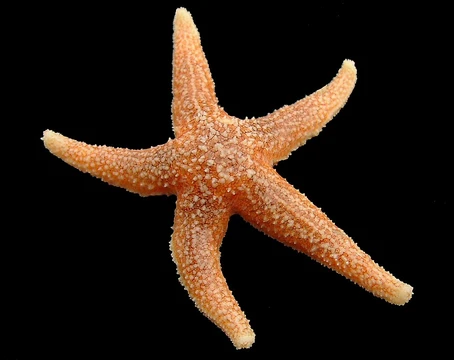
Freyella elegans
A deep-sea starfish with twelve arms and a complex taxonomic history.

Freyella elegans is a deep-water starfish belonging to the family Freyellidae and the order Brisingida, found at abyssal depths in the northwestern Atlantic Ocean. Its classification has been historically muddled. All species in the genus Freyella live in extremely deep water and are only rarely collected, usually by dredging or beam trawl, with specimens almost never coming up intact. This makes identifying and naming them difficult. In 1986, Maureen Downey reviewed the deep-sea Atlantic starfish described up to that time. She determined that a species first named *Brisinga elegans* by Verrill in 1884 had been redefined under multiple different names by later authors, and she synonymized all of them under *Freyella elegans*.
The starfish has a small central disc and typically twelve long, fairly rigid arms reaching about 210 mm (8 inches) in length. On the upper (aboral) surface of the disc, hexagonal plates each bear one to three small spinelets and are covered by a membrane lacking pedicellariae. The madreporite sits near the disc’s margin, while the anus is clearly visible near the disc’s center. Spines on the lateral plates are short and sturdy. The arms are long, narrow, and cylindrical near the disc, then widen slightly and become cigar-shaped farther out, tapering near the tips. There, the covering membrane is semi-transparent, with saddle-like bands and many small pedicellariae. On the underside of each arm, the ambulacral groove takes up more than half the arm’s width. Around the mouth on the lower (oral) surface, the outer spines form a bar across the ambulacral grooves.
This bathydemersal species lives in the northwestern Atlantic Ocean at depths around 3,000 meters (10,000 feet). It has been recorded from between Cape Hatteras and Georges Bank, as well as near Greenland and in the Gulf of Guinea. Little is known about its feeding. While some members of the Brisingida have been photographed with arms raised, apparently filter feeding, *Freyella* species have only been observed lying flat on the sediment, suggesting they are not suspension feeders. Some individuals have been found with small crustacean exoskeletons inside their mouths.
Quick Facts
- Genus
- Freyella
- Species
- elegans
Facts from the source article.
Lore & Background
The taxonomy of Freyella elegans has been complicated by the difficulty of collecting deep-water Freyella species, which are gathered only occasionally from isolated locations, almost exclusively by dredging or beam trawl. Targeted collection is virtually impossible, and specimens are almost never intact. In 1986, Maureen Downey published a study of deep-sea starfish from the Atlantic, finding that the species originally described by Verrill in 1884 as Brisinga elegans had later been redefined under different names; she reduced these to synonyms of Freyella elegans.
This starfish has a small disc and normally twelve long, rather rigid arms. The hexagonal plates on the aboral surface bear one to three spinelets and are covered by a membrane with no pedicellariae. The madreporite is near the margin of the disc, and the anus is distinct and near the center. The arms are long, narrow, and cylindrical near the disc, widening slightly and becoming cigar-shaped distally, with semi-transparent membrane, saddle-like bands, and many small pedicellariae near the tips. The ambulacral groove occupies more than half the width of each arm.
Little is known of its feeding habits. While some Brisingida have been photographed with arms raised, apparently filter feeding, Freyella species have only been observed lying flat on the sediment and are probably not suspension feeders; some have been found with small crustacean exoskeletons in their buccal cavities.
Reader's Guide
Freyella elegans holds significance as a species whose taxonomic identity was resolved by Maureen Downey's 1986 study, which consolidated multiple earlier names—including Brisinga elegans described by Verrill in 1884—into a single valid species. This resolution was necessary because deep-water Freyella species are rarely collected intact, making description and naming complicated. The species' distribution spans the northwestern Atlantic from Cape Hatteras to Georges Bank, near Greenland, and in the Gulf of Guinea, at depths around 3,000 meters. Its morphology includes twelve long arms, a small disc, and distinctive saddle-like bands and pedicellariae near the arm tips. Ecologically, it differs from some other Brisingida: while some members raise their arms to filter feed, Freyella elegans has only been observed lying flat on sediment, suggesting it is not a suspension feeder. Evidence of small crustacean exoskeletons in its buccal cavity hints at a benthic diet. The species remains poorly understood due to the challenges of deep-sea collection, and its feeding habits are largely unknown.
Did You Know?
- Freyella elegans has normally twelve long, rather rigid arms about 210 mm (8 in) long.
- Maureen Downey in 1986 reduced several earlier names to synonyms of Freyella elegans.
- This starfish has been detected between Cape Hatteras and the Georges Bank, near Greenland, and in the Gulf of Guinea.
The Puzzle of Naming a Ghost
All members of the genus Freyella inhabit the deepest parts of the ocean, and specimens of this starfish reach the surface only by accident—hauled up sporadically from isolated spots by dredges or beam trawls. Because no researcher can simply sail to a known site and collect a healthy individual, the material that does arrive is almost invariably broken or incomplete. This makes the very act of describing and naming a new species an extraordinary feat of patience. The taxonomic history of Freyella elegans illustrates the problem vividly. In 1884, A. E. Verrill described the animal under the name Brisinga elegans, but over the following decades several other authors reinterpreted the same organism and assigned it different names. It was not until 1986 that Maureen Downey, reviewing the entire body of Atlantic deep-sea starfish literature, recognized that all of these later names referred back to Verrill's original animal. She consolidated them as synonyms under Freyella elegans, finally giving the species a single, stable identity after more than a century of confusion.
Anatomy of the Abyss
Freyella elegans presents a striking silhouette: a compact central disc from which radiate twelve long, stiff arms, each reaching roughly 210 millimetres (about eight inches) in length. The upper, aboral surface of the disc is paved with hexagonal plates, each bearing one to three tiny spinelets and overlaid by a smooth membrane that lacks pedicellariae. The madreporite sits close to the disc's outer edge, while a clearly defined anus lies near the centre. Along the sides, the lateral plates carry short, stout spines. The arms themselves are narrow and cylindrical where they join the disc, then gradually broaden into a cigar-like shape before tapering to a point at the tips. In those distal regions the covering membrane turns semi-transparent, and the surface is studded with saddle-shaped bands and numerous small pedicellariae. Beneath each arm, the ambulacral groove is remarkably wide, taking up more than half the arm's total width. On the lower, oral surface, the spines flanking the mouth line up to form a continuous bar that spans across the ambulacral grooves.
Range in the Deep
Freyella elegans is a bathydemersal starfish, meaning it lives on or near the seafloor in the deep ocean rather than in the water column. Its known range is confined to the northwestern Atlantic, where it has been recorded at depths of approximately 3,000 metres (roughly 10,000 feet). Within that vast expanse, sightings are sparse and scattered. Specimens have been recovered from the stretch of ocean between Cape Hatteras and the Georges Bank, a region off the eastern coast of North America. The species has also been detected in waters near Greenland and, more surprisingly, in the Gulf of Guinea off the west coast of Africa. These isolated finds underscore just how little is known about the true geographic spread of the animal. Because every encounter depends on a research vessel happening to deploy a dredge or trawl in the right place at the right time, the distribution map for Freyella elegans is almost certainly incomplete, and the species may occupy additional deep-water basins that have simply not yet been sampled.
How a Ghost Feeds
Very little is known about the feeding ecology of Freyella elegans, and what little information exists comes from indirect observations rather than direct study. Within the broader order Brisingida, some starfish species have been captured on video with their arms raised into the water column, a posture consistent with filter or suspension feeding. Members of the genus Freyella, however, have only ever been seen resting flat against the sediment, suggesting they do not employ that strategy. Instead, the most concrete evidence of their diet comes from specimens in which the buccal cavities contained the exoskeletons of small crustaceans. This hints at a benthic scavenging or predation lifestyle, with the animal picking up or capturing small invertebrate remains from the seafloor. The combination of a wide ambulacral groove and the flat, sediment-hugging posture may be functionally linked to this mode of feeding, though no definitive behavioural study has confirmed the connection. In short, Freyella elegans remains one of the least understood deep-sea predators, its daily routines hidden beneath three thousand metres of black water.
Frequently Asked Questions
What is Freyella elegans?
Freyella elegans is a deep-water starfish in the family Freyellidae and order Brisingida, typically encountered at abyssal depths of roughly 3,000 meters in the northwestern Atlantic. It is a twelve-armed species with arms measuring around 210 mm, and it belongs to a genus whose members all inhabit extreme deep-sea environments.
Where exactly can you find Freyella elegans?
This species ranges across the northwestern Atlantic, from the waters between Cape Hatteras and Georges Bank up toward Greenland, with additional records from the Gulf of Guinea. Every known location shares the common trait of being bathydemersal or abyssal, near the 3,000-meter depth mark.
What are the key physical features of Freyella elegans?
The starfish normally bears twelve arms, each reaching about 210 mm (roughly 8 inches) in length. Its body plan is characteristic of the order Brisingida, placing it among the more morphologically complex deep-sea echinoderms.
Why is Freyella elegans's taxonomy so messy?
The species was originally described under a different name, Brisinga elegans, by Verrill, and its proper placement within Freyellidae was not firmly established until Maureen Downey's 1986 review of Atlantic deep-sea starfish. Because specimens are so rarely collected and often arrive damaged, pinning down the correct genus and species boundaries has remained an ongoing challenge.
Why is Freyella elegans so rarely seen or studied?
Every species in the genus Freyella dwells at extreme depths, so encounters depend almost entirely on dredging or beam-trawl operations, and even then the animals almost never survive the haul-up intact. This makes it one of the hardest groups of starfish to identify, measure, or photograph in a living state.
More in Starfish, Part 2 1-24
Spotted an error? Know more?
Reader corrections go straight into our review queue. Suggest an edit · How this site is sourced