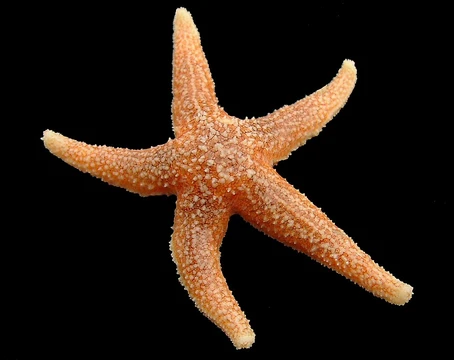
Luidia foliolata
A fast-moving starfish of soft seabeds in the northeastern Pacific.

Luidia foliolata, commonly known as the sand star, is a species of starfish in the family Luidiidae found in the northeastern Pacific Ocean. It inhabits sandy and muddy seabeds at depths to about 600 m (2,000 ft), and is notable for its long, flattened arms, lack of suckers on its tube feet, and its ability to move rapidly across soft sediments.
Quick Facts
- Taxon
- Luidia foliolata
Facts from the source article.
Lore & Background
The sand star has a small disc and five long, flattened arms with tapering tips. Its arms have rows of large marginal plates, each with several spines, but these are not visible from the aboral (upper) side. The tube feet have no suckers, ending instead with blunt points. This starfish seems to be easily damaged, often breaking into pieces if raised from the seabed by trawling, and even when brought up intact it frequently has missing or regenerating arms, perhaps from attacks by predatory crabs or fish.
The sand star is well-camouflaged on sandy and muddy seabeds, often half-covered with sediment. It can create a shallow depression and work its way under bivalve molluscs, polychaete worms, brittle stars, and sea cucumbers on which it feeds. Unlike some other starfish, it cannot evert its stomach, so is limited to smaller-sized prey. It is agile and can right itself rapidly if turned upside down. Its long, pointed tube feet are specially adapted for movement over soft sediments but lose traction on steeply sloping rocks. It is a fast traveller, moving across the seabed at 280 cm per minute, many times faster than slow species such as the leather star (Dermasterias imbricata), which moves only 15 cm per minute.
Reader's Guide
The sand star is significant as a fast-moving predator of soft-sediment communities in the northeastern Pacific. Its tube feet, lacking suckers and ending in blunt points, are a specialized adaptation for locomotion on sand and mud, enabling it to travel at 280 cm per minute—far faster than many other starfish. Its inability to evert its stomach restricts it to smaller prey, distinguishing its feeding ecology from that of other starfish. The species is also notable for its fragility; it often breaks apart when trawled, and many individuals show signs of arm loss and regeneration, likely due to predation by crabs or fish. This fragility and regenerative ability are key aspects of its life history. The sand star can be confused with Astropecten verrilli, but in that species the large marginal plates are visible from above, whereas in Luidia foliolata they are not. Its range extends from Alaska to the Galapagos Islands and Nicaragua, and it is found at depths up to about 600 m.
Did You Know?
- It can move across the seabed at 280 cm per minute, much faster than the leather star.
- It cannot evert its stomach, so it is limited to smaller-sized prey.
- It is often found with missing or regenerating arms, possibly from attacks by predatory crabs or fish.
Frequently Asked Questions
What is Luidia foliolata?
Luidia foliolata, commonly called the sand star, is a species of starfish belonging to the family Luidiidae. It is native to the northeastern Pacific Ocean and is recognized for its elongated, flattened arms and its preference for soft, sandy or muddy seabeds.
What makes Luidia foliolata different from other starfish?
Unlike most starfish, the sand star lacks suckers on its tube feet, which is unusual for the group. This anatomical quirk, combined with its long, flat arms, allows it to glide quickly across loose sediment rather than gripping a hard substrate.
How fast can Luidia foliolata move?
The sand star can cover roughly 280 centimetres (about 110 inches) in a single minute, making it one of the swiftest-moving starfish known. This speed lets it traverse soft seabeds far more quickly than typical echinoderms.
Where does Luidia foliolata live and how deep can it be found?
Its range stretches from Alaska southward to the Galápagos Islands and Nicaragua throughout the northeastern Pacific. It inhabits sandy and muddy bottoms at depths reaching approximately 600 metres (2,000 feet).
How big does Luidia foliolata get and what does it look like?
Adults can reach a maximum diameter of about 40 centimetres (16 inches) across their outstretched arms. Their colouration typically ranges from grey to greenish-grey or pale brown, and some individuals show white speckling across the body surface.
More in Starfish, Part 2 1-24
Spotted an error? Know more?
Reader corrections go straight into our review queue. Suggest an edit · How this site is sourced