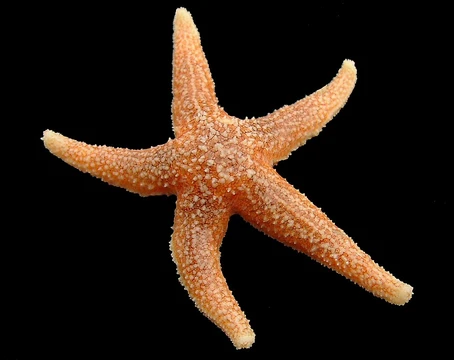
Novodinia antillensis
Deep-sea starfish with claw-like pedicellariae and possibly non-functional eyespots.

Novodinia antillensis, called the velcro sea star, belongs to the starfish family Brisingidae. It lives in deep waters of the tropical and subtropical western Atlantic Ocean, and is especially common at about 500 meters deep on the Mesoamerican Reef near Roatán, Honduras.
This starfish has ten to fourteen long, tapering arms. Each arm tip bears a large eyespot made up of roughly one hundred complex ocelli, though these structures contain almost no sensory cells and may not work. The central disc and arms are covered in spines, and those spines are equipped with pedicellariae—small, claw- or wrench-shaped organs.
The velcro sea star perches on the branches of deep-water corals that grow like trees. It stretches its arms into the water to catch drifting small crustaceans. The arms form a feeding fan; the pedicellariae grab and hold prey, and the arms curl into loops to move the food to the mouth.
On the Cape Fear coral mound off North Carolina, at about 400 meters deep, the main large bottom-dwelling animals included N. antillensis, along with American conger eels, alfonsino fish, sea urchins, and squat lobsters (Eumunida picta). Each species, especially the fish, preferred a specific niche, often on the mound’s southern and southwestern slopes. More occasional visitors to the seamount were shortbeard codling and blackbelly rosefish, mostly found on the lower slopes and base.
Two new steroidal saponins, named Sch 725737 and Sch 725739, have been isolated from N. antillensis.
Quick Facts
- Genus
- Novodinia
- Species
- antillensis
Facts from the source article.
Lore & Background
Novodinia antillensis perches on the branches of arboreal deep water corals, extending its arms into the water column to catch small crustaceans drifting past. The arms form a feeding fan, the pedicellariae grasp and secure the prey, and the arms form loops that surround the food item and take it to the mouth. This starfish has ten to fourteen long tapering arms with distinctive large eyespots on the tips, each composed of about a hundred complex ocelli; on close examination these structures were found to be virtually devoid of sensory structures and may be non-functional. The disc and arms are clad in spines, themselves armed with pedicellariae (small claw or wrench-shaped organs).
Reader's Guide
Novodinia antillensis is significant as a deep-sea predator that uses its specialized pedicellariae to capture drifting crustaceans while perched on corals. Its large eyespots, though prominent, appear to be virtually devoid of sensory structures and may be non-functional, raising questions about their evolutionary role. The species is a dominant component of the macrobenthos on the Cape Fear coral mound off North Carolina at around 400 meters depth, sharing the habitat with fish such as the American conger and alfonsino, as well as sea urchins and squat lobsters. Each species, especially the fish, had its own favoured niche habitat, often on the southern and southwestern slopes of the mound. More transient visitors included the shortbeard codling and blackbelly rosefish, mostly found on the lower slopes and base. Additionally, two novel steroidal saponins, Sch 725737 and Sch 725739, have been isolated from this starfish, indicating potential biochemical interest.
Did You Know?
- Its eyespots are composed of about a hundred complex ocelli that are virtually devoid of sensory structures and may be non-functional.
- It uses its pedicellariae to grasp and secure prey, then forms loops with its arms to bring food to the mouth.
- On the Cape Fear coral mound, it was a dominant macrobenthos species alongside the American conger and alfonsino.
Predatory Specialization Through Pedicellariae
Among the roughly 1,900 starfish species inhabiting the seabeds of every ocean, Novodinia antillensis stands out for an unusual offensive deployment of structures that, in most asteroids, serve a purely defensive or cleaning purpose. Pedicellariae are scissor-like ossicles positioned at the tips of spines, and in groups such as Valvatida and Forcipulatida they function to displace unwanted organisms that settle on the animal's surface. Novodinia antillensis, however, repurposes these same articulated structures as active prey-capture tools, a behavior it shares with the Antarctic Labidiaster annulatus. This predatory use places the species firmly within the broader pattern of starfish as opportunistic feeders and predominantly benthic invertebrate predators. While other asteroids employ specialized strategies like eversion of the stomach or suspension feeding, Novodinia antillensis relies on the mechanical action of its pedicellariae to seize prey, representing a distinct morphological solution to the same ecological niche of hunting small organisms on the seafloor.
The Layered Architecture of the Body Wall
Novodinia antillensis, like all asteroids, is built upon a multi-layered body wall whose complexity underpins its predatory capabilities. The outermost layer is a thin cuticle, beneath which lies a single-cell-thick epidermis. Deeper still, a thick dermis of connective tissue houses the endoskeleton: a lattice of calcium carbonate ossicles formed from honeycomb-like arrangements of calcite microcrystals. These ossicles take many forms—flat plates, granules, and spines—and cover the aboral surface. In Novodinia antillensis, the spines bear the scissor-like pedicellariae used for prey capture. Supporting this entire framework is a three-dimensional web of collagen fibres set at right angles to one another, with ossicles and papulae occupying the interstices. This architecture allows the arms to flex easily during normal movement yet snap into rapid stiffness when the animal needs to react under stress, a mechanical duality essential for a predator that must both track and seize its prey.
Hydraulic Locomotion and the Water Vascular System
The movement of Novodinia antillensis across the seabed is governed by a hydraulic network known as the water vascular system, a web of fluid-filled canals that handles locomotion, adhesion, food manipulation, and gas exchange simultaneously. Water enters through the madreporite, a porous sieve-like ossicle on the upper surface, then travels via a calcareous stone canal to a ring canal encircling the mouth. From there, radial canals extend along each arm's ambulacral groove, with short lateral canals branching alternately to either side. Each lateral canal terminates in a bulb-shaped ampulla connected to an external tube foot. When the ampulla's longitudinal muscles contract, water is forced into the tube foot, stretching it toward the substrate. Crucially, the grip is achieved not by suction but by adhesive chemicals, and release occurs through chemical changes and ampulla relaxation. The tube feet move in a coordinated wave, and because starfish descended from bilateral ancestors, Novodinia antillensis can shift into a bilateral gait when hunting or when threatened.
Ecological Position and the Broader Asteroid Context
Novodinia antillensis occupies a niche within a class of roughly 1,900 species distributed across every ocean, from warm tropical shelves to frigid polar waters and down to abyssal depths of 6,000 metres. As a predominantly benthic predator, it participates in the same trophic dynamics that make certain asteroids keystone species, such as the ochre sea star or the reef sea star, whose removal cascades through entire communities. Other members of the class, like the crown-of-thorns starfish, exert such intense predation pressure on coral that they reshape Indo-Pacific reef ecosystems, while the Northern Pacific seastar has been flagged among the worst invasive alien species. The fossil record of asteroids stretches back to the Ordovician, approximately 450 million years ago, though remains are sparse because the soft tissues disintegrate after death, preserving only ossicles and spines. Starfish reproduce both sexually and asexually, can regenerate lost arms, and even shed limbs defensively—traits that collectively ensure the class's remarkable persistence across geological time.
Frequently Asked Questions
What is Novodinia antillensis?
Novodinia antillensis, commonly called the velcro sea star, is a deep-water starfish belonging to the family Brisingidae. It is distinguished by its ten to fourteen long, tapering arms and a spiny central disc.
Where does Novodinia antillensis live?
This species is found in the tropical and subtropical western Atlantic at depths around 500 meters, with the Mesoamerican Reef near Roatán, Honduras being a particularly common site. It has also been recorded at roughly 400 meters on the Cape Fear coral mound.
Do the eyespots on Novodinia antillensis's arms actually work as eyes?
Each arm tip bears a large eyespot made up of about a hundred complex ocelli, but these structures contain virtually no sensory cells. They are widely considered non-functional and likely serve no true visual purpose.
How does Novodinia antillensis catch its food?
The velcro sea star arranges its arms into a fan-like shape to trap small crustaceans drifting through the water. It then draws the captured prey toward its central disc to eat.
What is the velcro sea star's main defense?
Its disc and arms are densely covered in spines armed with pedicellariae, small claw-like appendages that help repel predators and keep the surface free of debris. This bristly, hook-like coating is what gives the species its 'velcro' nickname.
More in Starfish, Part 2 1-24
Spotted an error? Know more?
Reader corrections go straight into our review queue. Suggest an edit · How this site is sourced