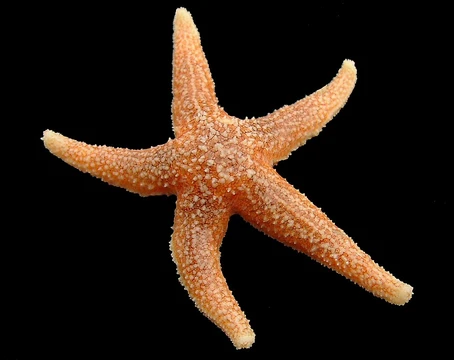
Zoroasteridae
One of three families of sea stars in order Forcipulatida.

The Zoroasteridae family is one of three families within the sea star order Forcipulatida. It includes seven living genera and one extinct genus. These sea stars are widely distributed, primarily across the Pacific, Atlantic, and Indian Oceans, with a smaller number found in the Arctic and Antarctic Oceans.
Quick Facts
- Taxon
- Zoroasteridae
- Diversity Link
- #Genera
- Diversity
- 7 living genera, · 35 species, See text.
Facts from the source article.
Lore & Background
The Zoroasteridae family was first described in the scientific literature through reports such as Sladen's 1889 work on Asteroidea from the Challenger expedition. The family includes seven living genera: Bythiolophus (monotypic, with B. acanthinus described by Fisher in 1916), Cnemidaster (six species, described by Sladen in 1889), Doraster (monotypic, with D. constellatus described by Downey in 1970), Myxoderma (five species, described by Fisher in 1905), Pholidaster (monotypic, with P. squamatus described by Sladen in 1889), Sagenaster (monotypic, with S. evermanni described by Mah in 2007), and Zoroaster (20 species, described by Thomson in 1873). One extinct genus, Terminaster, was described by Hess in 1974.
Reader's Guide
The Zoroasteridae are notable as one of three families within the order Forcipulatida, a group of sea stars. Their distribution across major oceans—Pacific, Atlantic, Indian, Arctic, and Antarctic—indicates a widespread ecological presence, particularly in deep-sea environments. The family's composition includes both living and extinct genera, with the extinct Terminaster providing a paleontological link to past marine ecosystems. The monotypic genera (Bythiolophus, Doraster, Pholidaster, Sagenaster) suggest specialized evolutionary lineages, while Zoroaster, with 20 species, represents the most diverse genus. The family's taxonomy has been refined through works by Fisher, Sladen, Downey, and Mah, with phylogenetic studies (e.g., Mah 2007) exploring evolutionary events in deep-sea Asteroidea. The family's significance lies in its contribution to understanding forcipulatid diversity and deep-sea starfish evolution, as documented in references such as the Challenger report and subsequent taxonomic revisions.
Did You Know?
- The Zoroasteridae contain seven living genera and one extinct genus.
- The genus Zoroaster includes 20 species, the most of any genus in the family.
- Species are found in the Pacific, Atlantic, Indian, Arctic, and Antarctic Oceans.
Discovery & a Tangled Identity
Zoroaster fulgens entered the scientific record in 1873 when Charles Wyville Thomson dredged specimens from the Atlantic Ocean and described the species in his landmark volume, The Depths of the Sea. That single act of documentation marked one of the earliest attempts to catalogue deep-sea megafauna, yet the species has since been mired in nomenclatural chaos. Researchers have applied at least six alternative names to what is now recognized as Z. fulgens, including Z. longicauda, Z. ackleyi, Z. bispinosus, Z. diomedeae, Prognaster grimaldii, and Prognaster longicauda. This proliferation of synonyms mirrors a broader disorganization within the Asteroidea class, where juvenile and adult body plans can differ so dramatically that misidentification becomes almost inevitable. The species sits within the Forcipulatida order and Zoroasteridae family, but its tangled nomenclature means that much of the historical literature on deep-sea starfishes may be describing Z. fulgens under an entirely different name, complicating any attempt to build a coherent picture of its biology.
An Armored Architecture of Ossicles
The body plan of Z. fulgens is a study in compact, heavily fortified design. Five radial arms radiate from a notably small central disc, with a deeply recessed mouth at the center. The internal skeleton is composed of calcified ossicles arranged in an imbricate, overlapping pattern that gives the animal a heavily armored appearance. On the disc, ossicles form a circular arrangement with a central plate surrounded by five radial and five interradial plates, enclosing a sharp-edged madreporite within a cavity. The arm walls are constructed from multiple layers of overlapping ossicles—carinals, abactinals, a single row of marginals, several rows of actinals, adambulacral, and ambulacral elements—each bearing spines and facets that interlock for both articulation and protection. Near the mouth, four rows of tube feet are present, reducing to just two rows toward the arm tips. The oral spines carry duck-billed pedicellariae alongside straight forcipulate pedicellariae, while the odontophore features fused doda and poda with teeth formed from galleried stereom.
Feeding in the Abyss
How Z. fulgens actually feeds remains one of the most debated questions in deep-sea echinoderm biology. Fatty acid biomarker and stomach content analyses by Howell and colleagues in 2003 initially grouped the species with suspension feeders, suggesting a primary reliance on photosynthetic microplankton and phytodetrital carbon. Yet the same study noted significant biomarker differences from other suspension feeders, and the animal's arm morphology does not strongly support that strategy. A later analysis revealed Mollusca remains in the stomach, reclassifying Z. fulgens as an infaunal predator with a broader, more generalist diet that also includes trace amounts of benthic echinoderms, crustaceans, and foraminiferans. Observations of the species at bathyal food falls have fueled a scavenging hypothesis as well. Regardless of the exact strategy, digestion is extracorporeal: the starfish everts its stomach over prey to break it down externally before ingesting the liquefied contents. The animal inhabits bathyal to abyssal depths from 200 to 6,000 meters across the Atlantic, Pacific, and Indian Oceans, where it has been recorded in large densities at single stations.
Growth, Regeneration & Hidden Diversity
Z. fulgens follows a direct developmental pathway, meaning its juveniles already resemble miniature adults rather than passing through a free-swimming larval stage. During ontogeny, however, the arms elongate far more than the disc widens, producing the species' signature long-armed, small-disced silhouette. Some ossicle counts shift as the animal grows while others remain fixed, and all ossicles enlarge with development. This morphological plasticity during growth is a major source of the taxonomic confusion that has plagued the species' identification. The starfish also possesses a remarkable regenerative capacity: lost arms can be rebuilt by re-forming ossicles in a manner analogous to embryonic development. Perhaps most strikingly, genetic and morphological research has revealed three distinct morphotypes within what is classified as a single species in the Atlantic. The robust-armed form occupies depths of 925 to 1,750 meters, the slender-armed form ranges from 1,300 to 2,200 meters, and the long-armed form is found below 3,300 meters, hinting at possible cryptic speciation across the depth gradient.
Frequently Asked Questions
Who is Zoroasteridae?
Zoroasteridae is a family of sea stars that belongs to the order Forcipulatida, making it one of just three families in that group. It currently comprises seven living genera along with a single extinct one.
What are Zoroasteridae's powers/role?
Members of this family are marine sea stars that occupy a wide range of ocean habitats, with their core territory spanning the Pacific, Atlantic, and Indian Oceans. A smaller contingent also holds ground in Arctic and Antarctic waters.
Why is Zoroasteridae important?
As one of only three families within Forcipulatida, Zoroasteridae accounts for a major share of that order's diversity. Its near-global spread across five ocean basins makes it a key reference point for understanding sea star distribution worldwide.
Where can fans spot Zoroasteridae?
The family's members are most frequently encountered in the Pacific, Atlantic, and Indian Oceans. They also maintain a smaller but present population in the Arctic and Antarctic, giving them a broad international footprint.
More in Starfish, Part 2 1-24
Spotted an error? Know more?
Reader corrections go straight into our review queue. Suggest an edit · How this site is sourced