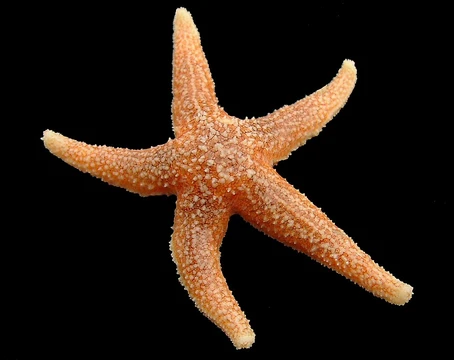
Luidia magellanica
Large, aggressive predator of echinoderms in the southeastern Pacific.

Luidia magellanica is a species of starfish in the family Luidiidae, found in the southeastern Pacific Ocean on the coast of South America. It is notable as a large and aggressive specialist predator of other echinoderms, playing a key role in controlling grazing echinoids in its subtidal habitat.
Quick Facts
- Taxon
- Luidia magellanica
Facts from the source article.
Lore & Background
Luidia magellanica occurs subtidally on rock bottoms with encrusting red algae (Lithophyllum) or soft sediments of coarse sand and shell fragments. It is a specialist predator of other echinoderms, including brittle stars such as Ophiactis, sea urchins such as Tetrapygus niger, and starfish such as Patiria. In the subtidal zone of temperate Chile, it feeds on eight different species of echinoderm and, along with Meyenaster gelatinosus, is the dominant predator.
Many starfish in this zone have missing or regenerating arms, likely from near-lethal encounters with L. magellanica or M. gelatinosus. Both species exhibit cannibalism. When attacked by M. gelatinosus or a larger member of its own species, L. magellanica tends to autotomise 4 to 5 cm of a single arm. In a study off the coast of Chile, between 50 and 70% of individual L. magellanica were found to have regenerating arms.
Other starfish recorded in the same zone off Peru include Patiria chilensis, Stichaster striatus, and Meyenaster gelatinosus. L. magellanica plays an important role in controlling grazing echinoids. Factors such as El Niño events can alter population dynamics: fewer recruits lead to more grazers like Tetrapygus niger and barren areas; more starfish reduce grazers and allow kelp to flourish.
Reader's Guide
Luidia magellanica is significant as a dominant predator in the subtidal zone of temperate Chile and Peru, where it helps regulate echinoderm populations. Its diet includes eight species of echinoderms, and it is one of two dominant predators alongside Meyenaster gelatinosus. The species' role in controlling grazing echinoids like Tetrapygus niger is critical: when L. magellanica numbers decline due to factors such as El Niño events, grazers increase and create barren areas; when numbers are high, kelp flourishes. This dynamic illustrates the starfish's influence on community structure. The high frequency of regenerating arms (50–70% in one study) indicates frequent predatory encounters, including cannibalism. Its ability to autotomise a portion of an arm when attacked is a defensive adaptation. The species is part of a cold-water echinoderm community that includes Patiria chilensis, Stichaster striatus, and Meyenaster gelatinosus. Its legacy lies in its top-predator status and its measurable impact on subtidal ecosystems along the South American coast.
Did You Know?
- Luidia magellanica is a specialist predator of other echinoderms, including brittle stars, sea urchins, and starfish.
- Between 50 and 70% of individuals off Chile had regenerating arms, likely from encounters with predators or cannibals.
- When attacked, L. magellanica autotomises 4 to 5 cm of a single arm.
- El Niño events can reduce L. magellanica recruitment, leading to more grazers and barren areas.
Frequently Asked Questions
Who is Luidia magellanica?
Luidia magellanica is a species of starfish in the family Luidiidae, native to the southeastern Pacific Ocean along the coasts of Peru and Chile. It is recognized as a notably large and aggressive predator within its subtidal ecosystem.
What are Luidia magellanica's powers/role?
This starfish is a specialist hunter of other echinoderms, feeding on eight species including brittle stars (Ophiactis), sea urchins (Tetrapygus niger), and even other starfish (Patiria). It acts as a top-down regulator of grazing urchin populations in its habitat.
What happens when Luidia magellanica loses an arm?
A severed arm typically measures about 4 to 5 cm (1.6 to 2.0 inches) in length before detaching. In a study off the Chilean coast, 50 to 70 percent of individuals were actively regenerating a lost arm, showing how routine this self-amputation is in the wild.
Why is Luidia magellanica important?
As a large, aggressive predator of echinoderms, it keeps grazing sea urchin populations in check within its subtidal habitat. Without this predatory pressure, urchin grazing could destabilize the rocky and sandy-bottom communities of the southeastern Pacific.
Where does Luidia magellanica live?
This species is found on both rocky substrates encrusted with red algae (Lithophyllum) and softer bottoms of coarse sand mixed with shell fragments. Its range is confined to the southeastern Pacific, specifically along the Peruvian and Chilean coasts.
More in Starfish, Part 2 1-24
Spotted an error? Know more?
Reader corrections go straight into our review queue. Suggest an edit · How this site is sourced