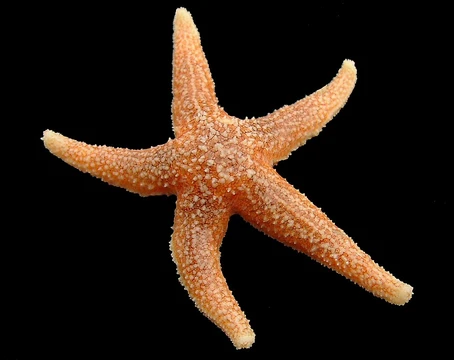
Trophodiscus almus
A deep-water starfish that broods young on its upper surface.

Trophodiscus almus is a species of starfish in the family Astropectinidae, found in fairly deep waters of the Sea of Okhotsk, the Sea of Japan, and around the Japanese island of Hokkaido. It is notable for brooding its young on its upper surface, a very unusual behavior among starfish.
Quick Facts
- Genus
- Trophodiscus
- Species
- almus
Facts from the source article.
Lore & Background
Trophodiscus almus was first described by the American zoologist Walter K. Fisher in 1917 from material collected by the marine research vessel USS Albatross. It was thought to be endemic to the Sea of Okhotsk, but has more recently been discovered in the Sea of Japan and waters around Hokkaido. Its depth range is 150 to 300 m, and it is fairly uncommon. In the Sea of Japan it is found on muddy sand bottoms where the water temperature is 1.5 °C.
The starfish has a five-armed pentagonal shape, growing to about 33 mm in diameter, with a wide disc and short, bluntly pointed arms. The aboral surface is covered in paxillae, umbrella-shaped structures with spiny margins. A notable feature is the 13 to 20 large calcareous plates extending around the margins of each arm. Two color forms exist: some individuals have a bright red or orange-red aboral surface and a paler reddish-brown oral surface; others have a yellowish-green aboral surface and yellowish-brown oral surface. In both forms, the superomarginal plates are paler and contrast with the rest.
Juveniles are brooded on the aboral surface of the female between the paxillae. Up to sixteen young have been found on one adult, and the juveniles are either reddish-orange or greyish-green. The color of the offspring does not always match that of the parent; greyish-green young have been found on red adults. This brooding location is very unusual among starfish, shared only with the sister species Trophodiscus uber, Leptychaster kerguelenensis, and Ctenodiscus australis.
Reader's Guide
Trophodiscus almus is significant primarily for its unusual reproductive strategy: brooding its young on the aboral surface between the paxillae. This behavior is extremely rare among starfish, with only three other species known to do so: its sister species Trophodiscus uber from the Sea of Okhotsk, Leptychaster kerguelenensis from the extreme south of the Indian Ocean, and Ctenodiscus australis from the Southern Ocean. The species was first described in 1917 by Walter K. Fisher from material collected by the USS Albatross, and was initially thought to be endemic to the Sea of Okhotsk. Its range has since been extended to the Sea of Japan and waters around Hokkaido. The starfish exhibits two distinct color forms—red/orange-red and yellowish-green—with the superomarginal plates paler in both. The offspring colors do not always match the parent, suggesting genetic or environmental variation. Its depth range of 150 to 300 m and preference for muddy sand bottoms at cold temperatures (1.5 °C) indicate a specialized deep-water habitat. The species is fairly uncommon, and its Japanese common name is Komochi-momiji.
Did You Know?
- Up to sixteen juveniles have been found brooded on a single adult.
- The species has two color forms: bright red/orange-red or yellowish-green.
- It was first described in 1917 by American zoologist Walter K. Fisher from material collected by the USS Albatross.
Frequently Asked Questions
Who is Trophodiscus almus?
Trophodiscus almus is a small starfish species in the family Astropectinidae, first formally named by zoologist Walter K. Fisher back in 1917. It grows to roughly 33 mm across and carries the Japanese common name Komochi-momiji.
What are Trophodiscus almus's powers/role?
Its signature trait is carrying its developing offspring on the top surface of its body, a form of parental brooding that is exceedingly rare in the starfish world. This makes it a standout example of how some echinoderms invest directly in their young rather than simply releasing them into the current.
Where does Trophodiscus almus live?
It is a deep-water resident, typically found between 150 and 300 meters depth in the Sea of Okhotsk, the Sea of Japan, and the waters around Hokkaido. The cold, dim environment of the North Pacific is its natural home range.
Why is Trophodiscus almus important?
Because almost all other starfish broadcast their larvae into open water, Trophodiscus almus's surface-brooding strategy offers a rare window into alternative reproductive tactics in echinoderms. Researchers study it to better understand how deep-sea invertebrates can provide direct parental care despite the challenges of their habitat.
More in Starfish, Part 2 1-24
Spotted an error? Know more?
Reader corrections go straight into our review queue. Suggest an edit · How this site is sourced