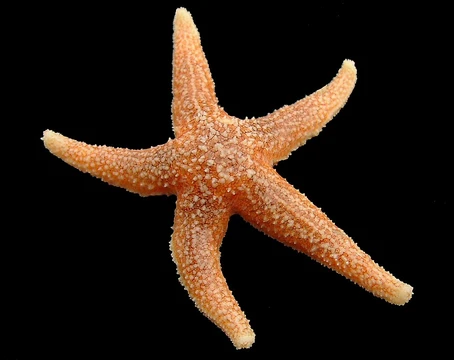
Luidia ciliaris
A seven-armed sea star that engulfs prey larger than its mouth.

**Luidia ciliaris**, also called the seven-armed sea star, belongs to the family Luidiidae. This starfish lives in the eastern Atlantic Ocean and the Mediterranean Sea.
Its body is orangeish-brown, with seven long arms that extend from a small central disk. The species can reach 40 cm across but is fragile, frequently losing arms that later regenerate. The arms have parallel sides, tapering only near the tips, and are edged with a noticeable fringe of white spines. The upper surface is covered with paxillae—pillar-like spines topped with tiny spinules—along with many-lobed, nipple-shaped papillae. No marginal plates appear on the upper side of the arms, but those on the lower side carry two-valved pedicellariae. The tube feet are long and numerous, lacking suction pads but possessing two sets of terminal bulbs. Gonads run in two rows along each arm. The mouth sits at the underside’s center, connected to an oesophagus and a cardiac stomach; there is no intestine, pyloric stomach, or anus.
This sea star occurs on the seabed from Norway and the Faroe Islands south to Cape Verde and the Azores, as well as in the Mediterranean. It inhabits the neritic zone down to 400 m depth, mostly on soft sediments where it sometimes burrows, though it can also be found on rock.
*L. ciliaris* is a predator and scavenger that feeds mainly on other echinoderms. In the Irish Sea, its primary prey includes the brittle stars *Ophiothrix fragilis* and *Ophiura albida*, and the sea urchin *Psammechinus miliaris*. It also consumes *Ophiocomina nigra*, but less often because that brittle star has better escape tactics. The seven-armed sea star moves quickly compared to other starfish: it lifts itself on its arm tips, walks in that position, then launches at prey. The ring of plates around its mouth can stretch or even tear, allowing it to swallow items much larger than its usual mouth size—for instance, it can pounce on a brittle star 25 cm across and engulf it whole. Undigested remains are expelled through the mouth.
Breeding occurs in early summer. Females release millions of eggs into the water, prompting males to release sperm. About four days after fertilization, the zygotes become bipinnarial larvae that drift as plankton. After several moults, the seven arms appear in a structure called the rudiment, attached to a stalk with bands of cilia.
Quick Facts
- Taxon
- Luidia ciliaris
Facts from the source article.
Lore & Background
Luidia ciliaris has an orangeish-brown color and seven long arms radiating from a small disk. It is a large but fragile sea star, easily losing its arms, which afterwards regenerate. The arms have parallel sides, taper only near the tip, and bear a conspicuous fringe of white spines along the margins. The upper surface is clothed in paxillae—spines shaped like pillars with flat tops bearing tiny spinules—and many-lobed, nipple-like papillae. No marginal plates are on the upper side of the arms, but those on the lower side bear pedicellariae with two valves. The tube feet are long and numerous, lacking suction pads but having two sets of terminal bulbs. The gonads are arranged in two rows along the length of the arms. The mouth is at the center of the underside, with an oesophagus and a cardiac stomach, but no intestine, pyloric stomach, or anus.
It occurs on the seabed in the eastern Atlantic Ocean and the Mediterranean Sea, in the neritic zone at depths down to 400 m, mainly on soft sediments into which it sometimes burrows, but sometimes on rock. It is a predator and scavenger, feeding predominantly on other echinoderms. A study in the Irish Sea found that the brittle stars Ophiothrix fragilis and Ophiura albida, and the sea urchin Psammechinus miliaris, formed the chief items of prey. The brittle star Ophiocomina nigra was also consumed, but in lesser quantities because it had more efficient escape strategies.
The seven-armed sea star moves rapidly in comparison with other sea stars. It hoists itself up on the tips of its arms, in which position it can 'walk', before launching itself at its prey. The ring of plates around its mouth are extensible or can even be ruptured to enable it to ingest food items much bigger than the normal size of its mouth. In this way, it can pounce on a brittle star 25 cm in diameter and completely engulf it. Undigested remains are ejected through the mouth.
Reader's Guide
Luidia ciliaris is significant for its unique feeding strategy and rapid locomotion. Unlike many sea stars, it lacks an intestine, pyloric stomach, and anus, relying on its cardiac stomach to digest prey externally and eject undigested remains through the mouth. Its ability to extend or rupture the ring of plates around its mouth allows it to engulf prey much larger than its mouth, such as brittle stars up to 25 cm in diameter. This species also exhibits a distinctive method of movement, hoisting itself on the tips of its arms to 'walk' before launching at prey. Its fragile body and ability to regenerate lost arms are notable adaptations. In reproduction, females release millions of eggs into the water column, stimulating sperm release by males. After fertilization, the zygotes develop into bipinnarial larvae that form part of the plankton. The larvae do not become a brachiolarial larva as in most sea star taxa; instead, they settle on the sea bed and metamorphose, with functional tube feet appearing in the juvenile before larval tissue is fully reabsorbed. The species' distribution spans the eastern Atlantic and Mediterranean, from Norway to Cape Verde and the Azores, at depths down to 400 m, primarily on soft sediments.
Did You Know?
- Luidia ciliaris has seven long arms and can grow up to 40 cm across.
- It lacks an intestine, pyloric stomach, and anus, ejecting undigested remains through its mouth.
- It can engulf a brittle star 25 cm in diameter by extending or rupturing the ring of plates around its mouth.
- Its larvae do not become a brachiolarial larva, unlike most sea star taxa.
A Fragile Giant of the Deep
The seven-armed sea star presents a striking silhouette: seven elongated arms radiating outward from a comparatively tiny central disk, all rendered in a warm orangeish-brown tone. Despite its impressive size—individuals can span up to forty centimetres across—Luidia ciliaris is remarkably delicate. Its arms, which run parallel-sided for most of their length and narrow only toward the tips, are easily torn away, though the animal is capable of regrowing them. Along each arm's edges runs a conspicuous fringe of white spines that gives the creature a lacy outline. The upper surface is densely covered with paxillae, pillar-shaped spines capped by a flat top studded with minute spinules, alongside numerous many-lobed, nipple-like papillae. On the underside, the marginal plates carry two-valved pedicellariae, while the long, abundant tube feet lack suction pads entirely, instead terminating in two sets of bulbs. Digestion is handled by a cardiac stomach and oesophagus at the central mouth; there is no intestine, pyloric stomach, or anus. Gonads line the arms in two parallel rows.
From Norwegian Shelves to Mediterranean Depths
Although it is a creature of the sea floor, Luidia ciliaris occupies a surprisingly broad stretch of the eastern Atlantic. Its range stretches from the cold waters around Norway and the Faroe Islands all the way south to the islands of Cape Verde and the Azores, and it also inhabits the Mediterranean Sea. Within these waters, the species is confined to the neritic zone, where it can be encountered at depths reaching four hundred metres. Its preferred substrate is soft sediment—sandy or muddy seabeds into which it occasionally buries itself—though it is not exclusively a soft-bottom dweller and will also be found resting on rocky surfaces. This combination of a wide latitudinal spread and a depth range extending well beyond the photic zone makes it one of the more geographically versatile members of the family Luidiidae, thriving in conditions that span from temperate to subtropical coastal waters.
A Pouncing Predator on the Seabed
Unlike many of its slower-moving sea star relatives, Luidia ciliaris is a fast and aggressive hunter. It feeds predominantly on other echinoderms, and research conducted in the Irish Sea identified the brittle stars Ophiothrix fragilis and Ophiura albida, along with the sea urchin Psammechinus miliaris, as its principal prey items. The brittle star Ophiocomina nigra was also taken, but in smaller quantities, likely because it possesses more effective escape mechanisms. To strike, the sea star first hoists itself upright on the tips of its arms, a posture that allows it to walk briefly before launching itself at a target. Its ring of oral plates is remarkably flexible—capable of stretching or even rupturing—so that it can swallow prey far larger than its resting mouth size. One documented example involves engulfing a brittle star nearly twenty-five centimetres in diameter in a single pounce. Anything that cannot be digested is simply expelled back through the mouth.
Millions of Eggs and a Planktonic Odyssey
Reproduction in Luidia ciliaris is timed to early summer, when females release vast clouds of eggs directly into the surrounding water. This broadcast spawning triggers males to discharge sperm, and fertilisation occurs externally. Roughly four days later, the resulting zygotes have developed into bipinnarial larvae, joining the planktonic community. Over the following weeks these larvae undergo several moults, during which the seven arms gradually take shape within a structure called the rudiment, attached to a stalk bearing bands of cilia. The larvae grow to about thirty-five millimetres over three to four months. Notably, this species skips the brachiolarial larval stage that is typical of most other sea star lineages. Instead, the developing juvenile settles onto the seabed, where metamorphosis proceeds. Functional tube feet become operational in the young animal before the remnants of larval tissue are completely reabsorbed, marking the transition to a benthic, predatory life.
Frequently Asked Questions
What is Luidia ciliaris?
Luidia ciliaris is a seven-armed sea star in the family Luidiidae, often referred to simply as the seven-armed sea star. It is a medium-to-large echinoderm whose arms can span up to 40 cm (about 16 in) across.
What does Luidia ciliaris look like?
It has a small central disk from which seven long, parallel-sided arms radiate, all in an orangeish-brown tone. The arm margins are trimmed with a conspicuous fringe of white spines, and the upper surface is textured with pillar-like paxillae and many-lobed, nipple-shaped papillae.
Where can you find Luidia ciliaris?
Its range covers the eastern Atlantic from Norway and the Faroe Islands southward to Cape Verde and the Azores, as well as the entire Mediterranean basin. It inhabits depths down to roughly 400 m (1,300 ft).
What does Luidia ciliaris eat?
It is a predator that specializes in other echinoderms, favoring brittle stars and sea urchins. Notably, it can engulf prey items that are larger than its own mouth opening.
How does Luidia ciliaris recover from losing an arm?
Although the animal is quite fragile and frequently sheds or loses arms, it is fully capable of regenerating them over time. This regenerative ability is a key survival trait for a species living in environments where physical damage is common.
More in Starfish, Part 2 1-24
Spotted an error? Know more?
Reader corrections go straight into our review queue. Suggest an edit · How this site is sourced