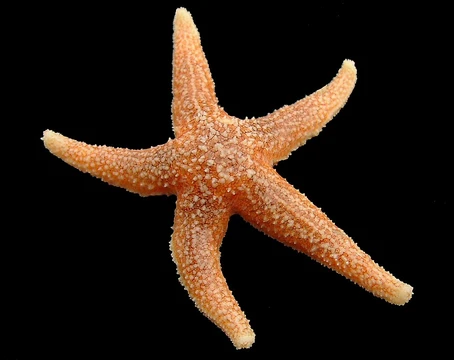
Luidia maculata
A large, smooth starfish with eight arms, native to the Indo-Pacific.

The eight-armed sea star, *Luidia maculata*, belongs to the family Luidiidae and the order Paxillosida. It lives in the Indo-Pacific region. While it can have anywhere from five to nine arms, eight is the most typical count.
This starfish can reach 25 cm (10 in) across. It usually has seven or eight long, slender, pointed arms (sometimes nine) and a small central disc. The upper surface is flat and covered with small, flat-topped structures called paxillae. Pale tube feet, which end in points instead of suction pads, run along the sides of the arms and the underside. There are two color forms: some individuals are a uniform dark brown or greenish-brown, while others have dark brown with orange-brown chevron marks, or light brown with dark marks. It can be confused with *Luidia savignyi*, but that species is spiny, whereas *L. maculata* is smooth. Another similar species, *L. magnifica*, usually has nine or ten arms.
It is found in the tropical Indian and Pacific Oceans, typically on muddy sand in lagoon floors, but also on other soft sediments and in seagrass beds. Its depth range extends from a few meters down to about 35 m (115 ft).
*Luidia maculata* partially buries itself in soft sediment, making it hard to spot. It is a predator, feeding mostly on sea urchins, especially irregular sand dollars and similar buried echinoderms. Unlike some related starfish that digest food externally, it pulls its prey into its mouth to consume it inside. When it emerges from hiding, it often leaves behind inedible fragments of prey tests in the hollow it vacated. It also eats sea cucumbers, brittle stars, bivalves, snails, crustaceans, and worms.
Quick Facts
- Genus
- Luidia
- Species
- maculata
Facts from the source article.
Lore & Background
Luidia maculata is a large starfish, reaching up to 25 cm in diameter, with a small central disc and usually seven or eight (sometimes nine) long, slender, pointed arms. Its aboral surface is flat with granulations and covered with flat-topped, table-like structures called paxillae. Rows of pale tube feet ending in points rather than suction pads are visible on the sides of the arms and oral surface. Two color forms exist: some individuals are uniform dark brown or greenish-brown, while others are dark brown with orange-brown chevron markings, or light brown with dark markings. It could be confused with Luidia savignyi, but that species is spiny whereas L. maculata is smooth; another similar species, L. magnifica, typically has nine or ten arms.
Reader's Guide
Luidia maculata is notable for its variable arm count, with eight arms being most common, and for its predatory ecology. It partially buries itself in soft sediment, making it difficult to spot, and feeds mostly on sea urchins, particularly irregular sand dollars and similar echinoderms that also live buried in sand. Unlike some related species that practice external digestion, L. maculata draws its prey inside its mouth to consume it. When it emerges from hiding, it often leaves behind inedible fragments of test from its prey in the hollow it vacated. Its diet also includes sea cucumbers, brittle stars, bivalves, snails, crustaceans, and worms. This species is distinguished from similar Luidia species by its smooth surface and typical arm count, and it inhabits muddy sand in lagoons and other soft sediments from a few metres down to about 35 m.
Did You Know?
- Luidia maculata is commonly known as the eight-armed sea star, though arm number varies from five to nine.
- It has two color forms: uniform dark brown or greenish-brown, or with orange-brown chevron markings.
- Unlike some starfish that practice extra oral digestion, Luidia maculata ingests its prey at the oral orifice and consumes it internally.
- It partially buries itself in soft sediment and often leaves behind inedible prey fragments when it emerges.
Frequently Asked Questions
What is Luidia maculata?
Luidia maculata is a large, smooth-bodied sea star in the family Luidiidae (order Paxillosida) found across the Indo-Pacific. It is most recognizable for its long, slender, pointed arms radiating from a small central disc.
How big does Luidia maculata grow?
This starfish can span up to 25 cm (about 10 inches) across, making it one of the more sizable members of its family. Its flat upper surface is dotted with small, flat-topped bumps called paxillae.
How many arms does Luidia maculata have?
While the species can range from five to nine arms, eight is by far the most typical count. The arms are long, narrow, and end in a sharp point rather than broadening at the tip.
Where does Luidia maculata live and at what depth?
It inhabits muddy sand on lagoon floors, other soft sediments, and seagrass beds throughout the Indo-Pacific. You can find it from just a few metres below the surface down to roughly 35 m (about 115 ft).
What makes Luidia maculata's tube feet different from other starfish?
Its pale tube feet run along the arm sides and underside but terminate in tiny points instead of the suction cups seen in many other sea stars. This gives the species a smoother, less grippy feel when you run a finger along its arms.
More in Starfish, Part 2 1-24
Spotted an error? Know more?
Reader corrections go straight into our review queue. Suggest an edit · How this site is sourced