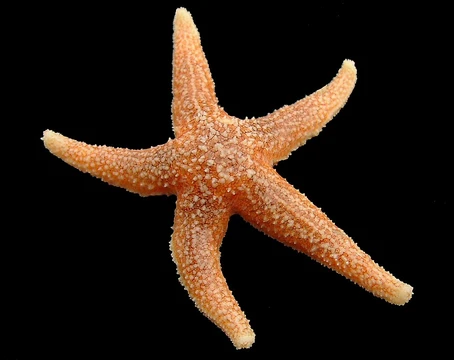
Zoroaster fulgens
Deep-sea starfish with three morphotypes and cryptic speciation.

Zoroaster fulgens is a deep-sea starfish first described in 1873 by Charles Wyville Thomson, who dredged it from the Atlantic Ocean. It belongs to the class Asteroidea, order Forcipulatida, family Zoroasteridae, and genus Zoroaster. Taxonomic confusion has led to many alternative names for this species, including *Z. longicauda*, *Z. ackleyi*, *Z. bispinosus*, *Z. diomedeae*, *Prognaster grimaldii*, and *Prognaster longicauda*.
As an echinoderm, *Z. fulgens* is a deuterostome with an internal mesodermal skeleton made of calcified ossicles. Its skeleton is heavily armored and imbricate. The starfish has five radial arms, a small central disc, and a deeply sunken mouth. Near the mouth, it has four rows of tube feet, which reduce to two rows farther out on the arms. The disc’s ossicles are arranged in a circle, with a central plate surrounded by five radial and five interradial plates. A sharp-edged madreporite sits inside a cavity formed by the interradial plates. The terminal plates are robust, with straight proximal edges and convex distal edges. The arm wall consists of overlapping ossicles—carinals, abactinals, a single row of marginals, several rows of actinals, adambulacrals, and ambulacrals—some bearing spines and facets for articulation and protection. Superambulacrals are reduced. Oral spines include duck-billed pedicellariae and straight forcipulate pedicellariae. The odontophore has fused doda and poda, large iioa, and teeth made of galleried stereom.
No specific research exists on *Z. fulgens* sensory systems, but starfish generally have a dispersed nervous system with a nerve ring around the mouth and radial nerves extending into the arms. They use chemoreception and mechanoreception through tube feet sensors, which also aid locomotion. Some starfish have eyes on arm tips for photoreception, but because *Z. fulgens* lives in abyssal zones, it may lack such features.
*Z. fulgens* is believed to be gonochoristic and a broadcast spawner, possibly with seasonal reproduction. It produces large lecithotrophic eggs that settle on the seafloor to become tiny juveniles. Gonads are located at the base of each arm, beside the ambulacral band. The starfish can regenerate lost arms by repairing ossicles in a process similar to initial growth.
Quick Facts
- Genus
- Zoroaster
- Species
- fulgens
Facts from the source article.
Lore & Background
Zoroaster fulgens was first described by Wyville Thomson in his book 'The Depths of the Sea…' as he dredged the Atlantic in 1873. It has five radial arms, a small disc, and a deeply sunken mouth. Its disc has ossicles arranged in a circle pattern with a central plate inside five radial and five interradial plates, and a sharp-edged madreporite inside a cavity formed by the interradial plates. The terminal plates are robust with straight proximal edges and convex distal edges. The arm wall is made of overlapping ossicles including carinals, abactinals, marginals (one row), actinals (several rows), adambulacrals, and ambulacrals, which can have spines and facets. It has reduced superambulacrals, oral spines with duck-billed pedicellariae and straight forcipulate pedicellariae, and teeth formed by galleried stereom.
Z. fulgens is a direct developer with juvenile stages that resemble adults, but features shift during ontogeny, often causing taxonomic disruptions. Arms grow more in length than the disc, resulting in long arms and a small disc. Ossicles can fluctuate in number or be fixed, but all enlarge during development. They are gonochoristic broadcast spawners with possible reproduction seasonality, producing large lecithotrophic eggs that settle on the benthos. They have gonads at the base of each arm and can regenerate lost arms by repairing ossicles.
Three distinct morphotypes are found in the Atlantic with differing depth ranges: robust-armed (925-1750m), slender-armed (1,300-2,200m), and long-armed (below 3,300m). Data suggests these morphotypes are reproductively isolated, with slender and long-armed more closely related and possibly in the process of speciation, while robust-armed is already a distinctly different species. Speciation is theorized to be due to physical barriers such as depth and continental slope, as well as historical climate changes.
Reader's Guide
Zoroaster fulgens holds significance as the most basal member of both the Forcipulatida order and the Zoroaster genus, with morphology similar to Paleozoic asteroids and single marginal plates linking it to Jurassic asteroids. This basal placement makes it important for understanding asteroid evolution. The species exhibits three distinct morphotypes in the Atlantic that appear reproductively isolated, suggesting ongoing or recent speciation driven by depth and historical climate events. Diet differences between Northeast and Northwest Atlantic populations may further indicate cryptic species. An Eocene fossil from Seymour Island, Antarctica, shows characteristics not completely identical to the extant species, possibly due to migration and adaptation during Oligocene-Miocene climate change or representing a distinct species. The fossil shares similarities with the robust morphotype. Despite its ecological importance—found in large densities at single stations—its feeding mechanism remains uncertain; evidence suggests it may be a suspension feeder, infaunal predator, or scavenger, with extracorporeal digestion. Its deep-sea habitat (bathyal to abyssal, 200-6000 meters) and taxonomic disorganization (many synonyms) add to its complexity.
Did You Know?
- Zoroaster fulgens is the most basal Forcipulatida and the most basal in the Zoroaster genus.
- It has three distinct morphotypes in the Atlantic with different depth ranges: robust-armed, slender-armed, and long-armed.
- An Eocene fossil of Z. fulgens was discovered in Seymour Island, Antarctica, but differs from the extant species.
- Its feeding method is unknown, but it uses extracorporeal digestion.
Taxonomic Identity and the Long History of a Deep-Sea Name
First brought to scientific attention in 1873 when Charles Wyville Thomson dredged specimens from the Atlantic Ocean and documented them in his work The Depths of the Sea, Zoroaster fulgens has endured a long history of taxonomic confusion. Classified within the phylum Echinodermata, class Asteroidea, order Forcipulatida, and family Zoroasteridae, this deep-sea starfish has accumulated a remarkable string of alternative names over the decades. Researchers have variously referred to it as Z. longicauda, Z. ackleyi, Z. bispinosus, Z. diomedeae, Prognaster grimaldii, and Prognaster longicauda, a tangle of synonyms that reflects ongoing disorganization within the group. As a deuterostome, it shares the broader echinoderm body plan of an internal mesodermal skeleton built from calcified ossicles, yet its particular arrangement of those structures sets it apart. The species' discovery during Thomson's pioneering deep-sea surveys marked one of the early forays into abyssal biodiversity, and its continued taxonomic ambiguity underscores how much remains unresolved about deep-ocean invertebrate diversity.
Skeletal Architecture and Morphological Distinctiveness
Zoroaster fulgens presents a compact central disc from which five radial arms extend, with a deeply recessed mouth positioned on the oral surface. The skeletal framework is notably heavily armored, with ossicles arranged in an imbricate, overlapping pattern that provides both structural integrity and protection. On the disc, ossicles form a circular arrangement enclosing a central plate, surrounded by five radial and five interradial plates. Within the cavity created by the interradial plates sits a sharply edged madreporite, the entry point for the water vascular system. The terminal plates are robust, featuring straight proximal edges and convex distal edges. Each arm's wall is constructed from multiple categories of overlapping ossicles—carinals, abactinals, a single row of marginals, several rows of actinals, adambulacrals, and ambulacrals—many bearing spines and facets that interlock for articulation and defense. Superambulacrals are reduced. Near the oral surface, spines are accompanied by two types of pedicellariae: duck-billed and straight forcipulate forms. The odontophore displays fused doda and poda, large iioa, and teeth composed of galleried stereom, a microstructural detail that distinguishes this species from close relatives.
A Mosaic Feeding Strategy in the Deep Benthos
The feeding ecology of Zoroaster fulgens remains one of the most debated aspects of its biology. Fatty acid biomarker and stomach-content analyses by Howell and colleagues in 2003 initially grouped the species with suspension feeders, suggesting a primary reliance on photosynthetic microplankton and phytodetrital carbon, with possible predation on copepods. Yet the same study noted significant differences in three biomarkers compared to other suspension-feeding species, and the arm morphology does not align well with a filter-feeding strategy. A separate investigation identified Mollusca remains in stomach contents, reclassifying Z. fulgens as an infaunal predator with a broader diet that also includes trace amounts of benthic echinoderms, crustaceans, and foraminiferans. Additional hypotheses include mucus-mediated collection of particles from the water column and scavenging at bathyal food-fall events, where the species has been observed. Regardless of the precise strategy, digestion is extracorporeal: the starfish everts its stomach over prey to break it down externally before ingesting the resulting nutrients. This flexibility in trophic role may explain why the species has been found in large densities at individual deep-sea stations across the Atlantic, Pacific, and Indian Oceans.
Development, Regeneration, and Depth-Linked Morphotypes
Zoroaster fulgens follows a direct developmental pathway, meaning juveniles emerge from large lecithotrophic eggs already resembling miniature adults rather than passing through a free-swimming larval stage. These eggs settle on the seafloor, and the young starfish grow with arms elongating disproportionately relative to the disc, producing the characteristic long-armed, small-disced adult form. During ontogeny, certain ossicle counts fluctuate while others remain fixed, and all ossicles enlarge as the animal matures. This developmental plasticity has contributed to the taxonomic confusion surrounding the species, as juvenile and adult morphologies can appear quite different. The starfish is also capable of regenerating lost arms by rebuilding ossicles in a manner analogous to embryonic growth. Reproduction is believed to be gonochoristic with broadcast spawning and possible seasonal timing, with gonads located at the base of each arm along the ambulacral band. Genetic and morphological research has identified three distinct morphotypes in the Atlantic: a robust-armed form at 925–1,750 meters, a slender-armed form at 1,300–2,200 meters, and a long-armed form below 3,300 meters, hinting at depth-driven speciation or adaptive divergence in the deep sea.
Frequently Asked Questions
Who is Zoroaster fulgens?
Zoroaster fulgens is a deep-sea starfish formally named in 1873 by Charles Wyville Thomson after he dredged specimens from the Atlantic. It sits within the class Asteroidea, order Forcipulatida, and family Zoroasteridae, carrying the genus Zoroaster.
What are Zoroaster fulgens's powers or defining traits?
As an echinoderm, it carries a heavily armored internal skeleton built from calcified ossicles arranged in an imbricate, plate-like pattern. It has five arms and tolerates an extraordinary depth span from roughly 200 to 6,000 meters. The species also displays three distinct morphotypes, hinting at hidden cryptic speciation beneath a single name.
Why is Zoroaster fulgens important to the field?
It is currently regarded as the most basal member of the order Forcipulatida and the most basal lineage within the genus Zoroaster, making it a critical anchor point for reconstructing the evolutionary tree of spiny starfish. Its position helps researchers calibrate how traits like heavy ossicle armor and the classic five-armed body plan evolved across the group.
Where can you find Zoroaster fulgens in the wild?
Specimens have been recovered from the Atlantic, Pacific, and Indian Oceans, typically at depths between 200 and 6,000 meters. It is not a shallow-water species and is most often encountered during deep-sea dredging or trawling expeditions rather than by casual observation.
More in Starfish, Part 2 1-24
Spotted an error? Know more?
Reader corrections go straight into our review queue. Suggest an edit · How this site is sourced