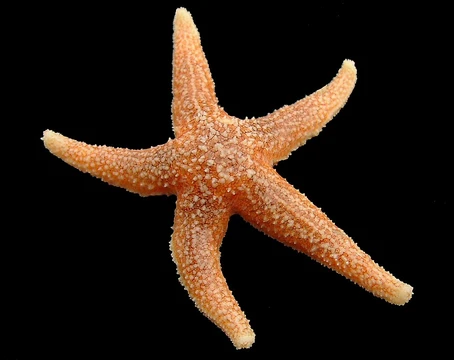
Freyellidae
Deep-sea starfish family with small disc and long arms.

Freyellidae is a family of deep-sea-dwelling starfish, one of two families in the order Brisingida. The majority of its species are found in Antarctic waters and near Australia, with others near New Zealand and the United States. Members of this family have a small, Ophiurida-like disc with more than five long, tapering arms, and are usually found on soft substrates at depths between 950 and 5,600 meters.
Quick Facts
- Taxon
- Freyellidae
Facts from the source article.
Lore & Background
The family Freyellidae was created in 1986 by American zoologist Maureen Downey, who split the existing family Brisingidae on morphological and behavioural grounds. The order Brisingida had been erected earlier to accommodate the starfish Brisinga endecacnemos, discovered in deep water off Norway in 1856, and another abyssal species, Brisinga coronata (now Hymenodiscus coronata). Since then dozens of new species have been described from deep water habitats.
Members of Freyellidae have a small, Ophiurida-like disc clearly demarcated from the arms, which number more than five. The disc is approximately circular with a rim of fused plates. The madreporite is near the margin of the disc. The arms are long and tapering, with the ratio of arm length to disc radius greater than 6/1, and an acute angle between the arms. After a narrow cylindrical portion, the part of the arms closest to the disc accommodates gonadal tissues and widens out, then tapers to a long point. They differ from the other Brisingida family, Brisingidae, in having curved interradial arcs, smaller madreporites, bare interradial plates on the disc, the aboral surface of the arms continuous with the disc, and plates on the proximal parts of the arms abutting rather than overlapping.
Freyellidae are usually found on soft substrates at depths between 950 and 5,600 m, which is greater than Brisingidae (100–4,000 m, usually on hard surfaces). Because their plates abut on the proximal ends of their arms, Freyellids have not been observed to raise their arms vertically above their discs, as Brisingidae do, and some are probably not suspension feeders. Some do raise the distal portions of their arms beyond the gonadal regions.
Reader's Guide
The creation of Freyellidae by Maureen Downey in 1986 represents a significant taxonomic refinement within the order Brisingida, based on morphological and behavioural differences from the other family, Brisingidae. The family encompasses six genera and dozens of species, with the genus Freyella alone containing 29 species. Its members are notable for inhabiting greater depths (950–5,600 m) than Brisingidae, and for their distinctive arm structure—plates that abut rather than overlap on the proximal arms, which prevents them from raising their arms vertically. This anatomical difference suggests that many Freyellidae are not suspension feeders, unlike their relatives. The family's distribution is primarily in Antarctic waters and near Australia, with additional records near New Zealand and the United States, highlighting its role in deep-sea biodiversity. The detailed listing of genera and species in the World Asteroida Database underscores the ongoing cataloging of these deep-sea organisms, contributing to the understanding of echinoderm evolution and ecology in abyssal habitats.
Did You Know?
- Members of Freyellidae are found at depths between 950 and 5,600 m, deeper than the related Brisingidae.
- Freyellidae have plates on the proximal parts of their arms that abut rather than overlap, unlike Brisingidae.
Taxonomic Tangles in the Abyss
The story of how we came to know Freyella elegans is as much a tale of frustration as of discovery. Every member of the genus Freyella inhabits the deepest waters, and specimens surface only by accident, hauled up from isolated spots by dredges or beam trawls. No researcher can simply sail to a known site and collect a healthy individual on purpose. The fragments that do make it to the surface are almost always broken, torn, or incomplete, which turns the basic act of describing and naming a species into an exercise in detective work. For decades, the same animal was reinterpreted and renamed by different taxonomists. It was first described by Verrill in 1884 under the name Brisinga elegans, but subsequent authors kept redefining it under new labels. It was not until 1986, when Maureen Downey published a comprehensive review of Atlantic deep-sea starfish, that the confusion was finally untangled. She demonstrated that all those later names were simply synonyms, collapsing them back into the single, original identity of Freyella elegans.
Architecture of the Arms
Freyella elegans presents a striking silhouette: a compact central disc from which radiate twelve long, stiff arms stretching to roughly 210 millimetres. The upper surface of the disc is paved with hexagonal plates, each carrying one to three tiny spinelets, all sealed beneath a smooth membrane devoid of pedicellariae. The madreporite sits close to the disc's outer edge, while a clearly defined anus marks the centre. Around the lateral plates, short but sturdy spines provide a rough texture. The arms themselves are the most distinctive feature. Narrow and cylindrical where they join the disc, they gradually broaden into a cigar-like profile before tapering to fine points. Near the tips, the covering membrane turns semi-transparent, and the surface is decorated with saddle-shaped bands and clusters of minute pedicellariae. Beneath each arm, the ambulacral groove is remarkably wide, consuming more than half the arm's total width. On the lower, oral surface, the spines flanking the mouth line up to form a continuous bar spanning across the ambulacral grooves.
A Ghost in the Deep Atlantic
Freyella elegans is a true bathydemersal creature, a permanent resident of the abyssal plain at depths hovering around 3,000 metres, roughly 10,000 feet below the surface. Its known range stretches across the northwestern Atlantic, with records from the stretch of seafloor between Cape Hatteras and the Georges Bank. Yet its distribution is not confined to that single corridor; specimens have also been recovered near Greenland and as far south as the Gulf of Guinea. These scattered, isolated find-spots underscore just how patchy our knowledge of this species truly is. Because it lives in such extreme depth, no one can simply dive down and observe it in its element. Every encounter is a chance event, a fragment hauled up by a trawl or dredge that was never specifically targeting a starfish. The result is a species whose full geographic range, population density, and local abundance remain largely unknown, documented only through the handful of broken specimens that have ever breached the surface.
Feeding in the Dark
What Freyella elegans actually eats remains one of the great unanswered questions about this species. Within the broader order Brisingida, some relatives have been captured on camera with their arms lifted skyward, clearly filtering particles from the water column. Freyella, however, tells a different story. Every observation of the genus on the seafloor shows individuals lying flat against the sediment, with no evidence of the raised-arm posture associated with suspension feeding. This strongly suggests they are not filter feeders. The only direct clue to their diet comes from a handful of specimens in which the buccal cavity still contained the exoskeletons of small crustaceans, hinting at a benthic, scavenging or predaceous lifestyle. Beyond those few fragments of evidence, the feeding ecology of Freyella elegans is essentially a blank page. In a habitat where light never penetrates and direct observation is nearly impossible, the daily life of this starfish remains shrouded in as much mystery as the darkness it inhabits.
Frequently Asked Questions
What exactly is Freyellidae?
Freyellidae is a family of deep-sea starfish that belongs to the order Brisingida, making it one of only two families within that order.
What do Freyellidae starfish look like?
Members of this family have a notably small disc that gives them an Ophiurida-like appearance, paired with more than five long, tapering arms extending outward.
Where and how deep can you find Freyellidae?
Most species inhabit Antarctic waters and the seas around Australia, with additional populations near New Zealand and the United States. They typically rest on soft substrates at depths between 950 and 5,600 meters.
How many genera and species are in Freyellidae?
The family comprises six genera in total, and the genus Freyella alone contains 29 described species.
Who established Freyellidae as a family and when?
The family was formally described by Maureen Downey in 1986.
More in Starfish, Part 2 1-24
Spotted an error? Know more?
Reader corrections go straight into our review queue. Suggest an edit · How this site is sourced