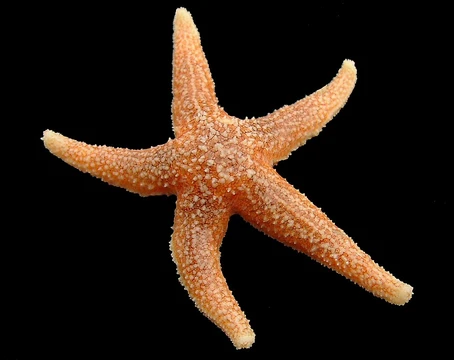
Forcipulatida
Order of sea stars with three families and 49 genera.

Forcipulatida is an order of sea stars made up of three families and 49 genera. Its members are distinguished by pedicellariae that feature a short stalk and three skeletal ossicles, a trait shared with brisingid sea stars, though forcipulatids generally have sturdier bodies. The order includes familiar species like the common starfish, *Asterias rubens*, and its range extends from North Carolina in the United States down to Santos in Brazil.
The order is divided into three families: Asteriidae (39 genera), Heliasteridae (two genera), and Zoroasteridae (eight genera). An alternative classification from the World Register of Marine Species lists seven families and 64 genera: Asteriidae, Heliasteridae, Pedicellasteridae, Pycnopodiidae, Stichasteridae, Zoroasteridae, and the extinct Terminasteridae. A 2020 study using phylogenetic analysis and scanning electron microscopy of skeletons and ossicles from the superorder Forcipulatacea found Asteriidae, Stichasteridae, Zoroasteridae, and Brisingida to be monophyletic.
Quick Facts
- Taxon
- Forcipulatida
Facts from the source article.
Lore & Background
Forcipulatids share with brisingid sea stars distinctive pedicellariae, which are composed of a short stalk with three skeletal ossicles. Unlike brisingids, however, forcipulatids tend to have more robust bodies. The order includes some well-known species, such as the common starfish, Asterias rubens. This order can be commonly found from North Carolina in the United States all the way to Santos in Brazil.
The order is divided into three families: Asteriidae (39 genera), Heliasteridae (two genera), and Zoroasteridae (eight genera). The World Register of Marine Species gives another taxonomy, with seven families and 64 genera, including Asteriidae, Heliasteridae, Pedicellasteridae, Pycnopodiidae, Stichasteridae, Zoroasteridae, and Brisingida. A 2020 study involving phylogenetic analysis and scanning electron microscopy recovered Asteriidae, Stichasteridae, Zoroasteridae, and Brisingida as monophyletic. The extinct family Terminasteridae has also been placed in this order.
Reader's Guide
The Forcipulatida order is significant as it contains the common starfish, Asterias rubens, a well-known species. Its taxonomy is subject to dispute: the article presents a classification of three families and 49 genera, while the World Register of Marine Species lists seven families and 64 genera. A 2020 study using phylogenetic analysis and scanning electron microscopy recovered several families as monophyletic, including Asteriidae, Stichasteridae, Zoroasteridae, and Brisingida. The extinct family Terminasteridae has also been placed in this order. The order's geographic range is documented from North Carolina in the United States to Santos in Brazil. The distinctive pedicellariae—a short stalk with three skeletal ossicles—are shared with brisingid sea stars, but forcipulatids have more robust bodies. These facts, drawn solely from the source article, highlight the order's biological and taxonomic interest without resolving the noted taxonomic disagreements.
Did You Know?
- Forcipulatida contains three families and 49 genera.
- The common starfish, Asterias rubens, belongs to this order.
- The extinct family Terminasteridae has been placed in this order.
Scissor-Like Defenses and Predatory Tools
Forcipulatida belongs to a select group of starfish lineages—alongside Valvatida—that have evolved pedicellariae, a distinctive anatomical feature absent in many other sea star families. These structures are pincer-shaped ossicles positioned at the tips of spines on the animal's surface. Their primary role is defensive: they actively displace any organisms that attempt to settle or rest on the starfish's body, keeping the surface clear of unwanted passengers. However, the utility of pedicellariae extends beyond mere defense. In certain species such as Labidiaster annulatus and Novodinia antillensis, these same scissor-like structures are repurposed as offensive tools, enabling the animal to snare and capture prey. This dual function—shielding the body while also serving as a hunting mechanism—highlights the versatility of what is essentially a modified calcium carbonate structure embedded within the dermis. The presence of pedicellariae in Forcipulatida marks it as part of a relatively specialized subset of the broader Asteroidea class, setting these animals apart from the majority of starfish that lack this particular armament.
Layered Architecture of the Body Wall
The body wall of Forcipulatida, like that of starfish broadly, is a multi-layered construction that balances protection with flexibility. From the outside in, a thin cuticle gives way to a single-cell-thick epidermis, followed by a substantial dermis of connective tissue. Within this dermis lies the endoskeleton: a lattice of calcium carbonate ossicles built from honeycomb-like calcite microcrystals. These ossicles take many forms—flat plates, granules, spines—and cover the upper surface of the animal. Beneath the dermis, a thin coelomic myoepithelial layer houses the musculature, and a peritoneum lines the internal cavity. Supporting this entire structure is a three-dimensional web of collagen fibres arranged at right angles to one another, with ossicles and papulae nestled in the interstices. This architecture permits the arms to flex easily during normal movement yet stiffen rapidly when the animal faces stress. In species that bury themselves in substrate, specialized umbrella-like structures called paxillae interlock at their edges to form a protective false cuticle, sheltering the madreporite and delicate gill structures within a water-filled cavity.
The Hydraulic Locomotion Engine
Movement in Forcipulatida and other starfish is driven not by muscles alone but by an elegant hydraulic network. Water is drawn in through the madreporite, a porous sieve-like ossicle on the upper surface, and channeled via a calcareous-lined stone canal to a ring canal encircling the mouth. From there, radial canals extend along the ambulacral groove of each arm, giving off short lateral canals that terminate in bulb-shaped ampullae. When the longitudinal muscles within an ampulla contract, water is forced into the corresponding tube foot, causing it to extend and press against the substrate. Crucially, the grip is not suction-based but chemical: adhesive substances in the tube foot latch the animal to surfaces, while a separate set of chemicals and ampulla relaxation permit release. The tube feet move in a coordinated wave, one section of an arm attaching as another detaches. The entire canal interior is lined with cilia to aid fluid movement. Because starfish descended from bilaterally symmetric ancestors, Forcipulatida members can move in a distinctly bilateral manner, particularly when hunting or responding to threats, and some even curl up their arm tips to expose sensory tube feet and eyespots to the environment.
Ecological Influence and Ancient Lineage
Members of the broader Asteroidea class, to which Forcipulatida belongs, occupy a range of ecological positions that can reshape entire marine communities. Some species function as keystone predators, exerting a disproportionate influence on biodiversity in their habitats. At the other extreme, certain starfish are devastating invasive threats: the tropical crown-of-thorns starfish devours coral across the Indo-Pacific, while the Northern Pacific seastar has been flagged among the Worst Invasive Alien Species. These animals are opportunistic feeders, predominantly preying on benthic invertebrates, though some have evolved specialized strategies such as everting their stomachs over prey or filtering particles from the water column. The fossil record of starfish stretches back to the Ordovician, roughly 450 million years ago, yet it remains sparse because the soft-bodied animals tend to disintegrate after death, leaving only scattered ossicles and spines for paleontologists to recover. Beyond their biological significance, starfish have long captivated human imagination, appearing in literature, legend, design, and even as food in certain cultures, their symmetrical star shape lending itself to iconic visual representation.
Frequently Asked Questions
Who is Forcipulatida?
Forcipulatida is an order of sea stars that groups together three families and 49 genera of spiny, sturdy-bodied starfish. It sits alongside the brisingid sea stars in sharing certain structural traits but is generally more robust in build.
What makes Forcipulatida's design unique compared to other starfish orders?
Members of this order carry pedicellariae built around a short stalk and exactly three skeletal ossicles, a structural signature they share with brisingids. However, forcipulatids tend to have noticeably sturdier, heavier bodies than their brisingid cousins.
Which families belong to Forcipulatida and how big are they?
The order splits into Asteriidae with 39 genera, Zoroasteridae with eight genera, and Heliasteridae with just two genera. Together these three families account for all 49 recognized genera in the order.
Where does Forcipulatida live in the wild?
The order's geographic reach stretches from the coastal waters of North Carolina, United States, all the way south to Santos, Brazil. This broad Atlantic distribution makes it one of the more widely encountered starfish orders in that region.
What is the most iconic species fans associate with Forcipulatida?
Asterias rubens, commonly called the common starfish, is the flagship species most people picture when they hear the name Forcipulatida. It belongs to the Asteriidae family and is one of the most recognizable sea stars along North Atlantic shores.
More in Starfish, Part 2 1-24
Spotted an error? Know more?
Reader corrections go straight into our review queue. Suggest an edit · How this site is sourced