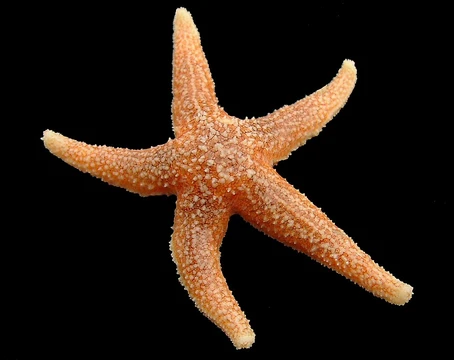
Patiria chilensis
A small, cushion-like starfish in the southeastern Pacific.

Patiria chilensis is a species of starfish in the family Asterinidae, found in the southeastern Pacific Ocean along the coasts of South America. It is notable for its broadly pentagonal, cushion-like body with five short arms and its role as an opportunistic feeder in the rocky intertidal zone.
Quick Facts
- Taxon
- Patiria chilensis
Facts from the source article.
Lore & Background
Patiria chilensis occurs in the rocky intertidal zone in temperate seas off the coast of Chile, primarily in the lower algal zone dominated by the kelps Lessonia nigrescens and Durvillaea antarctica and various encrusting coralline algae. Echinoids in this zone include Loxechinus albus and Tetrapygus niger, while starfish include Stichaster striatus, Meyenaster gelatinosus, and the dominant Heliaster helianthus. These starfish are the dominant carnivores in this zone and seem to play an important role in maintaining community structure. P. chilensis is a small species that avoids predation by larger starfish by tending to remain in concealed locations. It is not known to shed its arms, as many other local starfish do, but the arms sometimes get amputated, perhaps eaten by fish. When that happens, the arms do not regenerate, but the thick skin closes over the wound to heal it. Pollution can affect this species; the opening of a new sea outlet from a copper mine at Caleta Palito in Chile in 1975 caused mass mortality of Patiria chilensis, along with Stichaster striatus, Meyenaster gelatinosus, and the sea urchin Tetrapygus niger, which disappeared completely from the area.
Reader's Guide
Patiria chilensis is a small, cushion-like starfish that inhabits the lower algal zone of the rocky intertidal in temperate seas off Chile. It is an opportunistic feeder, scavenging dead animal matter and detritus, and is preyed upon by larger starfish such as Heliaster helianthus, from which it hides in concealed locations. Unlike many other starfish in the locality, it does not shed its arms, and if arms are amputated (possibly by fish), they do not regenerate; instead, the thick skin heals the wound. The species is part of a community where starfish are dominant carnivores that seem to maintain community structure. Its significance is highlighted by its vulnerability to pollution: the opening of a copper mine sea outlet at Caleta Palito in 1975 caused mass mortality of P. chilensis and other echinoderms, leading to the complete disappearance of the sea urchin Tetrapygus niger from the area. This event underscores the species' sensitivity to environmental disturbance and its role as an indicator of ecosystem health in the southeastern Pacific intertidal zone.
Did You Know?
- Patiria chilensis is a broadly pentagonal, cushion-like starfish with five short arms.
- It avoids predation by larger starfish by staying in concealed locations.
- When its arms are amputated, they do not regenerate; the thick skin closes over the wound.
More in Starfish, Part 2 1-24
Spotted an error? Know more?
Reader corrections go straight into our review queue. Suggest an edit · How this site is sourced