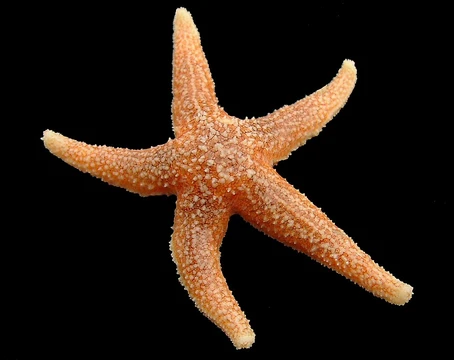
Parvulastra vivipara
One of six viviparous seastars, critically endangered in Tasmania.

Parvulastra vivipara, commonly known as the Tasmanian live-bearing seastar, is a tiny, uniformly orange-yellow seastar endemic to littoral waters in southeast Tasmania. It is notable as one of only six known seastar species to give birth viviparously, and it was added to the IUCN Red List in 2023 as Critically Endangered.
Quick Facts
- Taxon
- Parvulastra vivipara
Facts from the source article.
Lore & Background
Parvulastra vivipara was first described in 1969 as Patiriella vivipara, and was later placed into the novel clade Parvulastra in 2004 along with Parvulastra exigua and Parvulastra parvivipara. It is a member of the Asterinidae family, characterized by a 'knitted' appearance from crescent-shaped plates on the aboral surface. The species is a simultaneous hermaphrodite, self-fertile, and matrotrophic, with individuals typically having six to eight female gonads and a single male-type gonad. Embryos and juveniles are brooded within the parent's body cavity, with sibling cannibalism providing extraembryonic nutrition. Juveniles emerge through gonopores as large 'crawl-away' offspring, ranging from 1.5–5 mm in diameter.
Reader's Guide
Parvulastra vivipara holds significance as one of only six known viviparous seastars, with a unique reproductive strategy that includes self-fertilization, sibling cannibalism, and the production of large, crawl-away juveniles. Its conservation status is critical: since its description in 1969, densities have declined at all known sites, with a 90% reduction in metapopulation between 1974 and 2001. The species faces multiple anthropogenic threats, including urbanization, agricultural runoff, introduced species such as the Pacific oyster and Northern Pacific sea star, and climate-related changes. Its limited dispersal ability, due to the absence of a planktonic larval stage and geographic isolation of subpopulations, exacerbates its vulnerability. The IUCN has recommended enhanced monitoring and protection to preserve the species, as projections suggest populations could diminish to approximately one individual per site by 2111.
Did You Know?
- Juveniles can cannibalize their siblings inside the parent's gonadal cavity for extraembryonic nutrition.
- The species was accidentally introduced to a site at Woodbridge in 1995 when an aquarium population was liberated into the sea.
- Some individuals can have three, four, or six arms, though the typical shape is pentagonal.
More in Starfish, Part 2 1-24
Spotted an error? Know more?
Reader corrections go straight into our review queue. Suggest an edit · How this site is sourced