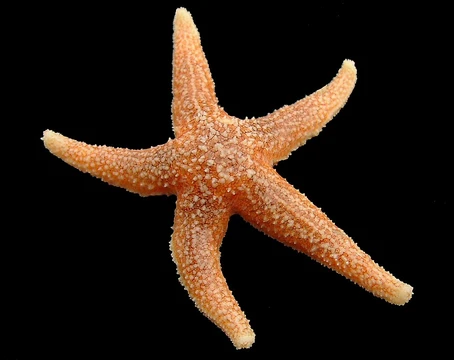
Parvulastra parvivipara
The smallest known starfish, viviparous and endemic to South Australia.

Parvulastra parvivipara is a tiny starfish from the family Asterinidae, recognized as the smallest starfish known. Adults reach about 1 cm (0.4 in) in diameter and are orange-yellow in color. This species is viviparous, meaning it gives birth to live young.
This starfish is endemic to the coast of South Australia, found only within about 200 km (120 mi) of the Eyre Peninsula. It lives in intertidal rock pools on granite rocks. Its distribution is patchy—some seemingly suitable pools have none, while others hold large numbers. The starfish prefers pools with little wave action, high biodiversity, and those located low on the beach rather than high up. Threats to this species include habitat deterioration and destruction from sedimentation, eutrophication, and coastal development. Because it relies on small boulders that are especially vulnerable to disturbances linked to rising sea levels, future restoration efforts may be needed to protect it.
The lifecycle of P. parvivipara is unusual for a starfish. Adults are self-fertilizing hermaphrodites, and eggs are brooded inside the gonads. There is no planktonic larval stage; instead, juveniles develop directly and are cannibalistic, feeding on other embryos and juveniles within the brood pouch. When mature, they are released into the water in batches of up to 20, likely settling in the same rock pool as their parents. Most starfish disperse as planktonic larvae, but this species cannot. It probably moves to a new pool only by chance when a wave sweeps it there. Because of this limited dispersal, a local population may be wiped out by adverse conditions and later recolonized.
Breeding occurs mostly in late spring and summer, though some individuals breed in autumn and winter. During the warmer months, brood sizes are smallest and the young are largest at birth. By adjusting the size and number of offspring, the starfish is thought to maximize the survival chances of its young.
Quick Facts
- Taxon
- Parvulastra parvivipara
Facts from the source article.
Lore & Background
Parvulastra parvivipara is a very small species of starfish in the family Asterinidae. Adults can grow to a diameter of about 1 cm (0.4 in) and are an orange-yellow colour. They are the smallest known starfish. The species is endemic to the coast of South Australia, where it is found within 200 km of the Eyre Peninsula. Its distribution is limited to intertidal rock pools on granite rocks. Some seemingly suitable pools contain none of these starfish, while others have large numbers. Starfish favoured pools with little wave action, but with a considerable degree of biodiversity. They also preferred pools low down the beach rather than high-level pools.
The lifecycle of P. parvivipara is very unusual for a starfish. The adults are self-fertilising hermaphrodites and the eggs are brooded within the gonads. No planktonic larval stage is seen, and the directly developing juveniles are cannibalistic, feeding on other embryos and juveniles while in the brood pouch. When mature enough, they are released into the water in batches of up to 20, where they continue their lives, quite probably in the same rock pool as their parents. Most starfish disperse to new habitats during the planktonic larval stage, but P. parvivipara is unable to do this. It likely can move to a new pool only by chance when an individual is swept there by a wave. Because of the inability of this species to disperse in a typical starfish manner, it may experience some adverse circumstances in any particular pool, be exterminated there, and perhaps recolonize the pool later.
Reader's Guide
Parvulastra parvivipara holds significance as the smallest known starfish and for its unusual reproductive strategy. Its viviparous nature—giving birth to live young—and self-fertilising hermaphroditism are rare among starfish. The absence of a planktonic larval stage limits its dispersal, making it vulnerable to local extinction in individual rock pools. The main identified threats to the species are habitat deterioration and destruction through sedimentation, eutrophication, and coastal development. As P. parvivipara uses mostly small boulders that are particularly susceptible to disturbances that are increasing with rising sea levels, future ecological restoration effects to protect this rare species may be required. Its limited distribution within 200 km of the Eyre Peninsula in South Australia, combined with its preference for specific rock pool conditions (low wave action, high biodiversity, low on the beach), underscores its ecological specialization. The species' lifecycle, including cannibalistic juveniles and seasonal breeding variations (most breeding in late spring and summer when brood sizes are smallest and juveniles largest), reflects an adaptive strategy to maximize offspring survival in a constrained habitat.
Did You Know?
- Adults of Parvulastra parvivipara can grow to a diameter of about 1 cm (0.4 in), making them the smallest known starfish.
- It is a viviparous species that gives birth to live young, with no planktonic larval stage.
- The species is endemic to a limited area of South Australia within 200 km of the Eyre Peninsula.
More in Starfish, Part 2 1-24
Spotted an error? Know more?
Reader corrections go straight into our review queue. Suggest an edit · How this site is sourced