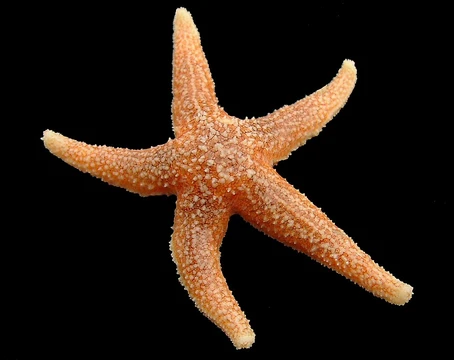
Nepanthia belcheri
A starfish that reproduces by splitting in two.

Nepanthia belcheri is a species of starfish in the family Asterinidae, found in shallow water in Southeast Asia and northeastern Australia. It is notable for its ability to reproduce both sexually and by fission, splitting in two to form new individuals, which results in highly variable numbers of arms.
Quick Facts
- Genus
- Nepanthia
- Species
- belcheri
Facts from the source article.
Lore & Background
Nepanthia belcheri is a small starfish with broad arms and rounded tips. Small specimens typically have five arms, while larger ones have six or seven, though the number can range from one or two to ten. Hubert Lyman Clark, writing in 1938, noted that no two of the 56 specimens at hand, nearly all from Lord Howe Island, were exactly alike in number, size, and form of arms. The starfish is a muddy brown color.
It is native to the Pacific coast of Australia from the Low Islands in Queensland to Port Jackson in New South Wales, and also occurs in Southeast Asia. It is found under boulders and rubble in muddy conditions, from the intertidal zone down to about 45 meters depth.
Nepanthia belcheri is a hermaphrodite. Its gonads generally produce oocytes, but some function as ovaries and others as testes. Sexual reproduction occurs in October and November, and the eggs have large yolk sacs, suggesting lecithotrophic larvae. During its second and third years, when arm length is about 15 or 22 mm, it can reproduce by fragmentation. A furrow appears on the disc, deepens, and the two sides pull apart, tearing the disc into two portions that grow new arms. After fission, gonads regress and individuals with mature female gonads become masculinized, developing male-type gonads.
Reader's Guide
Nepanthia belcheri is significant for its dual reproductive strategy, combining sexual reproduction with asexual fission. This allows the species to both disperse to new locations via sexually produced larvae and rapidly increase local population numbers through fragmentation. The resulting variability in arm number—from one or two up to ten—makes it a striking example of morphological plasticity in starfish. Hubert Lyman Clark's 1938 observation that no two of 56 specimens from Lord Howe Island were alike underscores this uniqueness. The species' ability to shift from female to male reproductive function after fission further highlights its adaptive flexibility. Its lifespan of at least four years, with measurable arm growth rates, provides a clear timeline for its development and reproductive cycles. The muddy brown coloration and habitat under boulders and rubble in shallow, muddy waters define its ecological niche. Overall, N. belcheri serves as a key case study in the balance between sexual and asexual reproduction in marine invertebrates.
Did You Know?
- Nepanthia belcheri can reproduce by splitting in two through fission.
- Hubert Lyman Clark stated in 1938 that no two of 56 specimens from Lord Howe Island were exactly alike in arm number, size, and form.
- After fission, individuals with mature female gonads become masculinized and develop male-type gonads.
- The species has a lifespan of at least four years.
More in Starfish, Part 2 1-24
Spotted an error? Know more?
Reader corrections go straight into our review queue. Suggest an edit · How this site is sourced