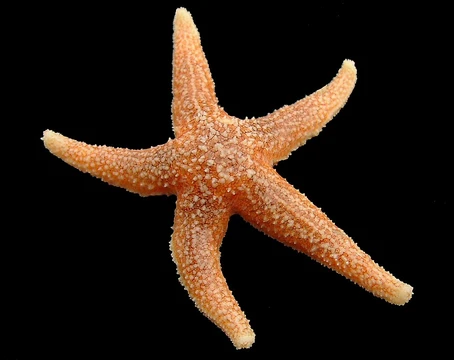
Meridiastra calcar
An Australian sea star with eight arms and variable coloration.

Meridiastra calcar, once known as Patiriella calcar, belongs to the sea star family Asterinidae and is found only in Australia. Its common names include carpet sea star, cushion sea star, and eight-armed sea star.
This sea star usually has eight short, triangular arms, though individuals with seven or nine arms occur. The arms are partly fused at the base, so the body looks like a disk with separate, ray-like tips of varying length sticking out. The upper surface can be any color or mix of colors, while the underside is always a uniform pale shade. From arm tip to arm tip, it reaches a maximum diameter of 5 to 10 centimeters.
The cushion sea star lives in the intertidal zone along Australian coasts, from the south coast of Western Australia to the coast of Queensland near Currumbin, and also around Tasmania, South Australia, Victoria, and New South Wales. It prefers rocky shores, inhabiting tide pools and waters up to 3 meters deep.
Like other sea stars, it moves slowly using its tube feet. It is omnivorous, feeding on algae, detritus, mussels, and other invertebrates. Like a few other species once placed in the genus Patiriella, it is viviparous, brooding its young inside its body.
Quick Facts
- Taxon
- Meridiastra calcar
Facts from the source article.
Lore & Background
The cushion sea star typically has eight short, distinct, triangular arms, though individuals with seven or nine arms can be found. These arms are laterally fused for part of their length, leaving ray-like tips of varying length to jut from the disk-like body. Its aboral surface can be any color or combination of colors, while the oral side is uniformly pale. This sea star attains a maximum diameter from arm tip to arm tip of 5 cm to 10 cm.
It is found in the intertidal zone of Australian coasts from Western Australia's south coast to Queensland's coast off Currumbin, including Tasmania, South Australia, Victoria, and New South Wales. It favors rocky coasts, abiding both in tide pools and to a maximum depth of 3 meters below sea level.
Like other sea stars, the cushion sea star is a slow-moving animal using its tube feet to move about, collecting or subduing food items that constitute its omnivorous diet: algae, detritus, mussels, and other invertebrates. This species is viviparous, like a few others classified in the genus Patiriella, brooding its young within the body.
Reader's Guide
Meridiastra calcar is notable as a common and colorful intertidal sea star endemic to Australia. Its former classification as Patiriella calcar reflects taxonomic revision within the family Asterinidae. The species is distinguished by its variable arm count—typically eight, but occasionally seven or nine—and its laterally fused arms that give it a cushion-like appearance. Its aboral surface exhibits a remarkable range of colors, making it visually distinctive. Ecologically, it plays a role as an omnivorous grazer and predator in rocky intertidal and shallow subtidal habitats, feeding on algae, detritus, mussels, and other invertebrates. Its viviparous reproductive strategy, brooding young within the body, is shared with only a few other Patiriella relatives. The species' distribution spans much of southern and eastern Australia, from Western Australia to Queensland, including Tasmania. Its common names—carpet sea star, cushion sea star, and eight-armed sea star—reflect its appearance and arm count. The species is documented in Australian seashore guides and museum fact files, underscoring its familiarity to naturalists and beachgoers.
Did You Know?
- Meridiastra calcar was formerly classified as Patiriella calcar.
- It typically has eight arms, but individuals with seven or nine arms can be found.
- This sea star is viviparous, brooding its young within the body.
More in Starfish, Part 2 1-24
Spotted an error? Know more?
Reader corrections go straight into our review queue. Suggest an edit · How this site is sourced