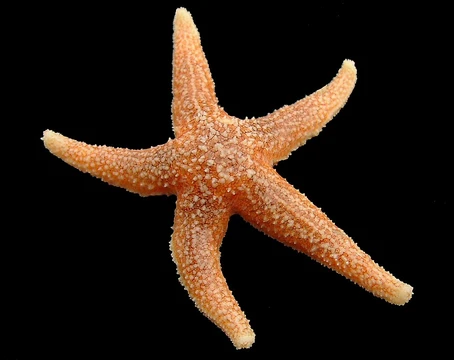
Luidia superba
Probably the largest five-armed starfish in the world.

Luidia superba is a tropical species of starfish in the family Luidiidae. It is notable for being probably the largest five-armed starfish in the world, with a maximum recorded radius of 41.5 centimetres. The species is endemic to the eastern Pacific, found off the Pacific coast of Colombia and in the Galapagos Islands.
Quick Facts
- Taxon
- Luidia superba
Facts from the source article.
Lore & Background
A single specimen of Luidia superba was first found off the Pacific coast of Colombia in 1888 by researchers aboard the vessel R. V. Albatross at a depth of 66 metres. This holotype had six arms, which for many years led to the mistaken belief that six arms were normal for the species. This specimen was described by A. H. Clark in 1917 and for a long time was the only known example of the species. Later, in 1977, several specimens were observed at night on the seabed of Tagus Cove, Isabela Island, in the Galapagos Islands, at depths of 9 to 18 metres. During the day, these starfish bury themselves under about 10 centimetres of sand, leaving only a depression as a clue. In 1977, they were quite common there, with about one individual per 10 square metres of seabed. Additional specimens were recorded during the Cortez 1, 2 and 3 cruises in 1982 and 1985.
Reader's Guide
Luidia superba holds significance as a large, endemic starfish of the eastern Pacific, with its discovery history illustrating how a single aberrant specimen can shape scientific understanding for decades. The holotype's six arms caused a long-standing misconception about the species' normal limb count. Its size is remarkable: the largest specimen from Tagus Cove had a radius of 41.5 centimetres, surpassing other large Luidia species such as Luidia magnifica (38 cm) and Luidia savignyi (37 cm). The species' habitat at Tagus Cove benefits from upwelling of the nutrient-laden Equatorial Undercurrent, which may encourage gigantism. However, after the severe El Niño event of 1982–83, Luidia superba was no longer found in its previous location in Tagus Cove, and its fate in the Galapagos Islands remains unclear. The species is likely an opportunistic predator and scavenger, based on related species that feed on bivalve molluscs, brittle stars and sea urchins, though stomach examinations of three specimens found only a few sea urchin spines.
Did You Know?
- The holotype of Luidia superba had six arms, which led to the mistaken belief that six arms were normal for the species.
- During the day, Luidia superba buries itself under about 10 centimetres of sand, leaving only a depression on the surface.
More in Starfish, Part 2 1-24
Spotted an error? Know more?
Reader corrections go straight into our review queue. Suggest an edit · How this site is sourced