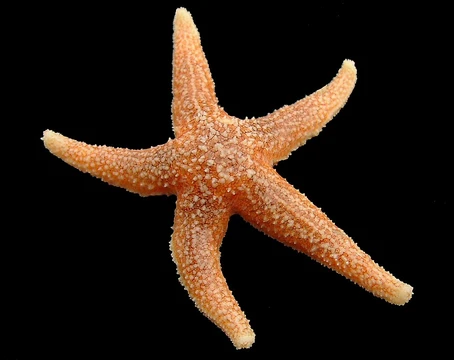
Luidia savignyi
A large, swift starfish that swallows its prey whole.

Luidia savignyi is a species of starfish in the family Luidiidae, found in the tropical and subtropical Indo-Pacific region. It is notable for its large size, rapid movement, and predatory behavior toward other echinoderms, which it swallows whole without stomach eversion.
Quick Facts
- Genus
- Luidia
- Species
- savignyi
Facts from the source article.
Lore & Background
Luidia savignyi is a large starfish, with the distance between the tips of extended arms sometimes reaching about 30 cm. It usually has six or seven slender arms with pointed tips attached to a relatively small central disc. The aboral surface is rough and granular, covered with paxillae—vertical columns tipped by clusters of tiny spines, often with a single larger orange spine in the center. Its color is highly variable between individuals, being greyish with beige, burgundy, greenish, or brownish spots and patches. On the oral surface, an ambulacral groove runs along each arm, lined with tube feet tipped with suckers, and the arms are clad with clawed pedicellaria. A rim of large, thick spines grows on the margin between the aboral and oral surfaces.
The species is native to the tropical and subtropical Indo-Pacific, from the Red Sea and East African coast to the Philippines and New Caledonia. It inhabits uncompacted sandy-mud but also frequents rock slabs covered with coral rubble and algae, at depths down to about 30 m. It is largely nocturnal and can move very quickly due to its long arms, and it can bury itself efficiently in sediment. It preys on sea urchins, irregular urchins, and starfish, particularly Astropecten polyacanthus. It almost appears to run after its prey, and other species flee at its approach. Unlike many starfish, it does not invaginate its stomach but stretches its mouth wide and swallows prey whole; the small disc becomes swollen and distorted after a large meal. When it attacks certain starfish such as Protoreaster nodosus and Nardoa gomophia, it soon abandons the potential prey. In contrast to the related Luidia maculata, no useful chemical substances have been discovered in its tissues.
Reader's Guide
Luidia savignyi holds significance as a large, fast-moving predator in Indo-Pacific benthic communities, distinguished by its method of swallowing prey whole rather than using stomach eversion. Its ability to bury itself and its rapid pursuit of prey, causing other species to flee, highlight its ecological role as an active hunter. The species' variable coloration and distinctive paxillae with orange spines contribute to its identification. Notably, the article notes that no useful chemical substances have been discovered in its tissues, contrasting with the closely related Luidia maculata. This absence of known bioactive compounds may influence future research directions. The species' preference for sandy-mud and rubble habitats, and its depth range to about 30 m, define its ecological niche. Its abandonment of certain prey like Protoreaster nodosus and Nardoa gomophia suggests selective feeding behavior. Overall, Luidia savignyi exemplifies a specialized echinoderm predator with unique feeding mechanics and rapid locomotion, contributing to the diversity of starfish in its range.
Did You Know?
- Luidia savignyi can have six or seven slender arms with pointed tips.
- It swallows its prey whole instead of everting its stomach.
- The species is found at depths down to about 30 m.
More in Starfish, Part 2 1-24
Spotted an error? Know more?
Reader corrections go straight into our review queue. Suggest an edit · How this site is sourced