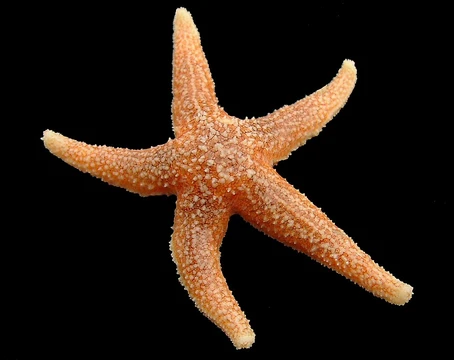
Luidia quinaria
A starfish with medicinal potential found in East Asian waters.

The spiny sand seastar, known scientifically as *Luidia quinaria*, belongs to the starfish family Luidiidae. This species inhabits the shallow waters of the China Sea and areas near the Korean archipelago. Its body contains several secondary metabolites that show medicinal promise, including an asterosaponin which could be helpful for treating coughs, asthma, and clearing mucus from airways.
Three subspecies are recognized: *Luidia quinaria bispinosa*, *Luidia quinaria chinensis*, and *Luidia quinaria quinaria*.
The starfish has a small central disc and five long, slender arms edged with short spines. The upper surface is covered with small, pillar-like spines that have flat tops, creating a smooth, table-like texture. This upper side is generally grey, with pink or orange margins along the arms. The underside is paler in color.
*Luidia quinaria* is a predator that lives in shallow water on soft sediments. In Japan’s Ise Bay, it was found throughout the bay’s oxygen-poor waters, while another starfish, *Astropecten scoparius*, stayed near the bay’s mouth. Stomach content analysis showed that *Luidia quinaria* mainly eats other echinoderms, especially the brittle star *Ophiura kinbergi*, which made up over half its diet. The other starfish mostly ate mollusks, such as the snail *Voorwindia paludinoides* and the clam *Alvenus ojianus*. These dietary differences are thought to result from varying food availability linked to different sediment types across the bay.
Quick Facts
- Taxon
- Luidia quinaria
Facts from the source article.
Lore & Background
Luidia quinaria has a small central disc and five long slender arms fringed with short spines. The aboral surface is covered in small paxillae, pillar-like spines with flat tops giving a smooth, table-like surface. Its general colour is grey with contrasting pink or orange margins to the arms, while the oral surface is paler. Three subspecies are recognized: Luidia quinaria bispinosa, Luidia quinaria chinensis, and Luidia quinaria quinaria.
This starfish is a predator found in shallow water on soft sediments. In Ise Bay in central Japan, it lived throughout the oxygen-poor waters while another starfish, Astropecten scoparius, occupied a separate zone near the mouth of the bay. Examination of stomach contents showed that Luidia quinaria largely fed on other echinoderms, particularly the brittle star Ophiura kinbergi, which formed more than half of its diet. The other starfish consumed molluscs such as the snail Voorwindia paludinoides and the clam Alvenus ojianus. Differences in diet were attributed to varying availability of food items due to sediment type.
Reader's Guide
Luidia quinaria is notable for its presence in oxygen-poor waters of Ise Bay, where it coexists with Astropecten scoparius but occupies a different zone. Its diet, dominated by the brittle star Ophiura kinbergi, contrasts sharply with the mollusc-based diet of its neighbor, highlighting how sediment variation influences prey availability. The species has drawn scientific interest due to several biologically active steroids isolated from its tissues. One such compound, an asterosaponin, may prove useful in the treatment of coughs and asthma and may help clear mucus from airways. This medicinal potential, combined with its ecological role as a predator in shallow soft-sediment habitats, makes it a subject of ongoing research. The three recognized subspecies reflect geographic variation across its range in the China Sea and Korean archipelago.
Did You Know?
- Its diet consists largely of the brittle star Ophiura kinbergi.
- An asterosaponin from its tissues may help treat coughs and asthma.
- It lives in oxygen-poor waters of Ise Bay, unlike the related Astropecten scoparius.
Frequently Asked Questions
Who is Luidia quinaria?
Luidia quinaria is a spiny sand seastar in the Luidiidae family, native to the shallow waters of the China Sea and the Korean archipelago. It is easily recognized by its small central disc and five long, slender arms lined with spines.
What are Luidia quinaria's powers or special abilities?
This starfish produces several secondary metabolites, most notably an asterosaponin that researchers are exploring as a treatment for coughs, asthma, and clearing mucus from the airways. In its ecosystem it also acts as a predator, feeding primarily on other echinoderms such as the brittle star Ophiura kinbergi.
Why is Luidia quinaria important to fans and scientists?
Its asterosaponin compound shows genuine pharmacological promise for respiratory medicine, potentially easing symptoms of coughs and asthma. Ecologically, it also helps regulate populations of other echinoderms in its native waters, making it a keystone small predator.
What subspecies of Luidia quinaria are recognized?
Three subspecies are currently acknowledged: Luidia quinaria bispinosa, Luidia quinaria chinensis, and Luidia quinaria quinaria. They all share the same basic body plan of a small disc with five spiny arms but differ in fine morphological details.
More in Starfish, Part 2 1-24
Spotted an error? Know more?
Reader corrections go straight into our review queue. Suggest an edit · How this site is sourced