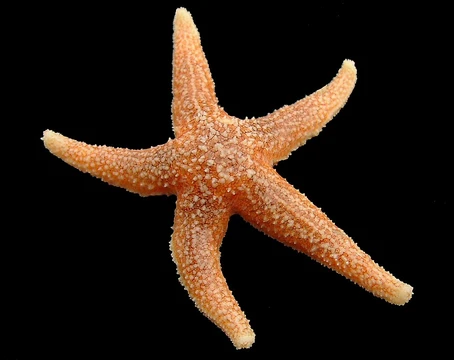
Henricia sanguinolenta
A colorful sea star that broods its eggs under its disk.

The northern henricia is a sea star found in the North Atlantic and North Pacific Oceans. It can be red, yellow, orange, purple, or lavender. It closely resembles *Henricia oculata* (the "bloody Henry"), and only lab tests can tell them apart.
This sea star lives from the shoreline down to 2,414 meters deep. It is often seen on beaches, under rocks, in tide pools, and on gravel in coastal and benthic zones. It almost always stays near sponges and coral, because the currents those creatures create help it filter feed.
*Henricia sanguinolenta* is both a planktivore and a carnivore. It filter-feeds on detritus and plankton, using sponge or coral currents. Its diet includes plankton, sponge tissue, ascidians, and other invertebrates. Vertebrates eat it.
It reproduces both sexually and asexually. Sexually, it is a stable gonochoric species that usually breeds in February and May. The sea stars migrate to warm, shallow water to mate through disk fusion. The female keeps fertilized eggs under her disk, then deposits them on the ground, covers them with mucus, and stays on top of them for three weeks until they hatch. They are polygamous and have a diploid chromosome number of 36. Asexually, it regenerates: if the disk splits in half or a ray is cut off, it can regrow over weeks to months.
The body has five slender rays that taper evenly to tips, connected by a central disc. It grows 5 to 12 centimeters across. The oral side of each ray is smooth, with an ambulacral groove holding two rows of tube feet. The dorsal side is rough, with groups of spinelets—each having three to six glassy points. The ray sides are curved and smooth. The ray tips have dark eyespots that sense light. The rays also hold parts of the pyloric stomach, parts of the nervous system, and most other organs.
The tube feet rows use a chemical adhesive (not suction) to stick to surfaces, helping the sea star grip prey and bring it to the mouth. They also aid gas exchange, are sensitive to chemicals (so the star can follow food trails), and excrete waste ammonia through diffusion.
There is no brain, and no capacity for planning. The nervous system has a motor system and a sensory system, connected by neurons, running up and down the arms and around the disc.
Like all sea stars, it uses seawater instead of blood.
Quick Facts
- Genus
- Henricia
- Species
- sanguinolenta
Facts from the source article.
Lore & Background
Henricia sanguinolenta is an invertebrate with slender five rays that taper evenly to tips connected by a central disc. On the oral side, the rays are smooth with an ambulacral groove containing two tube foot rows; on the dorsal side, the rays are rough with groupings of spinelets, each having three to six glassy points. The tube foot rows use a chemical adhesive to stick to surfaces instead of suction, and are sensitive to chemicals, aiding in detecting prey. The sea star has no brain but possesses a motor and sensory nervous system. It pumps filtered seawater through a vascular tube system, with water entering through a sieve-like madreporite on the oral side. The body wall consists of epidermis, dermis, thin cuticle, and a thin coelomic myoepithelial layer. It has two stomachs—a cardiac stomach and a pyloric stomach—along with a small intestine and rectum leading to an anus. Papulae, small gills on the rays and disc, excrete waste ammonia. The circulatory system forms three rings of vessels: the hyponeural haemal ring, the gastric ring, and the genital ring, with a heart beating six times per minute.
Reader's Guide
Henricia sanguinolenta is a planktivore and carnivore that filter feeds upon detritus and plankton, using currents created by sponges and coral to make feeding easier. It also feeds on sponge tissue, ascidians, and other invertebrates, and is itself eaten by vertebrates. The species is a stable gonochoric that reproduces sexually through disk fusion, with females incubating eggs under their disk and then depositing them on the ground, secreting mucus, and staying on top for three weeks until hatching. It can also reproduce asexually through regeneration if the disc is split in half or a ray is cut off. The sea star is almost always found near sponges and coral in coastal and benthic zones, from depths of 0 to 2414 meters. It is one of the only sea stars that broods its eggs, with larvae staying in a dome shape created by the female's arms until ready to enter the ocean. Henricia sanguinolenta does not react to the fluid of Asterias forbesi, which is toxic to most other sea stars. It has no negative or positive impact on humans, though its bright colors may slightly affect the tourist industry.
Did You Know?
- Henricia sanguinolenta can only be distinguished from Henricia oculata by laboratory tests.
- The sea star uses a chemical adhesive in its tube foot rows instead of suction.
- It broods its eggs by keeping them under the female's disk and staying on top of them for three weeks.
- The species has a diploid chromosome number of 36.
More in Starfish, Part 2 1-24
Spotted an error? Know more?
Reader corrections go straight into our review queue. Suggest an edit · How this site is sourced