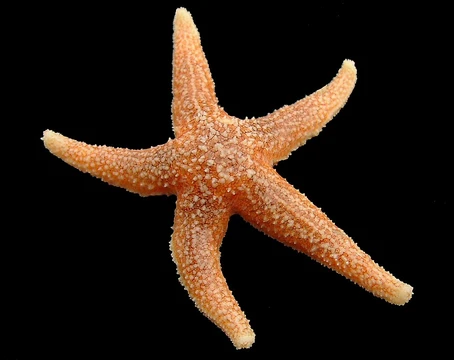
Henricia pumila
A small brooding blood star of the eastern Pacific.

The dwarf mottled henricia (Henricia pumila) is a blood star, a type of starfish belonging to the family Echinasteridae. For a long time, it was thought to be the same species as Henricia leviuscula, but in 2010 it was formally classified as its own species. What sets it apart are its small size as an adult, its habit of brooding its young externally, and certain physical traits like its mottled coloring. Its scientific name, *pumila*, is Latin for "dwarf."
This starfish lives in the cool, shallow waters of the eastern Pacific Ocean, along the North American coast from near Sitka, Alaska, down to Ensenada, Baja California. It is far less common in the Southern California region, with only a few recorded sightings near the Channel Islands, Santa Barbara, and San Diego. It is often found in the low intertidal zone, where it can be spotted in tide pools during low tide.
The dwarf mottled henricia usually has five short but slender arms that taper evenly to a blunt tip. Individuals with four or six arms are possible but rare. The top (aboral) side of its body can be orange, reddish orange, or purplish red, mottled with pale orange, cream, or lavender; the underside (oral side) is yellow or cream. Its upper surface is covered with pseudopaxillae—columnar skeletal plates topped with small spines—that have brush-like clusters of crystalline spines, giving it a textured look. Like other starfish, it moves using tube feet.
As a brooding species, the dwarf mottled henricia has been observed caring for its young from January to April. It is assumed that males and females are separate, though it may show hermaphroditism in its tissues, as some other brooding marine invertebrates do. After eggs are released through openings on the underside, the brooding parent curls its arms around a raised oral disc, keeping the embryos there until they emerge as free-crawling juveniles.
Quick Facts
- Taxon
- Henricia pumila
Facts from the source article.
Lore & Background
Previously considered conspecific with Henricia leviuscula, H. pumila was officially recognized as a separate species in 2010. Its small adult size, external brooding method of reproduction, and details in its morphology, such as its mottled appearance, distinguish it from H. leviuscula. Its specific epithet, pumila, comes from the Latin for 'dwarf'.
H. pumila occurs in the cool, shallow waters of the eastern Pacific Ocean, ranging along the North American coast from near Sitka, Alaska, to Ensenada, Baja California. It is much less common in the Southern Californian stretch of its range, with only a handful of sightings along the coasts of the Channel Islands, Santa Barbara, and San Diego. It is often observed in the low intertidal, where it can be spotted in tide pools at low tide.
The dwarf mottled henricia typically has five short, yet slender arms which evenly taper to a blunt tip. Four- or six-armed individuals may occur, but are rare. The aboral side of its body ranges from orange, reddish orange, or purplish red in color, mottled with pale orange, cream, or lavender; its oral side is yellow or cream. Its aboral surface is dotted with pseudopaxillae bearing brush-like clusters of crystalline spines, lending it a textured appearance. Like other starfishes, H. pumila locomotes using tube feet.
Reader's Guide
The dwarf mottled henricia is significant as a brooding species that was long confused with Henricia leviuscula until its formal recognition in 2010. Its small adult size and mottled coloration are key identifying features. The species is notable for its reproductive behavior: it broods its young from January to April, with the parent spiraling its arms around a raised oral disc to protect the embryos until they emerge as free-crawling juveniles. It is assumed that H. pumila has distinct sexes, but it may display hermaphroditism in its tissues, as seen in some other brooding marine invertebrates. Its distribution along the eastern Pacific coast, from Alaska to Baja California, is well documented, though it is rare in Southern California. The species' reliance on low intertidal tide pools makes it accessible to observers, contributing to its study and recognition as a distinct taxon.
More in Starfish, Part 2 1-24
Spotted an error? Know more?
Reader corrections go straight into our review queue. Suggest an edit · How this site is sourced