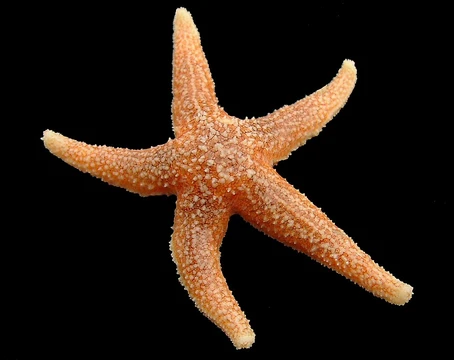
Henricia oculata
A five-armed starfish native to northwestern Europe, first described in 1777.

Henricia oculata, called the bloody Henry starfish, belongs to the family Echinasteridae. This starfish lives in northwestern Europe. British zoologist Thomas Pennant first described it in 1777 under the name *Asterias oculata*, and it was later moved to the genus *Henricia*.
The name *Henricia oculata* means "eyed Henry" in Latin. It has five arms and reaches about 12 cm (5 in) across. Its body is fairly stiff, and the upper surface feels rough because of many low spines beneath the skin. Color varies—dark red, brown, purple, or yellowish—and the outer parts of the arms are sometimes paler than the center and inner arm sections. It closely resembles *Henricia sanguinolenta* but usually has more irregularly arranged, more opaque dorsal spinelets.
This species appears in the northeastern Atlantic, mainly around the United Kingdom and Ireland. It also occurs in Guernsey, Jersey, and northern France, with isolated records from Norway and the United States. It is most common on the western coasts of the British Isles, living on rock, boulders, stones, shingle, gravel, and shelly bottoms. Its depth range goes from the low intertidal zone down to 50 m (160 ft) or deeper.
*H. oculata* is mostly a suspension feeder, taking in suspended organic particles, detritus, sponges, hydroids, and bryozoans. It can also evert its stomach to feed on other invertebrates. Over 90% of individuals host a parasitic copepod, *Asterocheres lilljeborgi*.
Quick Facts
- Genus
- Henricia
- Species
- oculata
Facts from the source article.
Lore & Background
Henricia oculata, whose Latin name translates as 'eyed Henry,' is a five-armed starfish growing to about 12 cm in diameter. Its aboral surface feels rough due to numerous low spines under the skin. The species is variable in color, appearing dark red, brown, purple, or yellowish, with the outer portions of the arms sometimes paler than the disc and inner portions. It closely resembles Henricia sanguinolenta but tends to have more irregularly arranged dorsal spinelets that are more opaque.
The species is found in the northeastern Atlantic Ocean, mainly around the coasts of the United Kingdom and Ireland, as well as in Guernsey, Jersey, and northern France. Isolated occurrences have been reported in Norway and the United States. It is most common on the western coasts of the British Isles and inhabits rock, boulders, stones, shingle, gravel, and shelly substrates, from the low intertidal down to 50 m or more.
Primarily a suspension feeder, H. oculata consumes suspended organic particles, detritus, sponges, hydroids, and bryozoans. It can also evert its stomach to feed on other invertebrates. More than 90% of individuals are associated with a parasitic copepod, Asterocheres lilljeborgi.
Reader's Guide
Henricia oculata holds significance as a well-documented species of starfish in northwestern European waters, first described by Thomas Pennant in 1777. Its notable variability in color—ranging from dark red to purple or yellowish—and its rough, spiny upper surface distinguish it from similar species like Henricia sanguinolenta. The species is ecologically important as a suspension feeder, consuming organic particles, detritus, sponges, hydroids, and bryozoans, and can supplement its diet by everting its stomach to feed on other invertebrates. A striking ecological feature is its high association with the parasitic copepod Asterocheres lilljeborgi, found on over 90% of individuals. Its distribution centers on the British Isles and nearby coasts, with isolated records in Norway and the United States, and it occupies a variety of substrates from the low intertidal to depths of 50 m or more. The species' rigid body and irregularly arranged dorsal spinelets contribute to its identification within the genus Henricia.
Did You Know?
- Henricia oculata was first described as Asterias oculata by Thomas Pennant in 1777.
- Its Latin name translates to 'eyed Henry.'
- More than 90% of individuals host the parasitic copepod Asterocheres lilljeborgi.
More in Starfish, Part 2 1-24
Spotted an error? Know more?
Reader corrections go straight into our review queue. Suggest an edit · How this site is sourced