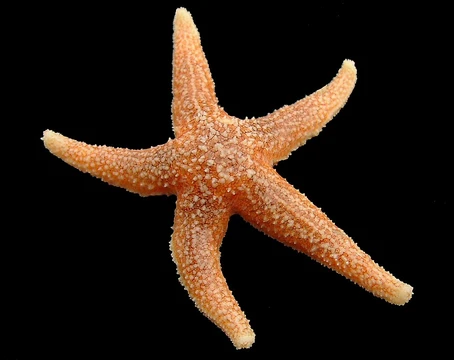
Henricia lisa
Deep-water starfish with dual-egg spawning strategy.

Henricia lisa is a deep-water starfish from the northern Atlantic Ocean, belonging to the family Echinasteridae. Like other members of its genus, it feeds by suspension, using flagellae in pouches at the base of its digestive glands to create water currents that draw in phytoplankton. These starfish are often found living with sponges, taking advantage of the water flow the sponges generate.
In the lab, Henricia lisa has been observed to spawn twice a year, triggered when seawater temperature passes through the 3 to 4 °C range. Around spawning time, individuals tend to gather together, likely to improve breeding success. The release of gametes into the water is timed with the lunar phases.
The species has an unusual reproductive strategy. Females produce two types of eggs: a small number of pale eggs are kept and brooded beneath the body, while a larger number of dark eggs are released freely into the water. It is thought that the extra pigment in the spawned eggs may protect their lipid content, helping the larvae survive.
Quick Facts
- Genus
- Henricia
- Species
- lisa
Facts from the source article.
Lore & Background
Henricia lisa is a suspension feeder, using Tiedemann pouches at the bases of its digestive glands to create water currents with flagellae, enabling efficient feeding on phytoplankton. It is often found in association with sponges, benefiting from the water currents they create. In the laboratory, Henricia lisa spawns twice a year, triggered when seawater temperature rises or falls through the 3 to 4 °C range. Around spawning time, individuals tend to aggregate, presumably to increase breeding success, and the release of gametes is synchronized with the phases of the moon. The species has an unusual breeding strategy: females produce two types of eggs. A few pale eggs are retained under the body and brooded, while larger numbers of dark eggs are freely spawned into the water column. It is hypothesized that the extra pigment in the spawned eggs may protect their lipid content and enhance larval survival.
Reader's Guide
Henricia lisa is significant as a deep-water starfish in the northern Atlantic Ocean, belonging to the family Echinasteridae. Its biology highlights a specialized suspension-feeding mechanism using Tiedemann pouches and flagellae, and its frequent association with sponges suggests an ecological reliance on sponge-generated water currents. The species' reproductive behavior is particularly noteworthy: spawning occurs twice a year, triggered by temperature shifts through a narrow 3–4 °C range, with gamete release timed to lunar phases. Its dual-egg strategy—brooding a few pale eggs while spawning many dark eggs—represents an unusual reproductive investment. The hypothesis that dark egg pigmentation protects lipid content and boosts larval survival underscores a potential adaptive advantage. These traits, documented through laboratory research, contribute to understanding reproductive diversity and ecological interactions among deep-sea starfish.
Did You Know?
- Henricia lisa spawns twice a year when seawater temperature passes through 3 to 4 °C.
- Females produce two types of eggs: pale eggs that are brooded and dark eggs that are freely spawned.
- Henricia lisa is often found in association with sponges, benefiting from their water currents.
More in Starfish, Part 2 1-24
Spotted an error? Know more?
Reader corrections go straight into our review queue. Suggest an edit · How this site is sourced