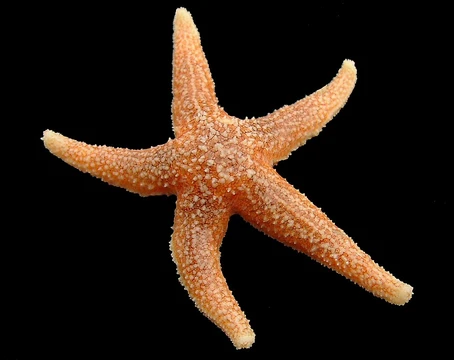
Henricia leviuscula
Pacific blood star: a small, smooth-rayed sea star of the Pacific coast.

The Pacific blood star (*Henricia leviuscula*) lives along the Pacific coast of North America, from Alaska to Baja California. Its most common color is bright orange-red, but it can range from tan to almost purple. The central disk is sometimes a mottled gray, and there may be lilac blotches forming a saddle-like mark between the rays—though the rays themselves are never mottled. It typically has five rays, occasionally four or six. The rays are smooth, lacking pedicellariae and spines. This is a relatively small sea star, usually measuring over 8 cm across and rarely exceeding 12 cm. Like all sea stars, it has a madreporite.
Reproduction is dioecious, and females are not known to brood young—though this conflicts with other reports that smaller females do brood while larger females release eggs directly into the water. This discrepancy leads biologists to suspect *Henricia leviuscula* is actually a species complex. Embryonic stages float freely and do not stick together. After hatching, the larvae are ciliated and swim. Spawned eggs measure about 1342 μm in diameter.
In a study of righting behavior, *Henricia leviuscula* twisted arms 1 and 3 toward each other, used arms 4 and 5 to support itself on the tank bottom, and raised arm 2 into a sitting-like position before flipping over. Its average righting time was 15.22 minutes.
Its habitat is the intertidal zone, under rocks and in protected spots, from the low-tide line down to about 400 m deep. It often hosts a commensal scaleworm, *Arctonoe vittata*.
There may be hybrids and possible distinct species that key to *Henricia leviuscula*. Subspecies include *Henricia leviuscula annectens* and *Henricia leviuscula leviuscula*.
It feeds mainly on sponges and small bacteria. Tiny particles are captured in mucus and swept to the mouth by ciliated tracts. It may also feed by applying its stomach to the surfaces of sponges and bryozoa.
Conservation status is not listed. Predators include humans and birds.
Quick Facts
- Genus
- Henricia
- Species
- leviuscula
Facts from the source article.
Lore & Background
Henricia leviuscula can usually be identified by its bright orange-red color, but variations from tan to almost purple occur. The disk may be mottled gray, and lilac blotches sometimes form a saddle-like marking between the rays, though the rays themselves are not mottled. The rays are smooth and appear smooth due to the lack of pedicellariae and spines. The species is relatively small, with a diameter usually over 8 cm and rarely exceeding 12 cm. As with all sea stars, it has a madreporite.
Reproduction is dioecious, and females are not known to brood young, though this statement conflicts with other sources stating that smaller females brood their young while larger females discharge eggs directly into the water. This discrepancy is one reason biologists believe Henricia leviuscula may be a species complex. Embryonic stages float freely, and post-hatching larvae are ciliated and swim. Spawned eggs have been measured at 1342 μm in diameter.
In a study of righting behavior, Henricia leviuscula twisted arms 1 and 3 toward each other, used arms 4 and 5 to support itself, and moved arm 2 up into a sitting-like position before flipping over, with an average righting time of 15.22 minutes. Its range extends from Alaska to Baja California, and its habitat is the intertidal zone under rocks and protected places from the low-tide line to about 400 m deep. It often hosts a commensal scaleworm, Arctonoe vittata.
Reader's Guide
Henricia leviuscula, the Pacific blood star, is a small sea star of the northeastern Pacific, notable for its smooth rays and variable coloration from bright orange-red to tan or purple. Its reproductive biology is a point of scientific interest: while the article states that females are not known to brood young, it also notes conflicting reports that smaller females brood and larger females release eggs directly into the water. This contradiction has led biologists to suspect that Henricia leviuscula may actually be a species complex, with possible hybrids and distinct species keying to this name. Subspecies recognized include Henricia leviuscula annectens and Henricia leviuscula levivuscula. The species feeds mainly on sponges and small bacteria, capturing particles in mucus and sweeping them to the mouth via ciliated tracts, or by applying its stomach to sponge and bryozoan surfaces. Its predators include humans and birds. The article lists numerous synonyms, including Chaetaster californicus, Cribrella laeviuscula, and Linckia leviuscula, reflecting a history of taxonomic revision. The species is not listed for conservation status.
Did You Know?
- The Pacific blood star's rays are smooth due to the lack of pedicellariae and spines.
- Its average righting time in a study was 15.22 minutes.
- Spawned eggs of Henricia leviuscula have been measured at 1342 μm in diameter.
- The species often has a commensal scaleworm, Arctonoe vittata.
More in Starfish, Part 2 1-24
Spotted an error? Know more?
Reader corrections go straight into our review queue. Suggest an edit · How this site is sourced