Echinasteridae
A family of starfish with eight genera and about 133 species.

The Echinasteridae are a family of starfish that make up the entire order Spinulosida. This group contains eight genera and roughly 133 species, all of which live on the seafloor in a wide range of habitats across the globe.
In terms of classification, the two largest genera are *Echinaster* and *Henricia*, each containing many closely related species that form species complexes. *Echinaster* species are mostly found in warm, shallow tropical waters, including continental shelves. *Henricia*, on the other hand, lives worldwide, typically in cold waters such as polar regions and deep abyssal zones. Two other genera, *Aleutihenricia* and *Odontohenricia*, are native to the northeastern Pacific near the Aleutian Islands.
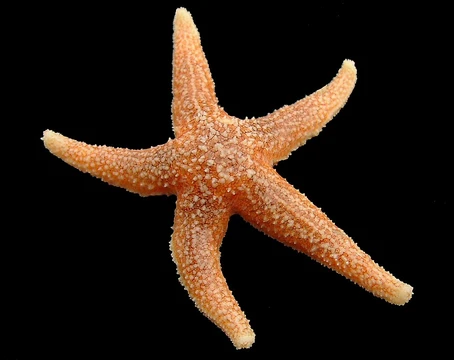
Physically, most echinasterids have five long, slender, often cylindrical arms attached to a thick but small central disc. Both the upper and lower surfaces are covered by a lattice of ossicles, which can be flat or rounded plates, or peg-like plates with broad bases. The mouth is ringed by tight-fitting triangular plates. The openings for the tube feet are small, and the plates alongside the ambulacral grooves are angular and spiny. These starfish lack pedicellariae.
Ecologically, echinasterids are epifaunal, living on the seabed atop rock, sand, gravel, or mud. They feed by grazing on encrusting invertebrates like sponges, tunicates, and molluscs, and also consume detritus. *Echinaster* species can use cilia to create a water current that draws zooplankton and organic particles into the mouth, while *Henricia* species act as scavengers and filter feeders.
Reproduction involves separate sexes. Females produce large, yolky eggs that develop into brachiolaria larvae. In some species, these larvae are planktonic, but in others, the female broods her young in a chamber beneath her arms. *Echinaster luzonicus* is notable for reproducing solely through autotomy—shedding its arms and regenerating a new disc from a single arm. Another species, *Henricia sexradiata*, also reproduces asexually, but by splitting its disc apart.
The recognized genera are: *Aleutihenricia*, *Dictyaster*, *Echinaster*, *Henricia*, *Metrodira*, *Odontohenricia*, *Plectaster*, and *Rhopiella*.
Quick Facts
- Taxon
- Echinasteridae
Facts from the source article.
Lore & Background
Echinasteridae contains eight genera and about 133 species. The two genera Echinaster and Henricia are the most speciose, forming species complexes. Echinaster has a largely tropical distribution and occurs in shallow seas including continental shelves, while Henricia is cosmopolitan, occurring mostly in cold waters, including polar habitats and abyssal locations. Aleutihenricia and Odontohenricia are native to the northeastern Pacific Ocean, in the vicinity of the Aleutian Islands.
Echinasterids are mostly five-armed starfish with thick but small discs, and long, slender, often cylindrical arms. The cuticle is covered on both the aboral and oral surfaces by a latticework of ossicles which are either flattened or rounded plates, or pseudopaxilliform plates with broad bases. The mouth is surrounded by tight-fitting triangular plates. The pores through which the tube feet project are small and the plates on either side of the ambulacral grooves are angular and bear spines. Echinasterids do not have pedicellariae.
Echinasterids are epifaunal animals that live on the seabed, on rock, sand, gravel or mud. They graze on encrusting invertebrates such as sponges, tunicates and molluscs, as well as feeding on detritus. Additionally, Echinaster uses cilia to create a current to draw zooplankton and organic particles into its mouth. Henricia is a scavenger and a filter feeder. The sexes are separate. The eggs are large and yolky and development is by way of brachiolaria larvae. In some species these are planktonic, but in others, the females brood their young in a brood chamber under their arms. Echinaster luzonicus is renowned for shedding its arms in autotomy, being then able to regenerate a new disc from a single arm; this is a form of asexual reproduction and E. luzonicus is not known to reproduce in any other way. Another echinasterid that reproduces asexually is Henricia sexradiata, but in this case, the disc also splits apart.
Reader's Guide
The Echinasteridae family is significant for its global distribution and diverse ecological roles, from grazing on encrusting invertebrates to filter feeding and scavenging. The family includes species complexes in the genera Echinaster and Henricia, which exhibit contrasting habitat preferences—tropical shallow seas versus cold, polar and abyssal waters. Their reproductive strategies are notably varied: some species produce planktonic brachiolaria larvae, while others brood young under the arms. Asexual reproduction occurs in at least two species: Echinaster luzonicus reproduces solely by autotomy, regenerating a new disc from a single arm, and Henricia sexradiata reproduces by splitting the disc. The absence of pedicellariae and the presence of a latticework of ossicles are characteristic morphological features. The family is also notable for containing genera with restricted ranges, such as Aleutihenricia and Odontohenricia, which are native to the northeastern Pacific near the Aleutian Islands. The World Register of Marine Species recognizes eight genera within the family.
Did You Know?
- Echinasteridae is the only family in the order Spinulosida.
- Echinaster luzonicus reproduces only by autotomy, shedding arms to regenerate new discs.
- Henricia sexradiata reproduces asexually by splitting its disc.
- Echinasterids lack pedicellariae.
More in Starfish, Part 2 1-24
Spotted an error? Know more?
Reader corrections go straight into our review queue. Suggest an edit · How this site is sourced