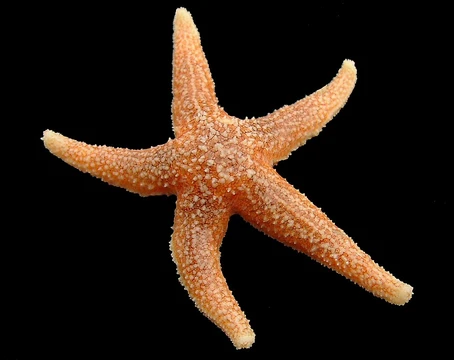
Cryptasterina pentagona
A pentagonal starfish that broadcasts eggs, diverging recently from a viviparous relative.

Cryptasterina pentagona is a species of starfish in the family Asterinidae, found in shallow waters in north eastern Australia. It is notable for its pentagonal shape and its life cycle as a broadcast spawner, releasing large-yolked eggs that develop into planktonic larvae, in contrast to the viviparous Cryptasterina hystera, from which it diverged only a few thousand years ago.
Quick Facts
- Taxon
- Cryptasterina pentagona
Facts from the source article.
Lore & Background
Cryptasterina pentagona is a species of starfish in the family Asterinidae. Its body is pentagonal with five short rays with rounded tips, covered by an integument with ossicles arranged in a longitudinal series along the rays. Papulae are present in a row along the edge of the rays and scattered over the aboral surface, which is covered by spiky granulations. There are no pedicellariae. The oral surface is flat, while the aboral surface forms a low dome.
Reader's Guide
Cryptasterina pentagona is significant as a broadcast-spawning species whose life cycle contrasts sharply with that of the very similar Cryptasterina hystera, which is viviparous. The two species appear to have diverged from a common ancestral line only a few thousand years ago, making them a notable example of recent evolutionary divergence. Its range in Australia extends from Mission Beach to Airlie Beach, though reports further south may be misidentifications with C. hystera, which is morphologically very similar but has been confirmed as a separate species through molecular data. The species' reproductive strategy involves the release of buoyant, golden, yolky eggs that are fertilized externally, developing into brachiolaria larvae that rise to the surface, then sink to the seabed to explore before metamorphosis at about nine days. Juveniles emerge as miniature five-rayed starfish with two pairs of tube feet per ray, amber in color from yolk reserves, and their mouths do not open for another three weeks.
Did You Know?
- Its larvae undergo metamorphosis at about nine days old.
- It diverged from the viviparous Cryptasterina hystera only a few thousand years ago.
More in Starfish, Part 2 1-24
Spotted an error? Know more?
Reader corrections go straight into our review queue. Suggest an edit · How this site is sourced