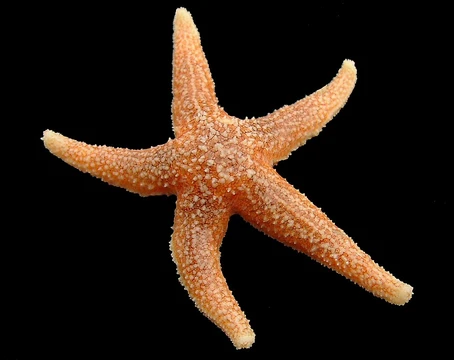
Cryptasterina hystera
A recently diverged, viviparous starfish from coastal Australia.

Cryptasterina hystera is a species of starfish native to a limited region of the Australian coast. It is notable for its recent divergence from a common ancestral line with Cryptasterina pentagona, from which it is morphologically very similar but reproductively distinct.
Quick Facts
- Taxon
- Cryptasterina hystera
Facts from the source article.
Lore & Background
Cryptasterina hystera is found in a limited region of the Australian coast, specifically around the shores and islands of Statue Bay in south east Queensland. It typically occurs under rocks and among mangroves in the upper intertidal zone. The species is very similar in appearance to Cryptasterina pentagona, and the two appear to have diverged from a common ancestral line a few thousand years ago.
Biologically, Cryptasterina hystera is a hermaphrodite; its gonads, known as ovotestes, can produce both sperm and eggs. Fertilization occurs when sperm liberated by another starfish is drawn into the gonad through the gonoduct. The eggs are few in number, have large yolks, and are retained inside the starfish, which is viviparous. The brachiolaria larvae that develop inside the gonads swim in the fluid there and are eventually released into the sea through the gonopore as juvenile starfish.
Members of the family Asterinidae appear prone to rapid change in their reproductive life cycle, and Cryptasterina hystera is one of several species that has recently diverged from its ancestral line. It has recently been recognised as a separate species from Cryptasterina pentagona, a morphologically similar species but with a different native range and a different method of reproduction.
Reader's Guide
Cryptasterina hystera holds significance as a recently diverged species within the family Asterinidae, illustrating the potential for rapid reproductive evolution. Its separation from Cryptasterina pentagona, a morphologically similar species, occurred only a few thousand years ago, highlighting a relatively recent speciation event. The species is notable for its viviparous reproduction, in which few, large-yolked eggs are retained and larvae develop inside the gonads before being released as juveniles. This contrasts with the reproductive method of its close relative, Cryptasterina pentagona. A research study demonstrated that embryos removed from the gonads could develop normally in the laboratory, with larvae exhibiting behavior similar to free-spawning starfish and undergoing metamorphosis after about sixteen days. This suggests that the species retains the developmental capacity of its free-spawning ancestors despite its derived reproductive strategy. The limited distribution of Cryptasterina hystera—only a small number of locations on the Australian coast—further underscores its distinctiveness and the importance of its habitat in Statue Bay.
Did You Know?
- Cryptasterina hystera is a hermaphrodite with gonads called ovotestes that produce both sperm and eggs.
- It is viviparous: eggs are retained inside the starfish, and brachiolaria larvae develop there before being released as juveniles.
- The species diverged from a common ancestral line with Cryptasterina pentagona only a few thousand years ago.
- In a laboratory study, embryos removed from the gonads developed normally and underwent metamorphosis after about sixteen days.
More in Starfish, Part 2 1-24
Spotted an error? Know more?
Reader corrections go straight into our review queue. Suggest an edit · How this site is sourced