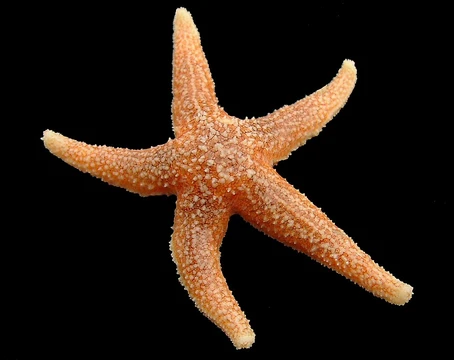
Asterinidae
A family of small, cryptic sea stars with crescent-shaped plates.

The Asterinidae are a large family of sea stars in the order Valvatida. They are generally small, flattened dorsally, with very short arms that often give a pentagonal shape, though some species possess more than five arms. Their aboral face is formed by crescent-shaped plates, sometimes giving a 'knitted' appearance to the skin.
Quick Facts
- Taxon
- Asterinidae
Facts from the source article.
Lore & Background
The Asterinidae are characterized by their small size, flattened body, and very short arms, often resulting in a pentagonal outline. The periphery is thin and formed by indistinct, tiny marginal plates. Their aboral face features crescent-shaped plates that can give a knitted appearance. Abyssal species, such as those in the genus Anseropoda, can be larger, exceeding 45 cm in diameter.
Most species are cryptic, hiding under rocks or in crevices. Several species reproduce asexually through fissiparity, which can lead to spontaneous proliferation in aquariums from a single inadvertently imported larva, as seen in Meridiastra and Aquilonastra. Some species, like Asterina pancerii, brood their young, bypassing a planktonic larval stage.
Feeding typically involves evaginating the stomach onto food fragments or algal and bacterial mats. However, Stegnaster inflatus uses its webbed shape to form a trap, rising on arm tips and falling onto prey seeking shelter. The family is found in almost all seas, from abysses to surface waters and from poles to tropics.
Reader's Guide
The Asterinidae are notable for their diverse reproductive strategies and global distribution. Their small, cryptic nature makes them common under rocks and in crevices, and their ability to reproduce asexually via fissiparity allows some species to proliferate rapidly in aquariums. The family includes both species that brood their young and those that pass through a planktonic larval stage. Feeding varies from typical stomach evagination on organic mats to the unique trap behavior of Stegnaster inflatus. Taxonomic uncertainty exists: O'Loughlin & Waters (2004) recognize 21 genera and 116 species, while the World Asteroidea Database lists 25 genera and 150 species. The family's morphological hallmark—crescent-shaped aboral plates—and its presence across all marine habitats underscore its ecological adaptability. The genera list includes 27 named genera, reflecting ongoing revision.
Did You Know?
- Some Asterinidae species can reproduce asexually by fissiparity, allowing them to proliferate from a single larva in aquariums.
- The abyssal genus Anseropoda can exceed 45 cm in diameter, unlike most small, pentagonal members of the family.
- Asterina pancerii broods its young, so they do not pass through a planktonic larval stage.
More in Starfish, Part 2 1-24
Spotted an error? Know more?
Reader corrections go straight into our review queue. Suggest an edit · How this site is sourced