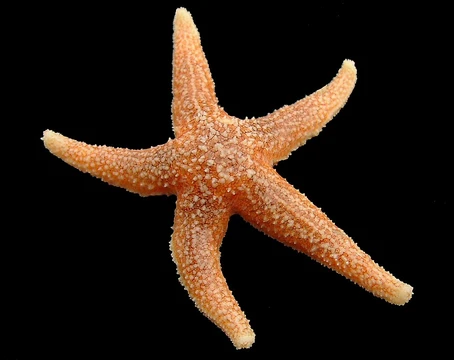
Archaster typicus
A starfish that performs pseudocopulation and buries in sand.

Archaster typicus is a species of starfish in the family Archasteridae, commonly known as the sand star or sand sifting star, though these names are also applied to starfish in the genus Astropecten. It is found in shallow waters in the Indo-Pacific region and is notable for its pseudocopulation behavior, which is unusual among starfish.
Quick Facts
- Genus
- Archaster
- Species
- typicus
Facts from the source article.
Lore & Background
Archaster typicus is a five-limbed star with long, slightly tapering arms and pointed tips, though occasionally three, four, or six-armed individuals occur. Adults grow to 12 to 15 centimetres in diameter, with males often smaller than females. It is adapted to life on the sandy seabed, burying in sediment during high tides and moving over the surface during low tides. The general colour is grey or brownish with darker and lighter patches, sometimes forming a chevron pattern; the underside is pale. The body is slightly inflated with a whitish madreporite near the centre of the disc. Small armour plates on the upper surface of the arms are lined in neat parallel rows, distinguishing it from the similar Astropecten polyacanthus. The marginal fringe spines are short, flat, and blunter than those of A. polyacanthus, and the tube feet have suckers.
It is found in the western Indian Ocean and Indo-Pacific at depths down to 60 metres, including the Maldive Islands, Bay of Bengal, Singapore, northern Australia, New Caledonia, the Philippines, China, southern Japan, and Hawaii. It inhabits areas with soft sediments such as sand, silt, and seagrass meadows. Larval settlement occurs among mangroves, and individuals gradually move to seagrass and sandy habitats as they age.
Archaster typicus is a detritivore, eating detritus and anything edible it encounters. To feed, it everts its stomach through its mouth on the underside, engulfs the food, and returns the stomach to its normal position. It is a broadcast spawner, but unlike most starfish, it performs pseudocopulation. About two months before spawning, starfish congregate, with males becoming more mobile. A starfish can distinguish male from female, probably by chemotactic recognition. The male climbs on top of the female and may remain for two months, synchronizing gonadal activity so that when the female releases eggs, the male releases sperm almost simultaneously. Mating occurs in September and October in the Philippines, with pair densities reaching up to 7 pairs per square meter during full moon and none during new moon.
Reader's Guide
Archaster typicus holds significance as a starfish that exhibits pseudocopulation, a rare behavior among echinoderms. The article describes how males climb onto females for up to two months, synchronizing gamete release to increase fertilization success. This behavior is notable because most starfish are broadcast spawners without such pairing. The species also plays a role in its ecosystem as a detritivore, consuming detritus and organic matter on sandy seabeds. Its ability to bury during high tides and emerge during low tides reflects its adaptation to intertidal and shallow subtidal environments. The article notes that its neat parallel rows of armor plates distinguish it from the similar Astropecten polyacanthus, which shares its habitat and coloring. The species' range across the Indo-Pacific, from the Maldives to Hawaii, and its occurrence in mangroves, seagrass meadows, and sandy areas, highlight its ecological flexibility. The documented mating season in the Philippines and the correlation of pair density with lunar phases provide specific insights into its reproductive ecology. Overall, Archaster typicus is a key example of behavioral and morphological adaptation in shallow-water starfish.
Did You Know?
- Archaster typicus performs pseudocopulation, with males climbing on top of females for up to two months before spawning.
- It can occasionally have three, four, or six arms instead of the usual five.
- Pair densities reach up to 7 pairs per square meter during full moon in the Philippines, but none during new moon.
- Its tube feet have suckers, not points, distinguishing it from some similar starfish.
More in Starfish, Part 2 1-24
Spotted an error? Know more?
Reader corrections go straight into our review queue. Suggest an edit · How this site is sourced