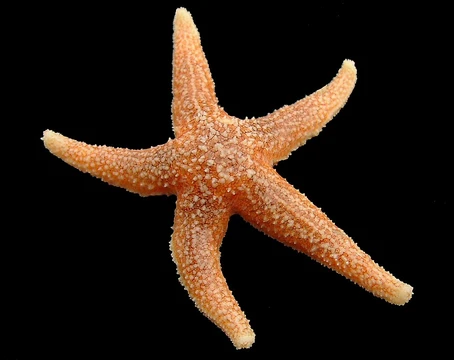
Aquilonastra conandae
A small, fissiparous starfish from the Mascarene Islands.

Aquilonastra conandae is a starfish in the family Asterinidae, native to the waters around the Mascarene Islands in the Indian Ocean. It reproduces asexually through fissiparity, is very small, and lives on coral reefs in the surf zone where waves are large.
This starfish measures less than 2 cm across, with seven or eight short, rounded arms that are often irregular in length due to regeneration and fissiparity. Each arm is about 5 mm long. It has multiple madreporites and a single spine on the interradial plates. Solitary papules sit on its upper surface. Its spikes are rough, granular, and crystalline, and are conical and prominent on the arms. The colour pattern is irregular, with a grey-beige background overlaid by granular patterns of reddish or greenish tones.
In addition to sexual reproduction, which occurs at the start of summer, A. conandae reproduces by fission. Its gonopores are on the upper side. The observed sex ratio is 52 males to 93 females, though some individuals are hermaphrodites.
The species was first found at Réunion Island, on a coral reef in the breaker zone at a site called the "Watering Hole" south of La Saline les Bains, where it is abundant. It has since been recorded across all the Mascarenes, mainly Mauritius and Rodrigues, living from the surface down to 10 m depth, most often on the reef front, rocky cliffs, and volcanic flows.
Described in 2006 by Australian marine biologists P. Mark O'Loughlin and Francis Winston Edric Rowe, the species is named after Chantal Conand, who collected the material at Réunion. The type specimen, collected at Trou d'Eau, is held in the National Museum of Natural History of France under registration "IE-2013-2489". The genus name *Aquilonastra* combines Latin *aquilonis* (northern) and *astra* (star), reflecting that this genus occurs in the northern Indo-Pacific. A similar fissiparous species, *Aquilonastra chantalae*, was described in 2013 from Europa Island in the Mozambique Channel.
Quick Facts
- Genus
- Aquilonastra
- Species
- conandae
Facts from the source article.
Lore & Background
Aquilonastra conandae was first spotted at Réunion Island at the breakers on a coral reef at a section known as the 'Watering Hole' (south of La Saline les Bains), where it is abundant. It was later identified in all the Mascarenes (mainly Mauritius and Rodrigues), occurring between the surface and 10 m (33 ft) but more often on the reef front and rocky cliffs, and also on volcanic flows. The species was described in 2006 by Australian marine biologists P. Mark O'Loughlin and Francis Winston Edric Rowe, based on material collected by Chantal Conand, after whom it is named. Its type specimen was collected in Trou d'Eau and is housed in the National Museum of Natural History of France under registration 'IE-2013-2489'. The genus name Aquilonastra comes from Latin aquilonis (meaning northern) and astra (meaning star), referring to the genus being found in the northern part of the Indo-Pacific. A similar fissiparous species, Aquilonastra chantalae, was discovered on Europa Island in the Mozambique Channel and described in 2013.
Reader's Guide
Aquilonastra conandae is significant as a small, fissiparous starfish that reproduces both sexually and asexually, with fission occurring at the beginning of summer. Its gonopores are located on the upper side, and the observed sex ratio is 52 males per 93 females, with some specimens being hermaphrodites. The species is discrete and camouflaged, with an irregular pattern of colours showing a grey-beige background with granular patterns of reddish or greenish. It has seven or eight short, rounded arms, often irregular in length due to regeneration and fissiparity, and possesses multiple madreporites, a single spine on the interradial plates, solitary papules on top, and rough, granular, crystalline spikes that are conical and prominent on the arms. Its legacy includes being named after Chantal Conand, who collected the type material, and it is part of a genus found in the northern Indo-Pacific. A similar species, Aquilonastra chantalae, was later described from Europa Island.
Did You Know?
- Aquilonastra conandae reproduces by fission in addition to sexual reproduction.
- The species has a sex ratio of 52 males per 93 females, with some hermaphrodites.
- Its type specimen is registered as 'IE-2013-2489' at the National Museum of Natural History of France.
More in Starfish, Part 2 1-24
Spotted an error? Know more?
Reader corrections go straight into our review queue. Suggest an edit · How this site is sourced