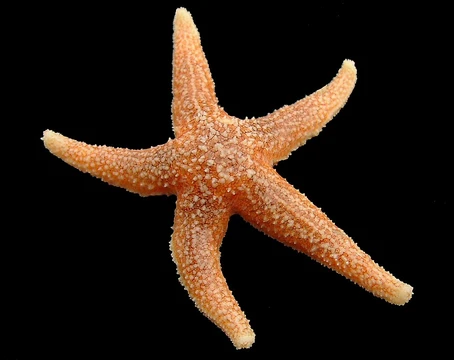
Aquilonastra chantalae
A small, fissiparous starfish from the Mozambique Channel.

Aquilonastra chantalae is a species of starfish belonging to the family Asterinidae and the genus Aquilonastra. It is notable as a fissiparous species, meaning it reproduces by fission, and exhibits a variable number of rays, typically between five and seven.
Quick Facts
- Genus
- Aquilonastra
- Species
- chantalae
Facts from the source article.
Lore & Background
Aquilonastra chantalae is a fissiparous species within the genus Aquilonastra, which typically have five rays but can have five to eight in fissiparous forms. This species generally has 5–7 rays, with six being the most prominent number and seven the rarest. The rays are discrete, with a wide basal end tapering distally to a rounded end. At a radial size of 4 mm, the star may have five rays, while smaller stars could have up to seven rays. Specimens have mostly digitiform abactinal spinelets and actinal interradial spines that are predominantly subsacciform.
As a member of the family Asterinidae, Aquilonastra chantalae shares characteristics such as a small, dorsally flattened body with short arms and a thin periphery built up by very small marginal plates. The aboral face is shaped by crescent-like plates. Most Asterinidae live sequestered in crevices and under rocks, and a great majority feed on algal or bacterial mat and other floating fragments of food. The species is found within the Mozambique Channel on the island of Europa and other scattered islands, as well as in the Indian Ocean.
Reader's Guide
Aquilonastra chantalae contributes to the understanding of fissiparous reproduction within the genus Aquilonastra, as it reproduces by fission and exhibits a variable ray count. Its description highlights the morphological diversity among small asterinid sea stars, particularly in ray number and spinelet forms. The species is named after Chantal Conand, a professor at the University of La Reunion, in recognition of her contributions to echinoderm research. Its distribution in the Mozambique Channel and Indian Ocean adds to the biogeographic knowledge of the family Asterinidae. While specific biological behaviors are not yet known, the species is presumed to share the feeding and habitat preferences of its family, such as living in crevices and under rocks and feeding on algal or bacterial mats. This entry underscores the importance of taxonomic description in documenting biodiversity, especially for small, cryptic marine invertebrates.
Did You Know?
- Aquilonastra chantalae is a fissiparous species, reproducing by fission.
- The most common number of rays in this species is six, while seven is the rarest.
- This species can be found on the island of Europa in the Mozambique Channel.
More in Starfish, Part 2 1-24
Spotted an error? Know more?
Reader corrections go straight into our review queue. Suggest an edit · How this site is sourced