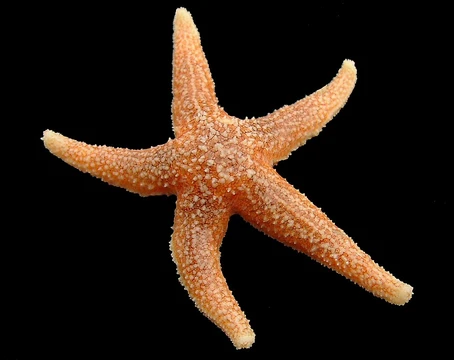
Aquilonastra burtoni
A small sea star that colonized the Mediterranean via the Suez Canal.

Aquilonastra burtoni is a small species of sea star from the family Asterinidae, originally described in 1840 by English zoologist John Edward Gray. It is notable for its Lessepsian migration from the Red Sea into the eastern Mediterranean through the Suez Canal, where the Mediterranean populations reproduce clonally via fissiparous asexual reproduction.
Quick Facts
- Taxon
- Aquilonastra burtoni
Facts from the source article.
Lore & Background
Aquilonastra burtoni was originally named Asterina burtoni by John Edward Gray from specimens collected by a Mr John Burton in the Red Sea. A second species, Asterina wega, was later used to describe a separate multi-armed form that reproduced by fissipary, while A. burtoni was reserved for the five-armed sexually reproducing form. Further studies suggest this is a complex of species: the three fissiparous Mediterranean populations have been named Aquilonastra yairi sp. nov., specimens from the Gulf of Aqaba as A. burtonii sensu stricto, and non-fissiparous specimens from Eilat as Aquilonastra marshae sp. nov., with the caveat that populations elsewhere still require proper study.
The species is small, with up to 8 rays (frequently 7), and often shows an asymmetrical form after fissiparous division, while larger specimens are typically symmetrical with 5 equal rays. It has an inconspicuous madreporite in most interradii, and the rays narrow basally to a finger-like distal part. The oral surface plates bear groups of three crowded mobile tapering spines, while dorsal plates have dense short tubercles. Its dorsal side is greenish gray with a large, irregular purplish brown central blotch surrounded by red spots at the arm bases; the arms are darker green distally with a pale median line.
Its native range includes the northwestern Indian Ocean, Red Sea, Persian Gulf, Sea of Oman, and eastern African coasts south to Zanzibar. It was first recorded in the Suez Canal in 1926 and in the eastern Mediterranean in 1966, reaching Cyprus by 2010. It is a benthic species found in shallow waters (0–10 m) under rock slabs and boulders, feeding on shade-loving animals such as sponges (Spirastrella spp., Timea spp.) and ascidians (Trididemnum, Eudistoma).
Reader's Guide
Aquilonastra burtoni is significant as a clear example of Lessepsian migration, having moved from the Red Sea into the eastern Mediterranean via the Suez Canal. Its Mediterranean populations are clonal, reproducing through fissiparous asexual reproduction, yet histological examination of those off the Israeli coast showed spermatogenesis in all mature individuals, with peak sperm production coinciding with peak fissiparous reproduction. This suggests the Mediterranean colonizers originated from a fissiparous population in the Red Sea. The species also illustrates taxonomic complexity: originally described as Asterina burtoni, it was later split into multiple species within the Aquilonastra genus, with Mediterranean fissiparous forms named Aquilonastra yairi sp. nov., Gulf of Aqaba specimens as A. burtonii sensu stricto, and non-fissiparous Eilat specimens as Aquilonastra marshae sp. nov. This unresolved status highlights ongoing debates in starfish taxonomy. Its legacy lies in demonstrating how a single species can exhibit both sexual and asexual reproduction, and how human-altered waterways facilitate biological invasions.
Did You Know?
- Aquilonastra burtoni was originally described in 1840 by English zoologist and philatelist John Edward Gray.
- Mediterranean populations of this sea star reproduce clonally through fissiparous asexual reproduction.
- The species has up to 8 rays, frequently 7, and often shows asymmetrical form after fissiparous division.
More in Starfish, Part 2 1-24
Spotted an error? Know more?
Reader corrections go straight into our review queue. Suggest an edit · How this site is sourced