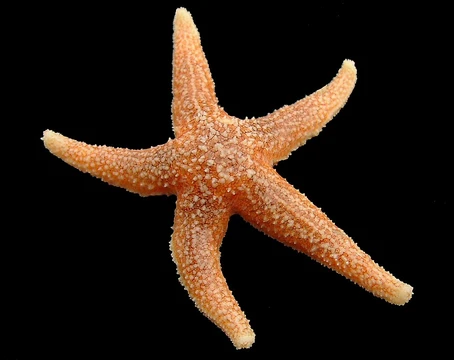
Acanthaster brevispinus
A short-spined crown-of-thorns starfish with a broad but patchy distribution.

**Acanthaster brevispinus**, commonly called the short-spined crown-of-thorns starfish, is one of only two species in the genus *Acanthaster*. Its better-known relative is *A. planci*, the common crown-of-thorns starfish.
**Physical description**
Like a typical starfish, *A. brevispinus* has a basic starfish body plan. It shares several traits with *A. planci*: a disc-shaped body, multiple arms, multiple madreporites, a flexible and prehensile body, dense spines, and a large stomach surface relative to its body mass. Its prehensile ability comes from two rows of numerous tube feet that run to the tip of each arm. Although it starts life with the usual five-fold symmetry (pentamerism) of starfish, it loses this as it matures into a multi-armed adult.
*A. brevispinus* is easily told apart from *A. planci* by several features: - Dense, blunt spines covering the upper (aboral) surface of its disc. - Short pedicellariae on the aboral surface. - A purple-brown aboral surface that becomes more intense along the arms. - Darker blotches around the edge of the disc and along the arms, including a large blotch at the base of each arm. - Pale marks on the disc between each arm. - Spines along the arms that are shorter than those of *A. planci*.
**Taxonomy**
American zoologist Walter Kenrick Fisher first described *A. brevispinus* from a specimen collected at 18 meters deep off Sirun Island in the Sulu Archipelago, Philippines. The holotype is kept at the U.S. National Museum in Washington (registration number USNM37027). In 1955, Madsen reviewed the genus *Acanthaster* and concluded there were three species: the Indo-Pacific *A. planci*; the short-armed, blunt-spined eastern Pacific *A. ellisii*; and *A. brevispinus*. Madsen suspected that *A. brevispinus* might just be part of the natural variation of *A. planci* across its wide range. Later, *A. brevispinus* was also reported from the Great Barrier Reef region. Jangoux and Aziz reported a specimen from the Seychelles, which they considered different enough from the holotype to name it *A. brevispinus seyshellesensis* nov. subsp.
**Etymology**
The genus name *Acanthaster* comes from the Ancient Greek *ákantha* ("spine, thorn") and *astḗr* ("star"). The species name *brevispinus* comes from Latin *brevis* ("short") and *spinus* ("spine").
Quick Facts
- Genus
- Acanthaster
- Species
- brevispinus
Facts from the source article.
Lore & Background
Acanthaster brevispinus was described by the American zoologist Walter Kenrick Fisher from a specimen collected at 18 m deep off Sirun Island, Sulu Archipelago, Philippines. The holotype is lodged in the U.S. National Museum, Washington, registration number USNM37027. Madsen (1955) reviewed the taxonomy of the genus Acanthaster and concluded that there were three species: the Indo-Pacific A. planci, the eastern Pacific A. ellisii, and A. brevispinus. Madsen suspected that A. brevispinus was part of the variability of A. planci over its wide geographical range. Subsequently, A. brevispinus was reported from the Great Barrier Reef region. Jangoux and Aziz reported a specimen from the Seychelles, which they considered sufficiently different from the holotype to describe as A. brevispinus seyshellesensis nov. subsp.
The body form of A. brevispinus is fundamentally the same as that of a typical starfish, but it is disc-shaped, multiple-armed with multiple madreporites, flexible, prehensile, and densely spined, with a large ratio of stomach surface to body mass. It is readily distinguished from A. planci by its dense blunt spines over the upper (aboral) surface of its disc, short pedicellaria on its aboral surface, purple-brown aboral surface becoming more intense along the arms, blotches of darker colour around the perimeter of the disc and along the arms including a large blotch at the base of each arm, pale marks on the disc between each arm, and spines along its arms which are not as long as in A. planci.
All specimens have been collected from at least moderate depth: 18 m, 20+ m and 63 m in the Seychelles. Apparently, all were collected from soft substrates, not hard substrates like coral reef. Data are minimal on the benthic communities of which they are a part. The Great Barrier Reef specimens came as an incidental bycatch of trawling inshore of the Great Barrier Reef off Townsville, from a sandy substrate. In the laboratory, the starfish were able to trap unrestrained scallops by slowly approaching over the scallop's hinge, and after trapping a scallop, they fed while adopting a characteristic arched posture. A. brevispinus is quite omnivorous, at least according to observations in the laboratory.
Reader's Guide
The significance of Acanthaster brevispinus lies primarily in its taxonomic relationship with the more widespread and destructive A. planci, and in the experimental hybridization study conducted by Lucas and Jones in 1973. This study demonstrated that A. brevispinus and A. planci are capable of interbreeding, with high fertilization rates and no evidence of gamete incompatibility. The resulting F1 hybrids showed intermediate features between the parent species, particularly in spine length, and were able to reach sexual maturity at the end of their second year. Further crosses with F1 A. planci hybrids showed high fertilization rates again, but survival was poor through early development and some morphological abnormalities occurred. The study suggests that gene flow through interbreeding could occur between the two species, though the hybrids did not show all the distinguishing features of A. brevispinus, such as the pale marks between the bases of the arms. The species' broad but patchy distribution across the Philippines, Great Barrier Reef, and Seychelles, and its collection from soft substrates at moderate depths, indicate a habitat distinct from the coral reefs typically associated with A. planci. Its ability to trap and feed on scallops, and the inheritance of this behavior by hybrids, provides insight into its ecological role and evolutionary relationships.
Did You Know?
- The specific epithet brevispinus comes from Latin brevis, meaning 'short', and spinus, meaning 'spine'.
- In laboratory experiments, A. brevispinus trapped scallops by slowly approaching over the scallop's hinge, where it was less visible.
- Hybrids between A. brevispinus and A. planci showed intermediate spine length and other features, but none showed the pale marks between the arms characteristic of A. brevispinus.
More in Starfish, Part 2 1-24
Spotted an error? Know more?
Reader corrections go straight into our review queue. Suggest an edit · How this site is sourced