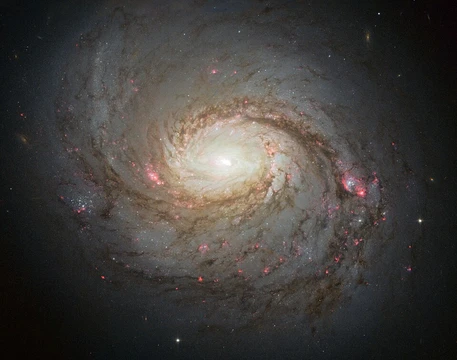
IC 485
A spiral galaxy with a debated AGN and a disc maser.

IC 485 is a spiral galaxy located in the constellation of Gemini, approximately 375 million light years from Earth. It is notable as a candidate disc-maser galaxy, hosting a broad multi-component H2O maser discovered using the Karl G. Jansky Very Large Array. The galaxy also contains a low luminous active galactic nucleus (AGN) whose classification has been debated between a LINER and a Seyfert type II galaxy, with its high X-ray luminosity supporting the latter.
- Discovered by
- Rudolf Spitaler
- Discovery date
- March 6, 1891
- Constellation
- Gemini
- Distance from earth
- 375 million light years
- Diameter
- 135,000 light years
- Morphology classification
- Sa
- Projected distance
- 122.0 ± 8.5 megaparsecs
Lore & Background
IC 485 was discovered by the Austrian astronomer Rudolf Spitaler on March 6, 1891. It has an estimated diameter of 1.35' × 0.32' arcmin, corresponding to about 135,000 light years across. The galaxy's morphology is classified as Sa, and it hosts a low luminous active galactic nucleus (AGN) with an X-ray luminosity of LX ~ 5 × 10^42 erg s−1. The nature of its AGN has been debated: it is either classified as a LINER or a Seyfert type II galaxy, but its high X-ray luminosity seems to confirm the latter.
Using the Karl G. Jansky Very Large Array, a team led by Jeremy Darling discovered a H2O maser containing a broad multi-component. The maser has a peak flux of 80 mJy with an isotopic luminosity of Liso = (868 ± 46) LΘ. Darling also found a faint unresolved radio source with an angular resolution of 90 milliarcseconds, equivalent to about 50 parsecs. In 2022, another team of astronomers studied the galaxy further and discovered two other 22 GHz H2O maser modules with a velocity separation of 472 km s−1. One module is located in the central nuclear region, while the other is at a redshifted velocity. Based on estimations of its connection with an edge-on disc, IC 485 has a black hole mass of MBH ~ 1.2 × 10^7 MΘ, and its core luminosity is estimated to be between 1 × 10^36 and 5 × 10^37 erg s−1.
Reader's Guide
IC 485 is significant as a candidate disc-maser galaxy, a relatively rare class of galaxies that host water masers in their nuclear discs, providing a tool for studying galactic dynamics and black hole masses. The discovery of its broad multi-component H2O maser using the Karl G. Jansky Very Large Array, led by Jeremy Darling, highlights the galaxy's utility in high-resolution radio observations. The subsequent detection of two additional 22 GHz H2O maser modules in 2022, with a velocity separation of 472 km s−1, further underscores its value for probing the kinematics of its central region. The galaxy's active galactic nucleus (AGN) remains a subject of debate, with its classification oscillating between a LINER and a Seyfert type II galaxy; the high X-ray luminosity tends to support the latter interpretation. The estimated black hole mass of approximately 1.2 × 10^7 solar masses, derived from its connection with an edge-on disc, and the core luminosity range of 1 × 10^36 to 5 × 10^37 erg s−1, contribute to understanding the relationship between AGN activity and host galaxy properties. IC 485 thus serves as an important case study for maser emission and AGN classification in spiral galaxies.
Did You Know?
- IC 485 was discovered by Austrian astronomer Rudolf Spitaler on March 6, 1891.
- It is a candidate disc-maser galaxy with a broad multi-component H2O maser.
- The galaxy's AGN is debated between being a LINER or a Seyfert type II galaxy.
- Its black hole mass is estimated at MBH ~ 1.2 × 10^7 solar masses.
More in Spiral Galaxies 1-24
Spotted an error? Know more?
Reader corrections go straight into our review queue. Suggest an edit · How this site is sourced