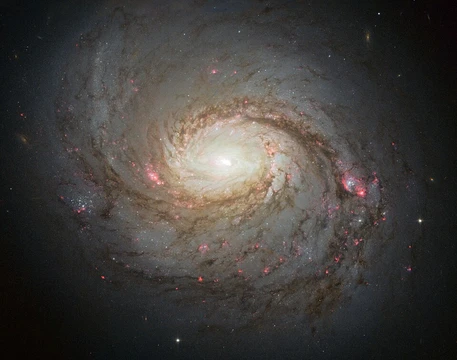
Alaknanda Galaxy
A distant spiral galaxy discovered by JWST in 2025.

The Alaknanda Galaxy (designated as UNCOVER DR3 ID 42812) is a spiral galaxy about 12 billion light years away, in the constellation Sculptor. It was discovered in 2025 with NASA's James Webb Space Telescope (JWST). It was discovered by two Indian astronomers Rashi Jain and Yogesh Wadadekar from the National Centre for Radio Astrophysics. The galaxy is notable for existing just 1.5 billion years after the Big Bang, making it an unusually early large spiral galaxy.
- Discoverers
- Rashi Jain and Yogesh Wadadekar
- Discovery institution
- National Centre for Radio Astrophysics
Lore & Background
The Alaknanda Galaxy was discovered by Rashi Jain and Yogesh Wadadekar while studying JWST images taken through 21 different filters. They spotted a galaxy remarkably similar to the Milky Way and estimated it formed when the universe was 1.5 billion years old. The discovery was published in the journal Astronomy and Astrophysics in November 2025. The galaxy lies behind the massive galaxy cluster Abell 2744. Its structure is spiral, with two sweeping arms wrapped around a bright, round central bulge spanning 10 kpc (0.033 Mly). It contains about 10 billion stars and is actively forming new stars at a rate of approximately 60 M☉ per year. The stellar mass of the galaxy is 1.58×10^10 M☉. The star formation rate in the Alaknanda Galaxy is about 20 times that of the Milky Way. It has been estimated that half of the stars in the galaxy formed in only 200 million years.
Reader's Guide
The Alaknanda Galaxy is significant as a large spiral galaxy that existed just 1.5 billion years after the Big Bang, challenging assumptions about how quickly such structures could form in the early universe. Its discovery using the James Webb Space Telescope in 2025 highlights the telescope's ability to probe the distant cosmos. The galaxy's high star formation rate—about 20 times that of the Milky Way—and its rapid formation of half its stars in 200 million years provide insight into the vigorous star-forming conditions of the early universe. Named after the Himalayan river Alaknanda, the galaxy was discovered by Indian astronomers Rashi Jain and Yogesh Wadadekar, and its findings were published in Astronomy and Astrophysics in November 2025.
Did You Know?
- It was discovered in 2025 using the James Webb Space Telescope.
- Half of its stars formed in only 200 million years.
The Discovery by Two Indian Astronomers
In 2025, two researchers at India's National Centre for Radio Astrophysics—Rashi Jain and Yogesh Wadadekar—made a finding that would reshape our understanding of early cosmic history. While carefully examining images captured by NASA's James Webb Space Telescope, they were working through data taken through twenty-one distinct filters of the instrument. It was during this meticulous review that the pair noticed a distant object whose structure strikingly resembled our own Milky Way. What they had stumbled upon was a fully formed spiral galaxy, catalogued under the survey identifier UNCOVER DR3 ID 42812. Their findings were formally presented in the peer-reviewed journal Astronomy and Astrophysics in November 2025. The discovery is particularly notable for being the work of two Indian astronomers, adding a significant chapter to the country's growing footprint in deep-space research and highlighting how the JWST's unprecedented sensitivity has opened new frontiers for researchers around the world.
Spiral Architecture and Stellar Mass
The Alaknanda Galaxy presents a textbook spiral morphology, with two long, sweeping arms that curve gracefully around a luminous, nearly spherical central bulge. That bulge stretches roughly ten kiloparsecs—about 0.033 million light-years—across, anchoring the galaxy's overall shape. Within its disk and core, an estimated ten billion stars orbit the galactic centre, giving the system a total stellar mass of approximately 1.58 × 10¹⁰ solar masses. Far from being a static collection of ancient suns, the galaxy is in a vigorous phase of stellar birth, churning out new stars at a rate of roughly sixty solar masses per year. This ongoing activity means the spiral arms are not merely structural features but active nurseries where gas clouds collapse into fresh stars. The combination of a well-defined two-arm pattern, a prominent round bulge, and sustained star formation paints a picture of a mature yet energetic system, one that bears a remarkable visual resemblance to the Milky Way despite existing at a vastly greater distance and in a far earlier epoch of the universe.
A Window into the Young Universe
At a distance of approximately twelve billion light-years, the Alaknanda Galaxy offers astronomers a glimpse into a period when the cosmos was still in its infancy. Estimates place its formation at roughly 1.5 billion years after the Big Bang, a time when the universe had barely had a chance to assemble the first generations of galaxies. What makes this object especially extraordinary is the pace of its stellar production: its star-formation rate runs about twenty times faster than that of the Milky Way today. Moreover, calculations suggest that half of the stars now visible in the galaxy came into being within a span of only two hundred million years—an astonishingly compressed burst of creation. Located in the constellation Sculptor, the galaxy sits behind the massive cluster Abell 2744, a gravitational lens that both complicates and aids its observation. Together, these characteristics position the Alaknanda Galaxy as a crucial data point for understanding how large, structured spiral systems could emerge so early in cosmic history.
Naming, Heritage, and the Indian Connection
The galaxy takes its name from the Alaknanda, a major Himalayan river in the Indian subcontinent, a choice that reflects the cultural heritage of its discoverers. Rashi Jain and Yogesh Wadadekar, both affiliated with the National Centre for Radio Astrophysics, brought this celestial object to the attention of the scientific community in 2025. Their work was conducted using data from NASA's James Webb Space Telescope, specifically images processed through twenty-one separate wavelength filters, and the results were published in the journal Astronomy and Astrophysics in November of that year. The naming after a well-known Indian river adds a layer of personal and national significance to what is, in astronomical terms, a landmark detection of an early-universe spiral. It also underscores a broader trend of Indian researchers contributing meaningfully to frontier astronomy, from radio observations to infrared deep-field surveys. The Alaknanda Galaxy thus carries not only scientific weight but also a story of place, identity, and the expanding reach of a nation's involvement in understanding the cosmos.
More in Spiral Galaxies 1-24
Spotted an error? Know more?
Reader corrections go straight into our review queue. Suggest an edit · How this site is sourced