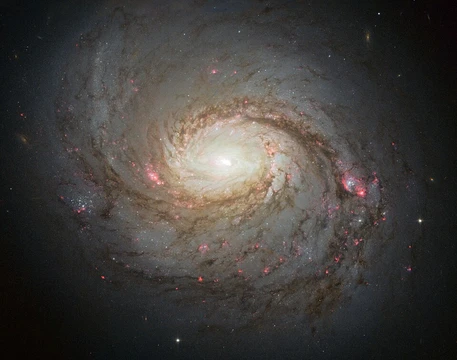
4C 11.50
A radio-loud quasar with an unusual spiral host galaxy.

4C 11.50, also known as Q1548+114A, is a radio-loud quasar located in the constellation of Serpens. It is notable for its host galaxy being a spiral galaxy undergoing strong gravitational interactions, which is unusual for radio-loud quasars, as they are predominantly hosted by elliptical galaxies. The object was first discovered as part of a double quasar pair by Alan Stockton in July 1974, but the two quasars were later found to be unrelated.
- Redshift
- 0.435
- Discoverer
- Alan Stockton
- Discovery date
- July 1974
- Constellation
- Serpens
- Host galaxy type
- spiral galaxy
- V magnitude
- -22.78
- Total host magnitude
- -21.32
Lore & Background
4C 11.50 was first identified as a double quasar pair by Alan Stockton in July 1974, with the two quasars separated by 2.5 arcseconds. The other quasar has a redshift of 1.901. Although initially proposed as a gravitational lens candidate, no second image was ever detected, and further spectra studies showed the two quasars are unrelated. The quasar itself has a redshift of 0.435.
The radio structure of 4C 11.50 is complex. On milliarcsecond scales, the nucleus appears weak with no extended structures, showing a slightly resolved component and a weak feature. On larger scales, it exhibits a detailed double-lobed structure and a straight radio jet extending southeast from the core. Only two jet knots and the northwestern hot spot show signs of linear polarization. The source is classified as compact, with a dominant component coincident with the quasar and two other steep-spectrum components. It was classified as a double source with a separation of 21 arcseconds at a position angle of 170°, and outer lobe structures containing multiple hot spots are present, with the source bent at 47° from the bright components.
The host galaxy is a spiral galaxy undergoing strong gravitational interactions, as indicated by a two-dimensional fitting model and a possible tidal arm feature observed by the Hubble Space Telescope. Three other galaxies lie to the west, forming a packed group. The radio core shows variability and brightening, has an inverted radio spectrum, and a total flux density of approximately 250 mJy, suggesting milliarcsecond-scale structure may be present.
Reader's Guide
4C 11.50 is significant primarily because its host galaxy is a spiral galaxy, which is highly unusual for a radio-loud quasar; such quasars are almost always hosted by elliptical galaxies. This makes it a rare and important object for studying the relationship between galaxy morphology and active galactic nuclei. The discovery of the object as part of a double quasar pair in 1974 initially raised the possibility of gravitational lensing, but subsequent observations ruled this out, demonstrating the importance of follow-up spectroscopy in resolving such ambiguities. The complex radio structure, including a straight jet, double lobes, and polarized features, provides insight into the dynamics of relativistic jets in a spiral galaxy environment. The detection of variability and an inverted radio spectrum suggests ongoing activity in the core. The presence of a possible tidal arm and three companion galaxies indicates that gravitational interactions may play a role in triggering the quasar activity, offering a case study for how galaxy interactions can fuel supermassive black holes in spiral hosts.
Did You Know?
- The host galaxy of 4C 11.50 is a spiral galaxy, which is unusual for a radio-loud quasar.
- The radio core of 4C 11.50 has an inverted spectrum and a total flux density of about 250 mJy.
- Three other galaxies are located to the west of 4C 11.50, forming a packed group.
Discovery and the Double Quasar Mystery
4C 11.50, also catalogued under the designation Q1548+114A, is a radio-loud quasar situated in the constellation Serpens, with a redshift of 0.435. Its story begins in July 1974, when astronomer Alan Stockton identified it as part of a double quasar pair. The two objects are separated by just 2.5 arcseconds on the sky, with the companion quasar residing at a considerably higher redshift of 1.901. This close angular proximity immediately raised the tantalizing possibility that the pair might be a gravitational lens system, in which the light of a single distant quasar would be bent by an intervening mass into two apparent images. However, despite this promising hypothesis, no second image was ever detected in subsequent observations. Further spectral analyses ultimately revealed that the two quasars are entirely unrelated to one another, each representing a distinct cosmic object at different distances. The gravitational lens proposal was therefore abandoned, and 4C 11.50 was recognized simply as a member of a chance alignment rather than a physically connected pair.
Multi-Scale Radio Morphology
Initial radio observations in 1974 revealed 4C 11.50 as a compact source with a dominant component aligned precisely with the quasar's optical position, accompanied by two additional components exhibiting steep spectral indices. That same year, the object was further characterized as a double source with a 21-arcsecond separation along a position angle of 170 degrees, one component carrying roughly twenty percent of the total flux density. Outer lobe structures hosting multiple hot spots were also identified, with the overall morphology described as bent at 47 degrees relative to the brightest components. Later, high-resolution observations using Very Long Baseline Interferometry and the Very Large Array painted a notably different picture. At milliarcsecond resolution, the nucleus appears faint with no extended emission, showing only a slightly resolved component and a weak secondary feature. On larger angular scales, however, the quasar displays a well-defined double-lobed morphology and a straight radio jet extending toward the southeast from the core. Notably, linear polarization is detected in only two jet knots and the northwestern hot spot, suggesting that magnetic field ordering is confined to specific regions rather than being pervasive throughout the structure.
An Unusual Spiral Host in a Crowded Field
One of the most striking aspects of 4C 11.50 is the nature of its host galaxy. Rather than the elliptical galaxy typically associated with radio-loud quasars, the host is classified as a spiral undergoing strong gravitational interactions. This classification rests on a two-dimensional fitting model and on the detection of a possible tidal arm feature in images obtained by the Hubble Space Telescope. The presence of a spiral host makes this quasar genuinely unusual within the broader population of radio-loud active nuclei. The galaxy's V-band magnitude is estimated at -22.78, while its total host magnitude reaches -21.32. Adding to the complexity of the environment, three additional galaxies lie to the west of the quasar, forming a tightly packed group with one another. This clustered arrangement, combined with the evidence for ongoing gravitational interactions, suggests that the host galaxy exists in a dynamically active environment, potentially influencing the quasar's evolution and the structure of its radio emission in ways that differ from the more quiescent settings of elliptical-hosted quasars.
Variability and the Inverted Core Spectrum
Beyond its static structural properties, 4C 11.50 exhibits measurable variability that adds another layer of interest to its study. The radio core has been observed to display signs of brightening over time, indicating that the central engine responsible for the quasar's emission is not in a steady state. The core's radio spectrum is classified as inverted, a characteristic often associated with self-absorbed synchrotron emission from compact regions. The total flux density of the source is estimated at approximately 250 millijanskys. This combination of an inverted spectrum and the relatively modest flux density leads researchers to suggest that a structure on milliarcsecond scales may well be present, even though it was not clearly resolved in the high-resolution VLBI observations. The interplay between the variable core emission, the inverted spectral shape, and the larger-scale jet and lobe morphology provides a rich framework for understanding how energy is transported from the central supermassive black hole out into the surrounding intergalactic medium, making 4C 11.50 a valuable case study in quasar physics.
More in Spiral Galaxies 1-24
Spotted an error? Know more?
Reader corrections go straight into our review queue. Suggest an edit · How this site is sourced