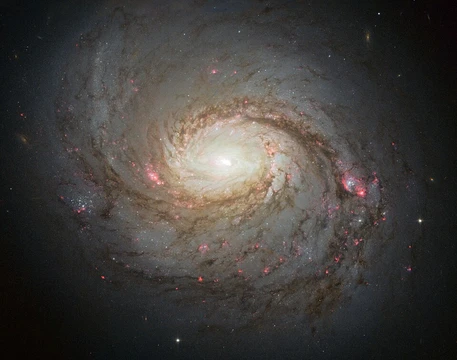
2MFGC 12344
A super spiral LINER galaxy in Serpens with a fast rotating disk.

2MFGC 12344, a super spiral galaxy, sits in the constellation Serpens. With a redshift of 0.140, it is classified as a low-ionization nuclear emission-line region (LINER) galaxy. This edge-on spiral shows a dust lane crossing above its nucleus. Its apparent luminosity is Lr = 7.9, and its total r-band isophotal diameter spans 120 kiloparsecs. The Wide-field Infrared Survey Explorer (WISE) measured a star formation rate of 1.35 solar masses per year at 12 micrometers, while the stellar mass, derived from W-1 band luminosity, is 11.74 solar masses. Gas mass, based on the star formation rate, comes to 10.7 solar masses. The galaxy’s inclination is 78°, determined from its z-band axial ratio, and its position angle is roughly 150°. Warm ionized gas shows a velocity dispersion of 21 ± 4 kilometers per second. A fast-rotating stellar disk reaches 530 kilometers per second, indicating a dark matter halo dominates dynamics in the inner regions. The stellar disk itself is very large, extending 200 kiloparsecs.
- Redshift
- 0.140
- Apparent luminosity r band
- 7.9
- Total r band isophotal diameter
- 120 kiloparsecs
- Star formation rate
- 1.35 M☉ per year
- Total stellar mass
- 11.74 M☉
- Gas mass
- 10.7 M☉
- Inclination angle
- 78°
- Position angle
- 150°
- Warm ionized gas velocity dispersion
- 21 ± 4 kilometers per second
- Rotation velocity
- 530 kilometers per second
Lore & Background
2MFGC 12344 is classified as an edge-on spiral galaxy with a dust lane crossing a region above its central nucleus. Its apparent luminosity is Lr = 7.9, and its total r-band isophotal diameter is 120 kiloparsecs. The galaxy's star formation rate is estimated at 1.35 M☉ per year based on 12 micrometer band data from the Wide-field Infrared Survey Explorer (WISE), while its total stellar mass is 11.74 M☉ based on W-1 band luminosity, and its gas mass is 10.7 M☉ based on star formation rate.
The inclination angle of 2MFGC 12344 is 78° as estimated from its z-band axial ratio, and its position angle is roughly 150°. Its warm ionized gas content shows a velocity dispersion of 21 ± 4 kilometers per second. The galaxy has a fast rotating stellar disk with a rotation velocity reaching 530 kilometers per second, indicating its dynamics are dominated by a dark matter halo located inside its inner regions. The stellar disk is very large, expanding to 200 kiloparsecs in total.
Reader's Guide
2MFGC 12344 is significant as a super spiral galaxy, a rare class of massive disk galaxies that are actively star-forming. Its classification as a LINER galaxy indicates a specific type of nuclear emission, and its edge-on orientation with a prominent dust lane provides a clear view of its structure. The galaxy's high rotation velocity of 530 kilometers per second and its large stellar disk of 200 kiloparsecs suggest a dominant dark matter halo within its inner regions, offering insights into the dynamics of such massive systems. The star formation rate of 1.35 M☉ per year, measured via WISE, and the derived gas mass of 10.7 M☉ contribute to understanding the star formation efficiency in super spirals. The galaxy's redshift of 0.140 places it at a considerable distance, and its measured properties—such as inclination, position angle, and velocity dispersion—provide a detailed kinematic profile. Its legacy lies in serving as a case study for the structure and evolution of super spiral galaxies, particularly regarding the role of dark matter in supporting rapid rotation and large disk scales.
Did You Know?
- It is categorized as a super spiral galaxy, a class of massive disk galaxies considered as star-forming.
- Its stellar disk extends to 200 kiloparsecs in total.
Classification and Celestial Identity
2MFGC 12344 occupies a distinctive niche in galactic taxonomy. Situated within the constellation of Serpens, this object carries the designation of a low-ionization nuclear emission-line region, commonly abbreviated as LINER, a label that reflects the specific ionization state of its central regions. Its redshift, measured at 0.140, places it at a moderate cosmological distance from Earth. Beyond that nuclear classification, the galaxy is further grouped among super spirals, a class reserved for exceptionally massive disk systems that continue to forge new stars. This dual identity—LINER and super spiral—marks a system where vigorous ongoing star formation coexists with the particular emission signatures that define the LINER category. Visually, 2MFGC 12344 presents as an edge-on spiral, meaning its disk is viewed nearly from the side, and a prominent dust lane can be observed sweeping across the region just above the central nucleus, lending the galaxy a layered, stratified silhouette against the deep background of Serpens.
Physical Structure and Spatial Scale
The architecture of 2MFGC 12344 reveals a galaxy of considerable spatial extent. Its total r-band isophotal diameter stretches to 120 kiloparsecs, while the stellar disk itself expands across a span of 200 kiloparsecs, underscoring the vast reach of its luminous matter. The apparent luminosity in the r-band is estimated at 7.9, providing a measure of how bright the system appears from our vantage point. The inclination angle, derived from the z-band axial ratio, is approximately 78 degrees, confirming the nearly edge-on orientation that gives the galaxy its characteristic thin, elongated profile. The position angle sits at roughly 150 degrees, dictating the orientation of the disk as projected onto the sky. A defining structural feature is the dust lane that traverses the area above the central nucleus, a signature of dense interstellar material threading through the disk. Together, these geometric and photometric properties paint a picture of a large, flat, dust-laden spiral whose scale rivals the most extended disk systems known.
Rotational Dynamics and the Dark Matter Envelope
The internal motion of 2MFGC 12344 tells a story of extraordinary rotational energy. Its stellar disk is a fast rotator, with velocities reaching as high as 530 kilometers per second—a figure that speaks to the immense gravitational potential shaping the galaxy's inner regions. This extreme rotation is not driven solely by visible matter; the dynamics are instead dominated by a dark matter halo that extends into the galaxy's innermost zones, providing the additional gravitational pull needed to sustain such speeds. In contrast to the rapid stellar rotation, the warm ionized gas content exhibits a much gentler velocity dispersion of 21 ± 4 kilometers per second, highlighting the different kinematic regimes operating within the system. The coexistence of a high-velocity stellar disk and a comparatively quiescent gas component suggests a complex interplay between the baryonic and dark components. The dark matter halo, embedded within the inner regions rather than confined to an outer envelope, plays a central role in governing the overall dynamical behavior of this super spiral.
Star Formation and Stellar Mass Budget
The ongoing birth of stars in 2MFGC 12344 has been quantified through infrared observations. Using the 12-micrometer band data collected by the Wide-field Infrared Survey Explorer, the total star formation rate is estimated at 1.35 solar masses per year, a steady pace that reinforces the galaxy's classification as an active star-forming system. The stellar mass of the galaxy, derived from its W-1 band luminosity, is estimated at 11.74 solar masses, while the gas reservoir available for future star formation is assessed at 10.7 solar masses based on the star formation rate. These figures, drawn from WISE's infrared capabilities, provide a snapshot of the baryonic matter budget: the mass already converted into stars alongside the gaseous fuel that remains. The fact that a substantial gas mass persists alongside a measurable star formation rate suggests that 2MFGC 12344 retains the raw material necessary to sustain its super spiral status over extended periods, continuing to forge new stellar populations within its vast 200-kiloparsec disk.
More in Spiral Galaxies 1-24
Spotted an error? Know more?
Reader corrections go straight into our review queue. Suggest an edit · How this site is sourced