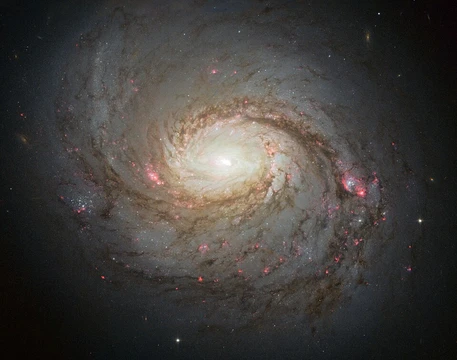
ALESS 073.1
An ancient spiral galaxy that challenges galaxy formation models.

ALESS 073.1 is a spiral and submillimeter galaxy in the constellation Fornax, roughly 12 billion light-years from Earth. Announced in February 2021 in the journal *Science*, its discovery has upended conventional ideas about how galaxies form and evolve.
A team led by Dr. Federico Lelli at Cardiff University observed the galaxy using the Atacama Large Millimeter/submillimeter Array (ALMA), the world’s largest radio telescope. The study produced what Cardiff University described as “one of the sharpest, direct images of a primordial galaxy ever produced,” allowing a detailed look at its internal structure.
Because ALESS 073.1 is 12 billion light-years away, the light we see comes from a time when the universe was only about 10% of its current age. Like all galaxies, it contains gas, dark matter, and dust, with stars held together by gravity. It formed roughly 1.2 billion years after the Big Bang, so the image shows it in its early years. Yet its physical traits suggest it is much older than that appearance implies. It has spiral arms extending from its center, a rotating disk, and a bulge—features normally associated with mature galaxies. This contradicts the earlier view that young galaxies are chaotic and shapeless, only stabilizing and developing such structure over billions of years. The core also hints at a supermassive black hole, producing more energy than typical stars.
The galaxy’s combination of youthful age and mature features challenges scientists’ understanding of galaxy formation, though more images are needed to see if this pattern appears elsewhere. Its massive bulge is especially significant: bulges were thought to form slowly through mergers over long periods, but about half of ALESS 073.1’s stars are packed into its bulge, showing such structures can arise much faster than previously believed.
- Distance from earth
- 12 billion light-years
- Constellation
- Fornax
- Discovery publication
- February 2021 in the journal Science
- Telescope used
- Atacama Large Millimeter/submillimeter Array (ALMA)
- Lead researcher
- Dr. Federico Lelli at Cardiff University
- Estimated formation time
- 12 billion years ago, 1.2 billion years after the Big Bang
Lore & Background
ALESS 073.1 was reported in a study led by Dr. Federico Lelli at Cardiff University, using the Atacama Large Millimeter/submillimeter Array (ALMA) telescope. The publication includes one of the sharpest, direct images of a primordial galaxy ever produced, allowing detailed study of its internal structure. The galaxy is about 12 billion light-years away, so the light observed is from when the universe was only 10% of its current age.
Like all galaxies, ALESS 073.1 is composed of gas, dark matter, and dust, made from stars held together by gravity. It is estimated to have formed 12 billion years ago, just 1.2 billion years after the Big Bang. Although the image shows the galaxy in its early years, its physical characteristics indicate it is much older than its features suggest. It exhibits features normally attributed to mature galaxies, such as spiral arms extending from its center, a rotating disk, and a bulge. This contradicts the previous understanding that young galaxies are chaotic and without structure.
The core of ALESS 073.1 hints at the presence of a supermassive black hole, as it produces more energy than is typical for stars.
Reader's Guide
The discovery of ALESS 073.1 challenges scientists' understanding of galaxy formation. Its young features, while displaying mature characteristics such as spiral arms, a rotating disk, and a bulge, contradict the expectation that young galaxies are chaotic and shapeless. The massive bulge of ALESS 073.1 also puts features typically associated with mature galaxies into question. Bulges were generally thought to form slowly over a long period through the merging of smaller galaxies, but the discovery indicates they can form much quicker than previously thought. Approximately half of ALESS 073.1's stars were found to be present in the bulge. However, more images and information are needed to determine if this phenomenon can be observed in other galaxies. The study's sharp, direct image of this primordial galaxy allowed astronomers to undertake a detailed analysis of its internal structure, providing new insights into early galaxy evolution.
Did You Know?
- ALESS 073.1 is located in the constellation Fornax, 12 billion light-years from Earth.
- The galaxy was observed using the Atacama Large Millimeter/submillimeter Array (ALMA), the largest radio telescope in the world.
- The light from ALESS 073.1 shows the galaxy when the universe was only 10% of its current age.
The Discovery and the Instrument That Made It Possible
In February 2021, a research team led by Dr. Federico Lelli at Cardiff University published a landmark study in the journal Science, introducing the astronomical community to ALESS 073.1, a spiral and submillimeter galaxy residing in the constellation Fornax. The breakthrough was made possible by the Atacama Large Millimeter/submillimeter Array, widely regarded as the largest radio telescope on Earth. By directing this extraordinary instrument toward the distant object, the team captured what Cardiff University described as one of the sharpest, most direct images of a primordial galaxy ever produced. This level of clarity was not merely a technical triumph; it opened the door to a detailed examination of the galaxy's internal architecture, something that had been largely impossible for objects at such extreme distances. The study effectively allowed astronomers to peer into the adolescence of a galaxy that had been forming for billions of years, offering a rare, high-resolution window into an era of cosmic history that is otherwise almost invisible to human observation.
An Anomaly in Structure: Mature Features in a Young Galaxy
ALESS 073.1 is composed of the same fundamental ingredients as any galaxy: gas, dark matter, dust, and stars bound together by gravity. What makes it extraordinary is the architecture those components form. The galaxy displays spiral arms radiating outward from its center, a rotating disk, and a central bulge—hallmarks traditionally associated with mature, fully evolved galaxies. Its core emits far more energy than would be expected from ordinary stellar processes, hinting at the presence of a supermassive black hole at its heart. The puzzle deepens when you consider the galaxy's age. It is estimated to have formed roughly 1.2 billion years after the Big Bang, meaning the light we observe today captures it during what should have been its earliest, most turbulent phase. Conventional wisdom held that young galaxies were chaotic and irregular, lacking defined shapes, and that orderly structures like spiral arms and bulges required billions of years of gradual settling and stabilization. ALESS 073.1 defies that narrative, presenting a fully organized structure while still in its cosmic youth.
Rethinking How Bulges and Galaxies Form
The discovery of ALESS 073.1 has struck at the heart of long-held assumptions about galaxy evolution. For years, the prevailing model held that the dense central concentrations of stars we call bulges grew incrementally, assembled piece by piece as smaller galaxies collided and merged over immense periods. ALESS 073.1 upends that timeline. Approximately half of its stellar population is concentrated in the bulge, yet the galaxy existed when the universe was only a tenth of its present age. This suggests that bulges can form dramatically faster than the standard model predicted. The finding forces researchers to reconsider not just bulge formation but the broader sequence of events in galaxy assembly. If a galaxy can achieve such structural maturity so early, the entire framework of how galaxies transition from chaotic collections of gas and stars into orderly spirals may need revision. The Cardiff team cautioned, however, that a single object is not yet sufficient to rewrite the rules. Additional observations of similar primordial galaxies are needed to determine whether ALESS 073.1 represents a common pathway or a rare outlier in the cosmic record.
A Glimpse into the Universe's Infancy
At a distance of approximately 12 billion light years, ALESS 073.1 offers humanity one of the most distant windows into the early universe ever achieved. Because light travels at a finite speed, the photons that reached Earth's telescopes departed the galaxy when the cosmos was merely ten percent of its current age. The galaxy itself is estimated to have taken shape only 1.2 billion years after the Big Bang, placing it in an epoch when the first generations of stars and structures were still coalescing from the primordial aftermath of cosmic creation. Located in the constellation Fornax, this old spiral and submillimeter galaxy serves as a time capsule, preserving a snapshot of galactic adolescence that no other instrument has captured with comparable clarity. The sheer distance also underscores the limitations of our observational reach: we are not seeing ALESS 073.1 as it is today, but as it was during its formative years, frozen in a state of rapid development. Every measurement taken of this object is, in effect, an archaeological dig into the universe's deepest past.
More in Spiral Galaxies 1-24
Spotted an error? Know more?
Reader corrections go straight into our review queue. Suggest an edit · How this site is sourced