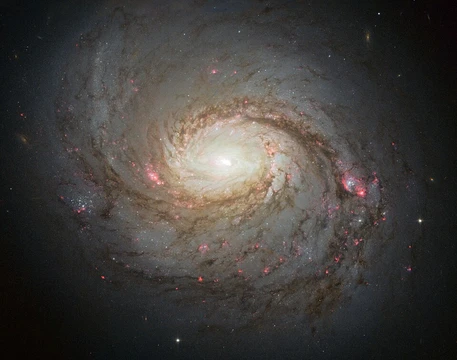
Spiral galaxy
Spiral galaxies feature rotating disks, arms, and often a central bar.

Spiral galaxies are a type of galaxy first identified by Edwin Hubble in his 1936 book *The Realm of the Nebulae*, placing them within the Hubble sequence. Typically, they have a flat, rotating disk made of stars, gas, and dust, with a dense central cluster of stars called the bulge. Around this, a much dimmer halo of stars often exists, many gathered in globular clusters. Their name comes from the spiral patterns that stretch from the center across the disk. These spiral arms are active regions where new stars form, glowing brighter than the rest of the disk due to the young, hot OB stars living there.
About two-thirds of spiral galaxies have an extra feature: a bar-like structure extending from the central bulge, with the spiral arms starting at its ends. The share of barred spirals has shifted over cosmic time. Roughly 8 billion years ago, only about 10% had bars; by 2.5 billion years ago, that rose to about a quarter. Today, over two-thirds of galaxies in the visible universe contain bars. The Milky Way is a barred spiral, though its bar is hard to see from our position inside the galactic disk. Strong evidence for this bar comes from recent surveys, including data from the Spitzer Space Telescope. Spiral and irregular galaxies together make up about 60% of galaxies in the current universe. They are most common in low-density areas and rare near the centers of galaxy clusters.
A spiral galaxy's structure includes several parts: a rotating disk of stars and interstellar matter, with spiral arms as key features; a relatively flat disk (thickness-to-diameter ratio around 0.2); a central bulge of mostly older stars, similar to an elliptical galaxy; a bar-shaped star distribution; a nearly spherical halo of stars, including many in globular clusters; a supermassive black hole at the bulge's center; and a nearly spherical dark matter halo. The importance of these components—by mass, brightness, and size—varies from galaxy to galaxy.
Spiral arms are long, thin star regions extending from the center of both barred and unbarred spirals. Their spiral shape gives the galaxies their name. Different Hubble types have distinct arm structures: Sc and SBc galaxies have loose arms, while Sa and SBa galaxies have tightly wound arms. In all cases, the arms are bright because they contain many young, blue stars, thanks to high mass density and rapid star formation.
- Proportion with bars present
- roughly two-thirds
- Proportion with bars 8 billion years ago
- about 10%
- Proportion with bars 2.5 billion years a
- roughly a quarter
- Proportion of galaxies today that are sp
- approximately 60%
- Oldest known spiral galaxy redshift
- 4.4
- Oldest grand design spiral galaxy age
- 11 billion years old
Lore & Background
Spiral galaxies were first classified by Edwin Hubble in 1936 as part of the Hubble sequence. They typically contain a flat rotating disk of stars, gas, and dust, a central bulge of older stars, and a fainter halo with globular clusters. Roughly two-thirds of all spirals observed today have a bar-like structure extending from the bulge, from which spiral arms begin. The proportion of barred spirals has changed over cosmic history: about 10% had bars 8 billion years ago, roughly a quarter 2.5 billion years ago, and over two-thirds today. The Milky Way is a barred spiral, though its bar is difficult to observe from Earth's position within the galactic disc. Spiral arms are regions of ongoing star formation, containing many young, blue stars that make them bright. The bulge of Sa galaxies tends to be large and composed of old, red Population II stars, while Sc galaxies have smaller bulges of young, blue Population I stars. Many bulges are thought to host a supermassive black hole at their centers, such as Sagittarius A* in the Milky Way. The oldest known spiral galaxy as of 2024 is BRI 1335-0417 with a redshift of 4.4, while the oldest grand design spiral is BX442 at 11 billion years old.
Reader's Guide
Spiral galaxies are a fundamental class in the Hubble sequence, first described by Edwin Hubble in 1936. They are notable for their flat rotating disks, spiral arms, and central bulges, with many also featuring a bar. The spiral arms are sites of active star formation, making them bright and distinctive. The proportion of barred spirals has increased over the universe's history, from about 10% eight billion years ago to over two-thirds today. Spiral galaxies, together with irregular galaxies, make up approximately 60% of galaxies in the present-day universe. They are mostly found in low-density regions and are rare in galaxy cluster centers. The study of spiral structure has involved hypotheses such as density waves and stochastic self-propagating star formation, though the winding problem remains a challenge. The oldest known spiral galaxies, such as BRI 1335-0417 and BX442, provide insights into galaxy formation in the early universe. In 2019, citizen scientists through Galaxy Zoo suggested that the usual Hubble classification for spiral galaxies may need updating. The Milky Way itself is a barred spiral, with evidence for its bar coming from surveys like the Spitzer Space Telescope.
Did You Know?
- Roughly two-thirds of all spiral galaxies observed today have a bar-like structure.
- The oldest known spiral galaxy, BRI 1335-0417, has a redshift of 4.4, meaning its light took 12.4 billion years to reach Earth.
- Spiral arms contain many young, blue stars due to high star formation rates, making them brighter than the surrounding disc.
Anatomy of a Spiral Galaxy
Spiral galaxies are architectural marvels composed of several distinct structural layers. At their core lies a flat, rotating disk of stars, gas, and interstellar dust, with a thickness-to-diameter ratio of roughly 0.2. Rising from the center of this disk is a bulge—a dense concentration of stars that in some cases mirrors the properties of a shrunken elliptical galaxy, while in others simply appears as a denser core of the disk itself. Surrounding the entire system is a near-spherical halo populated by older, metal-poor stars and numerous globular clusters. At the very heart of the bulge, many spirals harbor a supermassive black hole, and enveloping everything is a dark matter halo. In roughly two-thirds of these galaxies, a bar-shaped elongation of stars stretches outward from the bulge, serving as the launch point for the spiral arms. The relative mass, brightness, and size of each component shift from one galaxy to the next, making no two spirals structurally identical.
Spiral Arms and the Forging of Stars
The defining visual feature of a spiral galaxy—its sweeping arms—gives the entire class its name. These long, thin regions of stars unfurl outward from the galactic center, and their appearance varies dramatically across the Hubble sequence: Sc and SBc types display very loose, open windings, while Sa and SBa types show tightly coiled structures. What makes the arms glow brighter than the surrounding disk is the concentration of young, hot OB stars and other blue stellar populations. The high mass density within the arms drives an elevated rate of star formation, meaning these regions are essentially nurseries where new stars are continuously being born. The arms are not static structures but dynamic zones of ongoing stellar creation, their brilliance a direct consequence of the short-lived, luminous stars they produce. In barred spirals, the arms originate at the tips of the central bar, creating a seamless transition from the elongated core to the sweeping outer disk.
The Bar: A Cosmic Trend Over Billions of Years
One of the most striking evolutionary trends in spiral galaxies is the rise of the bar structure. Today, over two-thirds of all spirals within the observable Hubble volume possess a bar—a bar-shaped elongation of stars extending from the central bulge. Yet this was far from universal in the past. Roughly eight billion years ago, only about 10% of spirals showed bars; by 2.5 billion years ago that figure had climbed to approximately a quarter. The bar's prevalence has thus grown steadily across cosmic history. In edge-on views of barred spirals and lenticular galaxies, the bar can sometimes be detected through distinctive out-of-plane structures shaped like an X or a peanut shell, with maximum visibility at about half the bar's length. Our own Milky Way is a barred spiral, though the bar is notoriously difficult to confirm from our vantage point inside the disk. Surveys such as those conducted with the Spitzer Space Telescope have provided the most compelling evidence that stars in the Galactic Center do indeed form a bar.
Halo Stars, Mergers, and the Oldest Spirals
Beyond the orderly disk and bulge, spiral galaxies host a spheroidal halo of stars whose orbital behavior remains debated. These halo stars may follow retrograde or highly inclined paths, or move without any regular orbit at all. Many were likely captured from smaller galaxies that fell into and merged with the spiral over time—the Sagittarius Dwarf Spheroidal Galaxy is currently in the process of merging with the Milky Way, and some of its stars have already been absorbed into our halo. Unlike the dusty disk, the halo is essentially dust-free and populated by old, metal-poor Population II stars, along with numerous globular clusters. A few small red dwarfs near the Sun, such as Kapteyn's Star and Groombridge 1830, are thought to be halo interlopers, their irregular galactic orbits producing unusually high proper motion. Looking to the deepest past, BRI 1335-0417 holds the title of the oldest and most distant known spiral, its light traveling 12.4 billion years at a redshift of 4.4, while BX442 stands as the oldest grand-design spiral at eleven billion years old.
More in Spiral Galaxies 1-24
Spotted an error? Know more?
Reader corrections go straight into our review queue. Suggest an edit · How this site is sourced