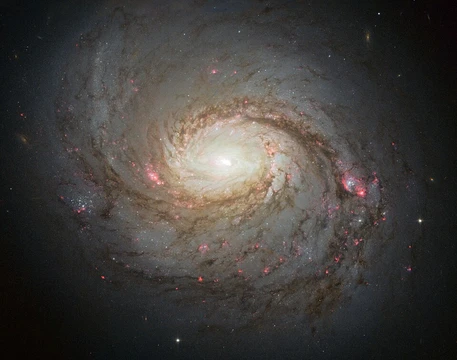
Arp 220
Closest ultraluminous infrared galaxy, merging two galaxies.

Arp 220 is a galaxy formed by the collision and ongoing merger of two smaller galaxies. It appears as the 220th entry in Halton Arp's Atlas of Peculiar Galaxies.
Located 250 million light-years from Earth, Arp 220 is the nearest example of an ultraluminous infrared galaxy (ULIRG). Its energy output, first detected by the IRAS satellite, is strongest in the far-infrared part of the spectrum. Because of its proximity and brightness, it is considered the classic example of a ULIRG and has been studied extensively.
Most of this energy likely comes from a massive burst of star formation, or starburst, probably set off by the galactic merger. Images from the Hubble Space Telescope, taken in visible light in 2002 and in infrared in 1997, revealed over 200 huge star clusters in the galaxy's central region. The largest of these clusters contains as much material as about 10 million suns.
Observations from the Chandra and XMM-Newton X-ray satellites suggest that Arp 220 may contain an active galactic nucleus (AGN) at its core. This raises questions about how galaxy mergers relate to AGN, since mergers are thought to trigger starbursts and may also feed the supermassive black holes that power AGN.
Surveys at submillimetre wavelengths, using instruments like the Submillimetre Common-User Bolometer Array (SCUBA) on the James Clerk Maxwell Telescope, have found many luminous far-infrared objects similar to Arp 220. Astronomers study Arp 220 and other nearby ULIRGs as local counterparts to these distant objects.
Researchers at the Arecibo Observatory have detected organic molecules in Arp 220. The galaxy also contains at least two bright maser sources: an OH megamaser and a water maser. In October 2011, astronomers observed a record seven supernovae in Arp 220 at the same time. The merger of the two galaxies began about 700 million years ago.
- Distance
- 250 million light years
- Type
- Ultraluminous infrared galaxy (ULIRG)
- Catalog number
- 220th object in Halton Arp's Atlas of Peculiar Galaxies
- Number of supernova spotted in october 2
- 7
- Merger started
- around 700 million years ago
- Most massive star cluster mass
- about 10 million suns
Lore & Background
Arp 220 is the result of a collision between two galaxies which are now in the process of merging. Its energy output was discovered by IRAS to be dominated by the far-infrared part of the spectrum. Most of its energy output is thought to be the result of a massive burst of star formation, or starburst, probably triggered by the merging of two smaller galaxies. Hubble Space Telescope observations of Arp 220 in 2002 and 1997, taken in visible light with the ACS, and in infrared light with NICMOS, revealed more than 200 huge star clusters in the central part of the galaxy. The most massive of these clusters contains enough material to equal about 10 million suns.
X-ray observations by the Chandra and XMM-Newton satellites have shown that Arp 220 probably includes an active galactic nucleus (AGN) at its core, which raises interesting questions about the link between galaxy mergers and AGN, since it is believed that galactic mergers often trigger starbursts, and may also give rise to the supermassive black holes that appear to power AGN. Astronomers from the Arecibo Observatory have detected organic molecules in the galaxy. Arp 220 contains at least two bright maser sources, an OH megamaser, and a water maser. In October 2011, astronomers spotted a record-breaking seven supernova all found at the same time in Arp 220. The merging of the two galaxies started around 700 million years ago.
Reader's Guide
Arp 220 is often regarded as the prototypical ULIRG and has been the subject of much study as a result. Luminous far-infrared objects like Arp 220 have been found in surprisingly large numbers by sky surveys of submillimetre wavelengths using instruments such as the Submillimetre Common-User Bolometer Array (SCUBA) at the James Clerk Maxwell Telescope (JCMT). Arp 220 and other relatively local ULIRGs are being studied as equivalents of this kind of object. Its significance lies in its role as a nearby laboratory for understanding ultraluminous infrared galaxies, the starbursts that power them, and the possible connection between galaxy mergers and active galactic nuclei. The detection of organic molecules and multiple maser sources adds to its importance for astrochemistry and astrophysical processes. The record of seven simultaneous supernovae highlights the extreme star formation activity in this merging system.
The Galactic Collision and Its Star-Birth Engine
Arp 220 exists as the dramatic aftermath of two galaxies crashing into one another, a merger that began roughly seven hundred million years ago and has not yet completed. This violent encounter is widely believed to have ignited an extraordinary episode of star formation, a starburst that now accounts for the bulk of the system's energy output. When the Hubble Space Telescope turned its instruments toward the galaxy's core—first with NICMOS in infrared in 1997 and later with the Advanced Camera for Surveys in visible light in 2002—astronomers uncovered more than two hundred massive star clusters packed into the central region. The single most enormous of these clusters holds material equivalent to roughly ten million solar masses, a staggering concentration of newborn stars. Because of this spectacular display, Arp 220 earned the 220th entry in Halton Arp's Atlas of Peculiar Galaxies, a catalogue designed to highlight objects that defy ordinary classification. The merger is still in progress, meaning the galaxy we observe today is a snapshot of an ongoing transformation rather than a finished product.
The Nearest Ultraluminous Infrared Beacon
At a distance of approximately two hundred and fifty million light years, Arp 220 holds the distinction of being the ultraluminous infrared galaxy (ULIRG) closest to our own Solar System. The Infrared Astronomical Satellite, IRAS, first revealed that the object's energy output is overwhelmingly concentrated in the far-infrared portion of the electromagnetic spectrum, a signature that set it apart from ordinary galaxies. Because of this defining characteristic and its relative proximity, Arp 220 has become the prototypical example of a ULIRG and has attracted a disproportionate amount of research attention over the decades. Its importance extends beyond a single object: sky surveys conducted at submillimetre wavelengths, particularly using the Submillimetre Common-User Bolometer Array (SCUBA) mounted on the James Clerk Maxwell Telescope, have uncovered surprisingly large populations of similar luminous far-infrared sources across the sky. Astronomers now routinely study Arp 220 and other nearby ULIRGs as accessible local analogues of the more distant, higher-redshift objects detected in those wide-field surveys, making the galaxy an indispensable calibration point for understanding how starburst-driven infrared luminosity works on a cosmic scale.
A Laboratory of Extreme Astrophysics
Arp 220 has proven to be an extraordinarily rich target for multi-wavelength observation. Radio astronomers operating the Arecibo Observatory have identified organic molecules within the galaxy, evidence that complex chemistry is thriving amid the chaos of the merger. The system also hosts at least two bright maser sources: an OH megamaser and a water maser, both of which serve as natural beacons for studying dense, star-forming regions. Perhaps most dramatically, in October 2011, astronomers detected a record-breaking seven supernovae simultaneously within Arp 220, a remarkable testament to the sheer volume of massive stars being born and dying in such a compressed timeframe. X-ray data from the Chandra and XMM-Newton satellites have further enriched the picture, while Hubble's combined visible-light and infrared imaging campaigns in 1997 and 2002 mapped the dense cluster population at the galaxy's heart. Together, these diverse observations make Arp 220 one of the most thoroughly characterized starburst systems known, offering researchers a rare opportunity to study every stage of the star-forming lifecycle in a single, relatively nearby object.
The Active Nucleus Question
One of the most compelling mysteries surrounding Arp 220 is the likelihood that it harbors an active galactic nucleus (AGN) at its very center. X-ray observations carried out by both the Chandra and XMM-Newton space telescopes have provided evidence pointing toward such a supermassive black hole engine, though the exact nature and contribution of the AGN to the galaxy's total luminosity remain subjects of active investigation. This finding is particularly significant because it sits at the intersection of two major astrophysical questions: whether galactic mergers are the primary trigger for starburst activity, and whether the same mergers can funnel gas toward central black holes, thereby igniting or amplifying AGN activity. If Arp 220 truly exemplifies this dual process, it would provide a concrete, nearby case study for a theoretical link that has long been debated. The galaxy's position as the 220th entry in Halton Arp's Atlas of Peculiar Galaxies reflects its unusual nature, and its status as the nearest ULIRG makes it an ideal laboratory for testing models of how mergers, starbursts, and supermassive black holes co-evolve. Understanding Arp 220's core may ultimately help astronomers decode the growth of black holes across the entire universe.
More in Spiral Galaxies 1-24
Spotted an error? Know more?
Reader corrections go straight into our review queue. Suggest an edit · How this site is sourced